

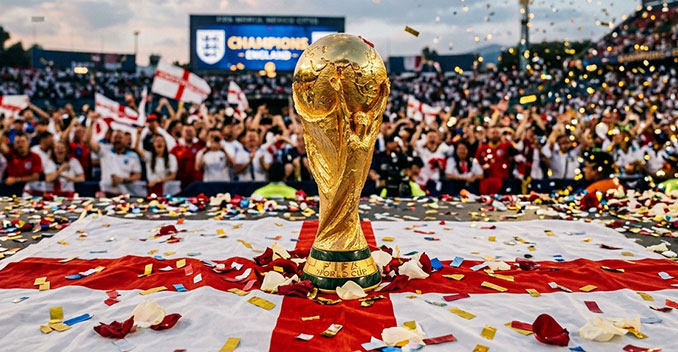
If you’re an English football fan like me, you’ll be used to the range of emotions, the highs and the lows like the vintage and vignetted memories of 1966 World Cups of England beating West Germany, Hurst scoring the goal and the epic moment when Moore lifted the trophy. Now to the lows, going out on penalties to West Germany in World Cup 1990 or Euro in 1996, losing out 6-5 to Germany, our old rival.
Today, the English team has probably never been so consistent on the world stage and the team looks like they’ve got the belief and right stuff to match any top footballing nation and on a good day they look unstoppable. When you see the lions roaring down the field linking up as a pack its frighteningly good and makes the hairs on the back of your neck stand up Kane, Bellingham, Pickford, Rice, Pickford, Saka they’re all assisting and more importantly linking up to feed each other shots on goal. And at the other side of the pitch Pickford is putting in a solid shift marshalling our defence supported by an equally talented unit Guehi and O’Reilly are solid choices and consistent in keeping attacks at bay. Tuchel is not short of a strong defensive options who can switch to attack.
It’s time to look beyond the past and stay focused on the future and this very moment, this time! I want to believe, I do believe!!! As the expanded 2026 FIFA World Cup transitions into its business end, after the group stages across Canada, Mexico and the United States, the familiar, rhythmic chant of “It’s Coming Home” has once again escaped the pubs of Albion to echo across the Atlantic, I’m sure Baddiel and Skinner are enjoying the royalties and rightly so the tune is a cracker! Yet, beneath the commercial spectacle of the largest 48-team tournament, a deeper, highly complex narrative is unfolding—one that merges elite athletic prowess with a little bit of geopolitics.
Football, by its very nature, is a global meritocracy. This 23rd edition of the tournament, spanning 16 host cities from Vancouver to Boston to Mexico City, makes this tournament definitely the largest geographical scale and quite possibly the hardest as there’s more talent to beat to win the coveted prize. A lot of that talent comes from nations of developing economies. It’s always a beautiful thing to see, that no matter what the country or how much global power and/or influence the nation or Head of State has (or how much they try to interfere, it all comes down to 90mins, 22 men, a ball and an insane amount of skill and of course a little help from lady luck.
Mega-Tournament Era
The 2026 FIFA World Cup represents a watershed moment in the commercialisation and globalisation of the modern game. For the first time in history, 48 nations qualified for the finals, generating a massive 104-match schedule designed to maximise broadcasting revenue for football’s governing body. The tournament format—comprising 12 groups of four teams, leading into an unprecedented Round of 32 knockout stages deepening the sport’s footprint across the globe.
This structural expansion has completely altered the physiological and logistical demands placed upon elite athletes. Nations are no longer merely competing on the pitch; they are navigating vast geographic distances, distinct time zones and extreme climate variations. A team playing a group stage match in the stifling humidity of Miami could find themselves flying thousands of miles to the high altitude of Mexico City for a knockout tie. This has helped level out the tournament to a degree. The era of the self-contained tournament base camp is evolving; 2026 is an exercise in physical and logistical endurance. The next World Cup will be hosted by Morocco, Spain and Portugal.
The Knockouts
As of this time of writing (Monday, 6 July 2026) the tournament has progressed beyond the group stages and ejected all the teams who didn’t make the cut. The competition said goodbye to some heavyweights with the requisite level of drama, sportsmanship and emotion. The footballing world witnessed staggering tactical battles, including Belgium’s astonishing 3-2 extra-time victory over Senegal in Seattle, secured by a Youri Tielemans penalty in the 125th minute—the deepest stoppage-time winner ever recorded in World Cup history. Not to mention Norway’s win to knockout five time world champions Brazil, 2-1 Erling Haalands 2 goals to Neymar’s spot kick.
Quarter Finalists
The upcoming quarter-final matchups have set the stage for intense continental friction:
- France vs. Morocco: Scheduled for Thursday, 9 July 2026, 9pm at Gillette Stadium in Foxborough, this tie is a highly anticipated rematch of the 2022 semi-final, pitching Kylian Mbappé’s pragmatic side against a brilliant Moroccan defence that eliminated the Netherlands on penalties.
- Norway vs. England: Set for Saturday, 11 July 2026, 10pm at Hard Rock Stadium in Miami, this match represents a massive tactical hurdle for the Three Lions against an incredibly physical, hyper-efficient Scandinavian counter-attacking system.
- Argentina vs. Switzerland: Set for Sunday, 12 July 2026, 2am.
- Spain vs. Belgium: Set for Friday, 10 July 2026, 8pm.
Interference: The Folarin Balogun Firestorm
The purity of the tournament’s sporting meritocracy was thrown into absolute chaos on Sunday, 5 July 2026, when FIFA announced the extraordinary decision to rescind a one-match knockout suspension for United States star striker Folarin Balogun. The 25-year-old Monaco forward, who is currently the top American scorer in the tournament with three goals, had been shown a straight red card by Brazilian referee Raphael Claus during the USA’s 2-0 Round of 32 victory over Bosnia and Herzegovina on Wednesday, 1 July, for an awkward challenge on Tarik Muharemović.
In an unprecedented breach of traditional athletic autonomy, US President Donald Trump publicly acknowledged during an Oval Office press conference on 6 July that he had personally called FIFA President Gianni Infantino to demand an immediate executive review. While the official line is that Trump insisted he did not apply undue pressure, stating he merely wanted to correct a “great injustice,” the Royal Belgian Football Association expressed outright astonishment at the sudden deletion of a mandatory red-card suspension. This marks the first time since the 1962 World Cup that a direct political intervention has successfully influenced tournament eligibility, raising profound, uncomfortable questions regarding the host nation’s undue leverage over football’s governing body ahead of the USA’s crucial Round of 16 clash with Belgium. At the time of writing the subsequent USA Vs Belgium match was not played. Update: it has now concluded and divine justice won out. America, the co-hosts USA did not go through and got knocked out. Football and behind the scenes machinations seldom mix well.
The Long Road
England’s presence in the final eight of this gruelling tournament is the product of a highly calculated, heavily scrutinised and rigorous approach . Following the conclusion of the domestic season, the managerial staff underwent an intensive squad selection process, balancing tournament experience with the explosive, transitional pace, eye for goal, discipline and attacking pace. The qualification campaign itself had been an exercise in professional efficiency, characterised by disciplined defensive structures and a reliance on elite individual transitions rather than the expansive, risky possession football of previous eras. But on the counter England open up the pitch precision accuracy.
The Team
Based on Thomas Tuchel’s most recent starting lineup from England’s dramatic 3–2 World Cup Round of 16 victory against Mexico, the original 26-man tournament squad is categorised below with non-starting players marked as (sub):
Goalkeepers
- Jordan Pickford
- Dean Henderson (sub)
- James Trafford (sub)
Defence
- Jarell Quansah
- Ezri Konsa
- Marc Guéhi
- Nico O’Reilly
- John Stones (sub)
- Dan Burn (sub)
- Djed Spence (sub)
- Reece James (sub)
- Trevoh Chalobah (sub)
Midfield
- Declan Rice
- Elliot Anderson
- Jude Bellingham
- Kobbie Mainoo (sub)
- Jordan Henderson (sub)
- Morgan Rogers (sub)
Strikers & Forwards
- Eberechi Eze (sub)
- Bukayo Saka
- Anthony Gordon
- Harry Kane
- Marcus Rashford (sub)
- Ollie Watkins (sub)
- Ivan Toney (sub)
- Noni Madueke (sub)
Head Coach
- Thomas Tuchel
The preparation strategy focused heavily on acclimatisation and psychological resilience. The coaching staff recognised early on that one of the primary threats to English tournament progression has historically been lack of discipline and attacking options. By selecting a balanced 26-man squad heavily weighted with versatile tactical profiles, the management insulated the team against the inevitable suspensions and injuries that define a modern multi-city tournament. This was not a squad picked to placate the tabloid press; it was an athletic unit engineered specifically to survive the attritional realities of elite international football.
Zagreb to Mexico City
England’s actual tournament has been a masterclass in management, contrasting with the erratic form of their rivals. Placed in Group L alongside a familiar European adversary, Croatia and explosive global contenders from Africa, Ghana and a physical team of the Americas, Panama the Three Lions opened their campaign with a tactical display against Croatia, England Winning 4-2, neutralising their midfield line to secure a vital opening result. This was followed by a high defensive strategy from Ghana which ended in 0-0 and lastly a solid win and performance against Panama who we beat 2-0, the squad kept their composure against a much more physical contact team. Upon entering the knockout rounds, England faced DR Congo in the Round of 32 on 1 July, surviving an early scare to secure a 2-1 victory courtesy of a late strike (’86 min) from Harry Kane. This set up a monumental game against co-hosts Mexico on Sunday, 5 July, at the legendary Estadio Azteca. Despite severe environmental pressures and red card that forced England to play with ten men they saw the game out winning an intense round of goals and equalisers to win 3-2.
Norway
The immediate obstacle standing between England and a place in the semi-finals is a formidable, rapidly evolving Norwegian squad. The Scandinavians have emerged as the genuine dark horses of the tournament, pulling off the single biggest upset of the Round of 16 by eliminating five-time champions Brazil with a stunning 2-1 victory in East Rutherford on 5 July. Under normal parameters, a quarter-final against Norway would be viewed with quiet confidence by the English press, but the reality on the ground in Miami on 11 July will be vastly different.
Norway’s tactical blueprint is built on a ruthless, hyper-modern counter-attacking framework that plays directly into England’s historic vulnerabilities attacking pace against elite physical power. Led by an inspired Erling Haaland and the creative brilliance of Antonio Nusa, the Norwegians possess the exact technical profiles capable (on a good day) of exposing structural spaces behind a fatigued English defensive line. While England boast world-class individual quality, common sense indicates that overconfidence at this stage would be catastrophic and its good to see England supporters keeping the faith and the England squad being disciplined on and off the pitch. Norway have demonstrated an ability to soak up pressure and strike with lethal efficiency; if England’s defensive transitions are even slightly misaligned, the Scandinavian hurdle could easily transform into a tournament graveyard. England needs to go out play good football, attack at the front, take every chance, direct the the ball in midfield and stay solid at the back.
Three Steps from Immortality
The mathematical reality confronting the English football team is simple yet brutally complex: they are precisely three matches away from footballing immortality. It keeps getting closer. The prize has induced a state of national breathlessness across the United Kingdom. If England beats the Norwegian threat in Miami, they will advance to a lethal semi-final encounter in a lethal crucible containing the winners of France Vs Morocco, Spain Vs Belgium or Argentina Vs Switzerland. An elite crowd.
Is it Finally Coming Home?
England’s march to the quarter-finals has been built on genuine athletic resilience, elite squad depth and a profound psychological evolution that has successfully buried the traumas of previous generations. Thomas Tuchel is getting results! The footballing machinery constructed by the English FA is functioning at its absolute peak, demonstrating a capacity to survive hostile environments, extreme travel schedules and administrative red-card crises and of course tough teams.
Yet, as the tournament reaches new highs, the overriding thread remains entirely undecided. Hopefully we’ve seen the one and only political meddling stopped – for good. Now the host nations and the world can get back to the integrity of the beautiful game, while a hyper-physical, inspired Norway squad stands ready to dismantle English dreams in Miami. The Three Lions are undeniably close to bringing football home, but in this expanded global arena the feeling and sense of destiny counts for little. We need results and quality play to flow in order to win and the English team are stepping up. Only a fluid flawless tactical execution and absolute ice-cold resilience will separate this English squad from ultimate sporting immortality.
Have Your Say
Is England’s modern tournament resilience a sign that football is truly destined to come home in the Fifa World Cup 2026, or will the physical toll of the expanded 48-team format expose lingering tactical vulnerabilities against Norway? How damaging is Donald Trump’s unprecedented executive intervention regarding Folarin Balogun to the sporting integrity of the 2026 World Cup?
Join the conversation or follow us on facebook, instagram, youtube, TikTok, LinkedIn and X/Twitter or why not submit your own article! Or email at contribute@criticalmatters.net to share your tactical analysis.
Facts and Links
Facts Section
- Tournament Expansion: The 2026 FIFA World Cup is the first edition to feature 48 teams and a 104-match schedule across three host nations: Canada, Mexico and the United States.
- Tie of the Round: On 1 July 2026, Belgium defeated Senegal 3-2 after extra time in Seattle; Youri Tielemans scored the winning penalty in the 124th minute, marking the deepest stoppage-time goal in tournament history.
- Folarin Balogun Red Card: The US forward was sent off on Wednesday, 1 July 2026, during a 2-0 win over Bosnia and Herzegovina after a VAR review by referee Raphael Claus.
- FIFA Executive Intervention: On Sunday, 5 July 2026, FIFA officially rescinded Balogun’s mandatory one-game suspension under Article 27 of their disciplinary code, following a direct phone call from US President Donald Trump to FIFA chief Gianni Infantino.
- England Knockout Results: England defeated DR Congo 2-1 in the Round of 32 on 1 July 2026 and advanced past Mexico in the Round of 16 on 5 July 2026 after a 3-3 draw at the Estadio Azteca, winning 4-2 on penalties.
- Norway Shock Triumph: Norway qualified for the quarter-finals by defeating five-time champions Brazil 2-1 on 5 July 2026 at the New York/New Jersey Stadium in East Rutherford.
- Quarter-Final Schedule: France vs. Morocco takes place on Thursday, 9 July 2026 at Boston Stadium; Norway vs. England takes place on Saturday, 11 July 2026 at Miami Stadium.
- Historical Parallels: England’s recent deep tournament runs include a semi-final appearance at the 2018 World Cup in Russia and a quarter-final finish at the 2022 World Cup in Qatar.



Be the first to comment