

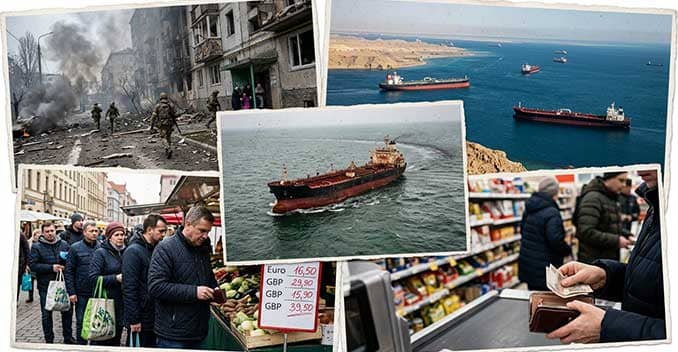
The press has recently been dominated by headlines proclaiming United State macroeconomic strength while conversely the American cost of living is declining sharply for consumers; and voters don’t want protracted unprovoked conflicts they want more money in their pockets and gasoline in their cars. This goes for the whole world right now. On paper, domestic structural adjustments and aggressive monetary strategies appear to have insulated the United States from the worst of global inflationary pressures. Yet, as any serious student of international political economy understands, an economy cannot be viewed in isolation. This domestic “decline” occurs in the shadow of a deeply volatile international reality—specifically, the high-stakes military intervention initiated by the West in early 2026. There are also the after affects and fallout on the rest of the world.
What is the Net Effect of the Iran War on US Citizens?
Domestic Insulation vs. Imperial Overextended Liabilities
On the surface, the immediate domestic markers for the American consumer look remarkably stable. According to the Bureau of Labor Statistics data from May 2026, core consumer indexes have shown remarkable resilience, creating an impression that the average household has successfully checked out from the brutal inflationary cycles of previous years. However, this apparent decline in the domestic cost of living operates on borrowed time. The net effect of the 2026 military campaign is not a reduction in overall costs, but a massive structural reallocation of liability from the private consumer to the national deficit.
By mid-March 2026, the direct cost of the military campaign to the US military was already pinned at a staggering $18 billion. Almost immediately after, the Pentagon requested an additional emergency allocation of $200 billion to sustain operations in the Persian Gulf. For the informed reader, the paradox is clear: while the supermarket shelf remains temporarily stable due to aggressive strategic reserves and currency manipulation, the long-term tax liabilities, national debt interest, and structural inflation built into a $200 billion emergency defence bill will ultimately be paid by the people with knock on effects globally.
Operation Epic Fury: Did the War in Iran Need to Happen?
The Interplay of Preemption, Politics, and Alternative Diplomacy
The question of necessity is where objective journalism must rigorously challenge official narratives. The Trump administration and its closest allies have maintained that military intervention was an unavoidable national security imperative. The public justification rested on a cocktail of existential threats: the prevention of an imminent nuclear breakout, the protection of global shipping lanes, and the neutralisation of hostile ballistic capabilities. To the uncritical observer, these arguments present a straightforward case of self-defense.
Yet, an enquiry into the weeks leading up to the 28 February 2026 strikes reveals a far more complex reality. Ongoing negotiations mediated by the Omani foreign minister had actually reported substantial, verifiable progress. Internal diplomatic dispatches indicated that Tehran was demonstrating a rare willingness to accept structural concessions regarding its enrichment facilities. The sudden transition from sensitive diplomatic backchannels to a high-intensity air campaign indicates that the intervention was less a matter of absolute military necessity and more a calculated choice of political posture, driven by an administration eager to project absolute global dominance.
The Catalyst: Why Did the War in Iran Start and How?
Operation Epic Fury and the Collapse of the Omani Backchannel
The conflict ignited with terrifying speed on 28 February 2026. Under the command name Operation Epic Fury, a highly coordinated, devastating wave of joint airstrikes executed by American and Israeli forces targeted command infrastructure, subterranean military facilities, and primary government complexes across Iran. The strikes achieved total tactical surprise but resulted in immense structural chaos, causing thousands of casualties and killing several high-ranking state officials, including Supreme Leader Ali Khamenei.
The immediate catalyst for this dramatic escalation was a severe domestic crackdown by Iranian security forces on civil protests earlier in the year, which Washington utilised as the legal and moral trigger for an unprecedented regional military buildup. By bypassing traditional United Nations Security Council pathways, the intervention effectively shattered the fragile remains of the post-2015 non-proliferation framework, replacing years of patient containment with a policy of direct, kinetic regime disruption.
Are Americans Better or Worse Off Under the Trump Administration?
Short-Term Protectionism versus Systemic Global Vulnerability
Assessing whether the American public is genuinely better off under the current executive requires an appreciation of profound nuance. If the metric of success is strictly defined by immediate economic protectionism, the administration’s strategy has achieved its short-term goals. By authorising the International Energy Agency to release a historic 400 million barrels of oil from strategic reserves and temporarily easing sanctions on specific transit routes, the White House successfully prevented an immediate, catastrophic spike in domestic gas pumps, keeping the localised cost of living artificially depressed.
However, a broader look reveals a much more fragile reality. By opting for unilateral military action, the administration has placed American forces, assets, and civilian contractors throughout the Middle East in a state of permanent vulnerability. With 15 US soldiers killed and over 530 personnel wounded in the ensuing counter-strikes, alongside billions of dollars in damaged maritime and radar infrastructure, the physical and strategic cost of maintaining this domestic economic illusion is extraordinarily high. Americans may be paying less for certain imported goods this month, but they are living within a significantly more hostile and unpredictable global order.
The Illusion of the Swift Victory
The Resilience of Asymmetric Resistance in Modern Warfare
A foundational error of modern Western military strategy is the assumption that overwhelming technological superiority translates into an immediate political surrender. Operation Epic Fury was widely expected by defense planners to de-escalate the regime’s capabilities within a matter of days. The sheer scale of the initial destruction was supposed to paralyse the state apparatus and force an immediate compliance with Western terms. Not unlike Ukraine.
Instead, the conflict has settled into a protracted, highly dangerous stalemate. Now stretching well past its second month, the war has demonstrated the stubborn resilience of asymmetric defence networks. Despite losing a vast number of ballistic launchers and naval vessels to Western forces, the remaining specialised units have successfully maintained a consistent, low-tech, high-disruption campaign of drone deployments and localised strikes that continue to deny the West the clean, decisive victory it promised its domestic audiences.
The Battle for Public Perception
Truth Social Decrees versus Tehran’s Rhetoric of Defiance
As the kinetic conflict slows into a operational gridlock, the battlefield has shifted entirely to the realm of public perception and political face-saving. On 6 March 2026, President Trump made his administration’s position clear, declaring on Truth Social that “There will be no deal with Iran except UNCONDITIONAL SURRENDER!”. This absolute rhetoric was followed by a public declaration on 24 March claiming that the United States and Israel had already “won” the war—a statement issued even as counter-strikes continued to impact regional targets.
Tehran has engaged in an equally intense campaign of defiance to preserve its domestic legitimacy. Despite suffering catastrophic leadership losses and severe structural damage, the regime’s foreign ministry has systematically dismissed American claims of capitulation as “false and baseless.” Each side is trapped by its own public declarations; the White House cannot accept anything less than a highly visible diplomatic victory, while the remaining Iranian political leadership understands that any sign of overt submission would mean the immediate collapse of their remaining internal authority.
The Global Perception and Reality on the Ground
A Belligerent White House and a World that Has Almost Stopped Listening
There is a profound disconnect between the high-volume announcements emanating from Washington and the diplomatic reality observed by the rest of the world. The official White House rhetoric remains uncompromisingly bellicose, belligerent and characterised by repeated threats to “blast infrastructure into oblivion” unless total compliance is achieved. Yet, across the capitals of Europe and the Global South, there is a growing perception that this aggressive language is underdelivering on actual stability.
A clear example of this rift occurred on 28 February, when the UK Prime Minister, Sir Keir Starmer, alongside the leaders of France and Germany, issued a joint statement that pointedly chose diplomacy over regime change, stating clearly that they did “not believe in regime change from the skies.” While the UK permitted the defensive use of key bases like RAF Fairford and Diego Garcia to intercept incoming missile threats, the European powers have actively resisted joining the broader offensive campaign. The global community is increasingly tuning out the absolutist messaging from Washington, viewing it as an unstable mix of domestic political theatre and unstrategic escalation.
More Pain for the World Economy and People Everywhere
The Transmission of Financial Hardship Beyond Western Borders
While the American consumer remains insulated behind strategic reserves and currency dominance, the rest of the world is experiencing severe economic pain. The conflict has triggered the single largest supply disruption in the history of the global oil market, easily eclipsing the energy crises of the 1970s. For nations across Europe and the developing world that lack massive strategic reserves, the reality on the ground is an immediate, punishing spike in the cost of basic energy, agricultural fertilisers, and international transit.
The international financial system has translated this localised warfare into generalised, global inflation. The maritime insurance industry, vital for international commerce, completely withdrew war-risk cover for the Persian Gulf in early March, effectively halting standard commercial shipping. This single structural adjustment has driven up the cost of everyday commodities from London to Nairobi, proving that a artificially lower cost of living in the United States is being actively subsidised by increased financial hardship for vulnerable populations across the globe.
Grassroots Fury: The Fuel Protests in Kenya
How Western Geopolitical Decisions Trigger Global Social Unrest
The direct human cost of this economic spillover is vividly illustrated by the severe social unrest breaking out across the Global South. In Kenya, the sudden, dramatic contraction of global oil supplies sent domestic fuel prices to historic highs. The result was immediate and volatile: massive, widespread civilian protests erupted across major urban centres, including Nairobi, as ordinary citizens found themselves completely priced out of basic transportation and food distribution networks.
These protests highlight a critical element of modern global politics that is frequently ignored by Western media. The average citizen in Nairobi or Mombasa has no stake in the strategic balance of power in the Persian Gulf, yet their daily economic survival is completely upended by decisions made in Washington and Jerusalem. This highlights the deep systemic ignorance built into Western foreign policy, which treats regional military operations as isolated tactical exercises while completely ignoring the inevitable wave of inflation and human suffering they trigger across the developing world.
The Nuclear Paradox and Nuclear Ambitions
Why Enrichment Continues Despite Subterranean Destruction
One of the primary strategic arguments advanced in favor of Operation Epic Fury was the permanent neutralisation of the regime’s non-conventional weapons development. Western intelligence had long warned that the containment protocols were failing, and the airstrikes specifically targeted known enrichment centers with high-yield, bunker-busting munitions. The political objective was to dismantle the technical infrastructure so thoroughly that any path to a weapon would be delayed by decades.
The reality on the ground, however, has exposed this calculation as a profound misconception. International Atomic Energy Agency updates indicate that while technical inspections have been severely disrupted by the hostilities, the core scientific expertise and decentralised enrichment programs remain fully operational. If anything, the shock of a direct existential assault has eliminated any internal political debate within Iran regarding the necessity of a deterrent. The remaining leadership is now more motivated than ever to accelerate hidden enrichment activities, turning the war into a self-fulfilling prophecy that has made long-term non-proliferation completely impossible.
The Gatekeepers of Hormuz – Discovering the Lever of Disruption
The Accidental Leverage of the World’s Most Dangerous Choke Point
Perhaps the most significant unintended consequence of the 2026 war was the transformation of the Strait of Hormuz from a highly monitored shipping lane into an absolute weapon of economic asymmetric warfare. On 4 March 2026, the Iranian Revolutionary Guard Corps formally announced the effective closure of the waterway. By utilising localised sea mining, swift-boat boarding actions, and targeted drone strikes on merchant vessels—such as the fatal attacks on the tankers Skylight and MKD VYOM—the regime successfully shut down nearly all commercial transit through a choke point that carries 20% of the world’s petroleum supply.
This absolute blockade gave the regime a diplomatic lever of extraordinary power—one they did not fully appreciate until the war began. By demonstrating that they could single-handedly freeze global energy flows and trigger historic maritime insurance cancellations, the authorities discovered they didn’t need a conventional navy to challenge the West. This effective gatekeeping capability completely altered the calculations of international markets, forcing the United States to implement a incredibly risky counter-blockade on 13 April and turning a localised conflict into a global economic hostage situation.
Diplomatic Gridlock: Finger-Pointing, Broken Accords, and the Failure of Mediation
The Pakistani-Mediated Ceasefire and the Retreat from True Statesmanship
Diplomacy in the current climate has largely degenerated into a public exercise in finger-pointing and defensive posturing. While Pakistan successfully stepped in to broker a fragile, temporary two-week ceasefire on 8 April 2026, the subsequent negotiations in Islamabad rapidly deteriorated. The United States demanded an immediate, unconditional reopening of the Strait of Hormuz and absolute nuclear concessions before any permanent sanctions relief could be discussed. In response, the Iranian delegation rejected the framework, counter-proposing a rigid 10-point plan that demanded an immediate end to the US naval counter-blockade.
This diplomatic gridlock is the natural result of an international environment where statesmanship has been entirely replaced by unilateral coercion. Because both sides view the conflict through the lens of absolute victory or total surrender, intermediate compromises are treated as political treason. The ceasefire remains highly unstable, with both bellicose powers openly accusing the other of systematic bad faith, ensuring that the global economy remains trapped in a state of prolonged anxiety while true structural peace remains entirely out of reach.
Reconciling the West’s Prosperity with Global Hardship
While the American consumer is shielded for the moment by strategic petroleum reserves and aggressive currency insulation, the real cost of this economic stability is being paid daily on the streets of Nairobi, in the frozen shipping accounts of European importers, and on the volatile waters of the Persian Gulf.
To view the current economic landscape as a winning strategy domestic policy is to choose ignorance over reality. The 2026 Iran War has demonstrated that in an interconnected world, true economic health cannot be achieved through unilateral military force. Until Western leadership recognises that domestic prosperity is permanently linked to stable, multilateral diplomacy and genuine global cooperation, the apparent declines in the cost of living will remain nothing more than a temporary illusion—an unsettling calm before the inevitable economic storm.
Verified Facts
- 12-Month US Inflation (April 2026): The US Consumer Price Index for All Urban Consumers (CPI-U) rose 3.8% over the 12 months ending April 2026, with the energy index specifically increasing by 17.9%.
- Conflict Initiation Date: On 28 February 2026, Israel and the United States launched a coordinated series of airstrikes against Iran, targeting military installations and assassinating key leaders, including Supreme Leader Ali Khamenei.
- Strait of Hormuz Closure: Following the initial strikes, Iran effectively closed the Strait of Hormuz on 4 March 2026, disrupting approximately 20% of the world’s petroleum trade and creating the largest supply disruption in global oil market history.
- US Military Financial Costs: By 19 March 2026, the immediate cost of the conflict to the US military reached $18 billion, prompting a subsequent Pentagon request for an additional $200 billion in emergency funding.
- The Pakistani Ceasefire Accord: A temporary two-week ceasefire mediated by Pakistan was officially agreed upon by the United States and Iran on 8 April 2026, though subsequent framework negotiations in Islamabad stalled over maritime access and sanctions relief.


Be the first to comment