

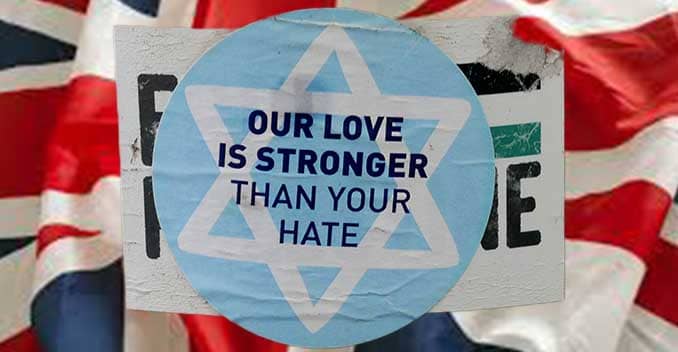
In the quiet, leafy enclaves of North London, where the aroma of fresh challah usually defines the midweek rhythm, a different, more acrid scent has taken hold. It is the smell of smoke and the chill of a security state that has moved from the theoretical to the visceral. The United Kingdom has found itself gripped by an escalating fever of antisemitism—one that has transitioned from the dark corners of the internet to the bloodied pavements of Golders Green. We are no longer merely discussing “hate speech”; we are witnessing a coordinated assault on the right of a community to exist in peace.
The statistics are not just sobering; they are a condemnation. With recorded incidents peaking at a record 4,103 in 2023 and sustaining a terrifying plateau through 2025 and early 2026, the nation is being tested and thankfully is showing signs of coming together and community. The latest attack—a double stabbing in the heart of the Jewish community, 29 April 2026—has forced the government’s counter-terrorism advisor to label the situation a matter of “National Security.” This is the dialectic of modern Britain: a society that prides itself on diversity bears witness to one of its oldest immigrant communities living in a heightened state of alert and caution. Behaviours and public displays of Jewish identity or becoming less visible.
A Climate of Escalation
The current climate did not emerge in a vacuum. It is the result of a “perfect storm” of geopolitical triggers and digital radicalisation. Following the 7 October 2023 attacks, the UK saw an immediate and unprecedented spike in anti-Jewish hate, recorded by the Community Security Trust (CST) at 4,103 incidents—the highest ever reported in a single year.
This was not a fleeting moment. The data shows a “normalisation” of hate, where monthly incident totals have rarely dropped below 200 for the past 30 months. In 2025, the CST recorded 3,700 incidents, the second-highest year on record. We have moved from a society where antisemitism was a fringe concern to one where it is an embedded, daily reality for British Jews, fuelled by the “globalisation of the intifada.”
The Golders Green Terror: A National Security Crisis
On the, 29th April 2026, the threat reached a new peak. Two Jewish men were stabbed in Golders Green in what Counter-Terrorism Policing has formally declared a “terrorist incident.” Head of Counter-Terrorism Policing Laurence Taylor confirmed the declaration after the suspect, a 45-year-old Somali-born British national, was apprehended.
The attack has prompted the government’s terror advisor to state that the climate is now one of “National Security.” This isn’t just about a single perpetrator or single group targeting another; it is about the realisation that Jewish life in London has become a primary target for radicalised violence. The stabbing follows a month of fear, where the community has been targeted by arson, explosives, and chemical threats.
A Spectrum of Condemnation
The reaction across the political spectrum has been swift and unanimous. Prime Minister Keir Starmer and the Shadow Home Secretary have both condemned the Golders Green stabbings as an “appalling assault on our values.” The government has pledged an additional £25 million—on top of an existing £54 million grant—to increase police patrols and security around synagogues and schools.
However, beneath the condemnations lies a growing debate: why did it take a fatal attack in Manchester and a stabbing in London for the state to recognise the severity of the threat? The political desire of a safe Britain is being countered by the the Jewish experience on the ground.
The Rise of the Volunteer Volunteers in the Community
As trust in general policing is stretched, the Jewish community has turned inward for protection. Jewish Security Volunteers, primarily through the Community Security Trust (CST), have become a ubiquitous sight. At Jewish schools, parents now act as “Security Volunteers,” manning gates and patrolling perimeters.
This isn’t a choice; it’s a necessity. With university-related incidents falling by 41% in 2025 only because Jewish students are increasingly avoiding campuses, the community is retreating into fortified enclaves. The “Jewish Security Volunteer” is the physical manifestation of a community that feels the state’s protection is no longer sufficient.
The Profile of a Suspect
While details remain sparse, police have identified the Golders Green suspect as a man of Somali descent. This fits a troubling pattern observed in recent UK terror incidents where the perpetrators are often British nationals who have been radicalised online.
Investigations are currently probing whether the suspect acted as a “lone wolf” or was influenced by broader extremist networks. The challenge for security services is that these individuals often fly under the radar until the moment they strike, leaving the community in a state of permanent “high alert.”
The last six years are punctuated by moments of extreme violence. In March 2026, four community-funded Hatzola ambulances were destroyed in an arson attack in Golders Green, causing £1 million in damage. Responsibility was claimed by Harakat Ashab al-Yamin al-Islamia, believed to be a proxy for foreign interests.
This followed the horrific Heaton Park Synagogue Terror Attack on Yom Kippur, 2 October 2025, where a Syrian-born attacker killed worshippers Melvin Cravitz and Adrian Daulby. Going further back, the Hanukkah Bus Attack of December 2021 and the London Convoy Incident of May 2021—where occupants called for the rape of Jewish women—serve as the historical context for today’s fear.
The Digital Enclaves of Hate
Beneath the physical attacks lies a digital bedrock of hate. Online antisemitic incidents reached record levels in 2023 and 2025, often spiking around Middle Eastern conflicts. These enclaves, away from public scrutiny, act as echo chambers where tropes about “Zionist control” are laundered into calls for violence.
The UK’s Online Safety Act (OSA), which came into full force on 15 January 2026, by proxy attempts to curb this, but the “Spike” around the Israel/Gaza war proved that the internet remains a primary vector for radicalisation.
The last six years is a grim ledger: 1,684 incidents in 2020 rising to 4,103 in 2023. As a society, the only action must be a return to the principle that an attack on one community is an attack on the sovereignty of the state. We cannot allow Jewish schools to be fortresses and synagogues to be targets.
Solidarity is not a slogan; it is a policy. It requires the full weight of the law—as seen in the conviction of Dylan Earl, sentenced to 17 years for masterminding arson for Russia’s Wagner Group—to be applied to antisemites. No technology and no state-sponsored proxy should be able to make a British citizen afraid to wear their kippah on a London bus.
[Facts]
- 2 October 2025: Heaton Park Synagogue Terror Attack, Manchester. Deaths: Melvin Cravitz and Adrian Daulby.
- 23 March 2026: Four Hatzola ambulances destroyed by arson in Golders Green.
- 29 April 2026: Golders Green stabbing declared a terrorist incident.
- 4,103: Number of antisemitic incidents in 2023 (CST Record).
- £54 Million: Total government funding for Jewish community protective security in 2025/26. A three year committment.
- 15 January 2026: Implementation of the UK Online Safety Act (OSA) requirements for platforms like Grok.

Be the first to comment