

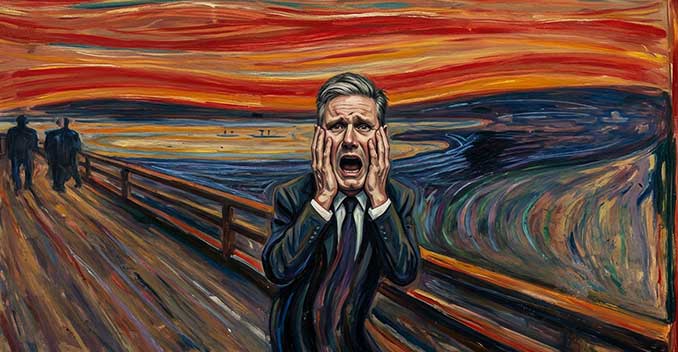
A profound and destabilising shift is tearing through the fabric of British politics. For months, the internal consensus holding the Labour administration together has been fraying under the weight of persistent economic stagnation and deep policy disagreements. In May 2026, the dam finally broke. The local council and devolved nation elections delivered a historic, crushing verdict against the sitting government, turning simmering backbench anxiety into an open, high-stakes rebellion.
The scale of the electoral defeat has shattered the executive’s authority. Labour suffered its heaviest losses in a generation, shedding 1,496 councillors and losing control of 38 councils across England. Crucially, the party lost control of the Senedd in Wales for the first time since its establishment in 1999, accompanied by a devastating wave of defeats at the hands of Reform UK and the Green Party in traditionally secure working-class heartlands.
To evaluate this crisis requires looking past simple internal disputes. This dramatic challenge to the leadership occurs against a highly volatile international backdrop—specifically, the economic fallout from the ongoing war in Ukraine and the intense geopolitical friction in Iran, which has severely disrupted global energy supply chains and left British consumers facing a brutal cost-of-living squeeze. The thread linking modern cabinet resignations to local government collapse is clear: while the central leadership has attempted to maintain an ultra-cautious, minimalist policy platform, the electorate’s patience has entirely run out and in many cases so has the Cabinet’s members. This briefing analyses the mechanics of the emerging Labour leadership contest, tracing how a historic electoral defeat has triggered a furious battle for the direction of the party and the future of the Prime Minister’s office as well as growing loss of confidence.
The Core Fault Lines of the Westminister Crisis
To fully map this unprecedented political realignment, our analysis focuses on four areas:
- The Reality of Unpopularity: Tracking how collapsing personal approval ratings stripped the Prime Minister of his defensive shield against internal critics.
- Run on the Cabinet: Analysing the strategic departures of high-profile ministers who chose to abandon the executive rather than sink with it.
- Resurgence of Rivals: Evaluating the operational manoeuvres of the three primary contenders positioning themselves for the crown.
- The Structural Risks: Projecting the long-term structural risks to British governance, whether through total party disintegration or a weakened, marginal victory.
The Anatomy of Decline: The Strategic Undoing of Keir Starmer
The Failure of the Ultra-Cautious Strategy
The rapid erosion of the Prime Minister’s political authority is the direct result of a fundamental strategic miscalculation. Upon entering office, the central leadership adopted an intensely cautious approach to governance, deliberately lowering expectations and prioritising fiscal restraint over sweeping structural reforms. The objective was to reassure international financial markets and present an image of steady, predictable competence.
However, this strategy left the administration uniquely exposed when external economic shocks began to hit home. As energy costs surged due to the Ukraine War and latterly the maritime blockades in the Middle East, the government refused to deploy aggressive state interventions or large-scale public investment to shield households. This policy vacuum allowed political opponents to frame the Prime Minister not as a steady manager, but as a detached manager overseeing national decline without a clear plan for recovery shedding support daily even amongst the party faithful.
The Verdict of the Public: Collapsing Metrics and Rising Discontent
The Grim Data of Public Favourability
The depth of the leadership’s vulnerability is starkly laid bare by the latest public opinion tracking. A comprehensive YouGov favorability survey conducted between 12 and 13 May 2026 revealed that public opinion toward the Prime Minister has plummeted to historic lows. Only 23% of British citizens view Starmer favorably, while a massive 69% see him unfavorably, leaving him with a catastrophic net favorability rating of -46.
These numbers reveal an electorate that has largely turned its back on the administration’s message. Crucially, this discontent is no longer confined to traditional political opponents; it has deeply penetrated the core 2024 Labour supporters, where a substantial majority of voters now express deep frustration with the government’s perceived lack of direction and inability to resolve the ongoing high-street economic squeeze. Ultimately the buck stops with Keir Starmer.
Defiance at the Dispatch Box: The Prime Minister Vows to Fight On
The Defensive Fortress of Number 10
Despite the extraordinary scale of the swingeing electoral defeat and growing anger from his own MPs, the Prime Minister has refused to step aside quietly. Allies within Downing Street insist that he remains entirely determined to fight any formal leadership challenge, viewing the current crisis as a temporary wave of panic that can be managed through traditional party discipline and appeals to national stability.
In public statements, the Prime Minister’s team has consistently warned against the dangers of internal division, arguing that plunging the country into a chaotic leadership contest amid a volatile international security environment would be deeply irresponsible. However, historical parallels—most notably the downfalls of Margaret Thatcher in 1990 and Tony Blair in 2006—prove that when a prime minister’s personal brand becomes a proven liability at the ballot box, raw defiance inside Downing Street is rarely enough to halt a determined internal rebellion.
The Cabinet Collapses: Ministerial Resignations Break the Line
The Prime Minister’s defensive strategy suffered a near-fatal blow when a coordinated wave of resignations ripped through the senior ranks of his government. High-profile figures, including Health Secretary Wes Streeting and prominent frontbencher Jess Phillips, chose to resign from their posts, openly stating that they had lost all confidence in the Prime Minister’s ability to lead the country forward.
These high-level departures have effectively broken the principle of collective cabinet responsibility. By stepping away from the executive immediately following a difficult King’s Speech that failed to offer a bold alternative vision, these ministers have signaled to the wider parliamentary party that the current leadership model is no longer functional, creating a highly volatile environment where a formal leadership contest is now practically unavoidable.
What does a Leadership Contest Means Practically?
The Machinery of a Parliamentary Ouster
Practically, a formal challenge to a sitting Labour Prime Minister triggers a complex, highly regulated constitutional process. Under party rules, a challenger must secure the formal nominations of a significant percentage of the Parliamentary Labour Party (PLP) to get onto the ballot. This requires intensive, behind-the-scenes lobbying as factions scramble to secure signatures from wavering backbenchers.
If a challenger successfully meets the required nomination threshold, the contest moves to a dual-stage vote involving both the parliamentary party and the broader national membership. For a nation already navigating economic instability, this process effectively puts major long-term policy decisions on hold, leaving government departments paralysed as senior ministers abandon their briefs to organise campaigns and compete for votes across the country.
A Dangerous Interregnum: Do We Need a Leadership Contest Now?
The Stagnation of the State Machinery
The unfolding challenge introduces a profound constitutional dilemma regarding the timing of the rebellion. Critics of the coup argue that launching a inward-looking political battle is an act of political self-sabotage that the United Kingdom can ill afford. With inflation remaining sticky and complex negotiations over international trade and defence requirements demanding constant executive attention, a prolonged leadership vacancy risks creating a dangerous vacuum at the heart of the state.
Conversely, those driving the challenge insist that allowing a paralysed, deeply unpopular Prime Minister to remain in office is far more dangerous. They argue that an administration completely stripped of its public mandate is inherently incapable of making the difficult decisions needed to stabilise the economy. From this perspective, a rapid, decisive leadership contest is not a distraction, but an essential step to clear the air and restore functional governance to the country.
The Strategist in the Wings: Wes Streeting’s Calculated Move
Positioning for the Modernised Center
Following his dramatic resignation as Health Secretary, Wes Streeting has emerged as the clear competent standard-bearer for the modernising, centrist wing of the party. Streeting’s allies have been aggressively canvassing backbench MPs, presenting him as a highly articulate communicator capable of taking the fight directly to Reform UK and the Conservatives on television screens and in the chamber. Although at present its not clear whether he has the numbers behind him.
Streeting’s platform is built around a promise of radical public sector reform and an unyielding focus on economic growth. He argues that the current leadership’s primary error was a failure of communication and a lack of political courage in tackling deep-seated institutional inefficiencies. By presenting himself as a bold, forward-looking reformer, Streeting aims to capture the support of MPs who fear that under the current management, the party is drifting toward a historic defeat at the next general election. However beware, Streeting is also a strong proponent and open about steps towards rejoining the EU.
The Voice of the North: Andy Burnham’s Bold Path Back to Westminster
The Mayor’s Move for the Crown
The most logistically complex and fascinating challenge comes from outside the current parliamentary party. Andy Burnham, the highly popular Mayor of Greater Manchester, has officially confirmed his desire to stand for the leadership and secure a return to Westminster as an MP. Burnham’s path back to Parliament was cleared when Labour MP Josh Simons announced his intention to stand down, opening the way for Burnham to contest the upcoming Makerfield by-election.
Let’s not forget Burnham was blocked before in a cynical move from the Labour Party. Burnham enters the race as a major political threat to the Westminster establishment. The May YouGov data confirms that he remains the most popular Labour figure in the country, holding a net favourability rating of +4 and standing as the only senior figure viewed positively by a clear majority of 2024 Labour voters. Running on a platform that emphasises regional devolution, social justice, and a clean break from the “Westminster bubble,” Burnham aims to position himself as a powerful champion for communities that feel completely abandoned by the political centre.
Cleared for Combat: Angela Rayner’s Resurrection
The Deputy’s Freedom of Manoeuvre
For months, the political prospects of former Deputy Prime Minister Angela Rayner were heavily overshadowed by an intense, highly publicised HMRC investigation into her past housing and tax affairs. However, the political dynamic transformed completely on 14 May 2026, when authorities formally cleared Rayner of any deliberate wrongdoing, freeing her from a major political vulnerability. While she has settled £40,000 in unpaid stamp duty, she faced no financial penalties, completely removing the issue as a barrier to advancement.
Now fully cleared for combat, Rayner occupies a uniquely powerful position in the emerging race. Holding deep roots within the party’s traditional trade union base, she has refused to rule out a leadership bid, while carefully stating that she will not personally “trigger” a contest against the incumbent. Her survival has made her an essential kingmaker; any challenger seeking to assemble a winning coalition across both the parliamentary party and the national membership will find her endorsement or active participation absolutely critical.
The Gatekeepers: Who Can Muster the Required Backbench Support?
The Brutal Math of the Nominations Threshold
While several high-profile figures harbour clear ambitions for the top job, the reality of parliamentary arithmetic acts as a brutal gatekeeper. Securing the necessary nominations from a deeply divided, anxious PLP requires far more than media popularity; it demands an intricate network of personal alliances and organisational strength. Nomination need to secure a 20 percent of the PLP (Parliamentary Labour Party) – meaning any challenger would currently need the backing of 81 Labour MPs. This could change if any have the whip withdrawn.
This threshold creates distinct challenges for each contender. Wes Streeting must prove he can expand his appeal beyond his core centrist base to capture the support of unaligned backbenchers. Meanwhile, Andy Burnham faces a race against time, needing to win the Makerfield by-election before he can formally collect signatures within the Commons. This numbers game means that the opening days of the contest will likely witness intense horse-trading, as marginal candidates withdraw to throw their weight behind viable frontrunners in exchange for senior cabinet pledges.
The Disintegration Scenario: The Risk of Full-Scale Factional War
The Ghost of the 1980s Realignment
The ultimate nightmare for the wider labor movement is that a prolonged leadership contest could cause the party to fracture entirely. If the battle between the centrist modernisers, the regional devolutionists, and the traditional left becomes more volatile, more toxic, the internal coalition that holds the party together could simply disintegrate.
Such a breakdown would carry profound historical echoes of the early 1980s, when intense ideological warfare led directly to the formation of the Social Democratic Party (SDP) and guaranteed a generation of political exile. In the volatile environment of 2026, a fractured governing party would find itself utterly devoured by a surging Reform UK on its right and an ascendant Green Party on its left, potentially reducing a historic parliamentary force into a collection of warring regional factions.
The Pyrrhic Victory: A Weakened Incumbent and a Paralysed State
The Cost of a Marginal Survival
The final, equally perilous scenario is one where the Prime Minister manages to survive the leadership challenge, but only by the narrowest of margins. A slender victory inside the parliamentary party would offer a temporary reprieve rather than a genuine resolution to the crisis, leaving the executive permanently damaged and stripped of any authentic political authority.
An administration operating under a pyrrhic victory would find itself utterly paralysed. Every controversial piece of legislation, every budget measure, and every major infrastructure decision would be held hostage by shifting factions of disgruntled backbenchers demanding policy concessions. The country would be left with a government capable of surviving internal votes but entirely incapable of delivering effective leadership, prolonging an agonising period of political stagnation precisely when the national economy requires bold direction.
The Crucible of Power: A Journalistic Conclusion
The High Stakes of the Coming Months
The current Labour leadership crisis is far more than a standard piece of Westminster theatre; it represents a fundamental turning point for the modern British state. The shattering results of the May 2026 local elections have exposed a profound disconnect between the central government’s ultra-cautious policy platform, u-turns, weak immigration posture and an electorate facing intense economic pressure and international instability. Whether through the rise of a bold reformer like Wes Streeting, the dramatic return of a regional heavy-hitter like Andy Burnham, or a narrow, bruising survival by the incumbent, the current model of governance has reached its absolute limit.
As the party enters this political crucible, the stakes for the wider nation could not be higher. Britain requires a strong, focused executive capable of navigating a perilous global landscape and implementing long-term solutions to a persistent domestic cost-of-living crisis. The upcoming contest will determine not only who holds the keys to 10 Downing Street, but whether the governing party can rediscover a coherent national purpose, or whether it will allow internal divisions to paralyse the machinery of the British state.
Verified Facts
- May 2026 Local Election Losses: The official election returns on 8 May 2026 confirmed that the ruling Labour Party suffered a historic defeat, losing 1,496 council seats and dropping outright control of 38 councils across England.
- Loss of the Senedd: For the first time since its inception in 1999, Welsh Labour lost its governing control of the Senedd, with First Minister Eluned Morgan among the high-profile casualties losing her seat.
- Starmer’s Net Approval Metrics: A YouGov favourability tracker conducted from 12 to 13 May 2026 recorded the Prime Minister’s personal approval at 23% vs 69% disapproval, generating a net rating of -46.
- Burnham’s Return Mechanism: On 14 May 2026, Labour MP Josh Simons confirmed his intention to stand down from parliament, allowing Greater Manchester Mayor Andy Burnham to seek selection for the safe seat of Makerfield to enable his leadership bid.
- Rayner Tax Investigation Clearance: On 14 May 2026, HMRC formally concluded its investigation into Angela Rayner, clearing her of deliberate wrongdoing regarding past stamp duty liabilities after she settled a £40,000 underpayment without further penalty.



Be the first to comment