

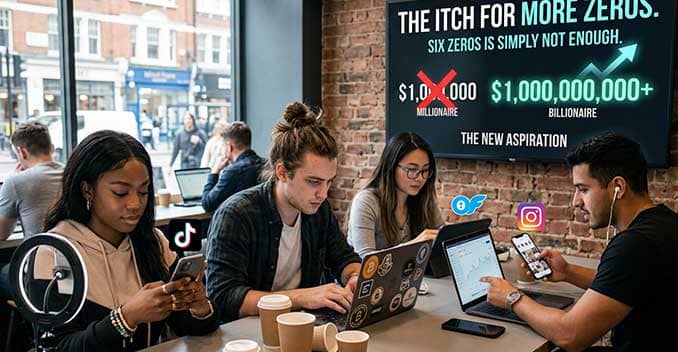
We have witnessed the death of modest aspiration. There was a time, perhaps late last century, when a comfortable suburban semi-detached house, an annual trip to the Mediterranean, and a fully paid pension were the markers of definitive economic victory. Today, that entire paradigm feels impossibly quaint—a middle-class relic buried under the weight of baby boomers, wage stagnation, fewer jobs, fiercer competition, financial hyperinflation and relentless algorithmic comparison; and lastly the hyper visibility of wealth and celebration of it. The goalposts have not merely shifted; they have been launched into the stratosphere. We have the power of the collective sum of all human experience and learning in our pockets, so is it a wonder that our ambitions have similarly increased?
Six zeros was the Gold standard. Shows like Who Wants To Be A Millionaire popularised this. For many once you purchase a house in London, you’ll be left with a solid savings but this is a far cry from a fortress balance sheet insulated from economic shocks. Nobody wants to be comfortable anymore. Nobody even wants to be rich. The seemingly new baseline for modern ambition is the nine-zero club. Everyone wants to be a billionaire or so it seems? At times it can be difficult to determine what people want versus what they are fascinated by; versus what narratives are being pushed onto them by broadcasters, organisations, celebrities. Many of whom invest in and benefit from the very economy and ideas that are pushed via subtle narrative shift towards ultra luxury and hyper commercialisation. Most are not immune.
This shift is not merely a quantitative evolution of greed; it is a cultural mutation. It has fundamentally re-engineered how we value our time, construct our identities, and view our futures. We are trapped in a high-stakes, 24-hour feedback loop where hyperconnectivity has turned ordinary life into an unbearable waiting room for a financial breakthrough that, for 99.9% of the population, will never arrive. It is an aesthetic of perpetual hustle, a fixation on wealth, equity stakes, and an absolute refusal to accept mediocrity. In and of itself this is a good thing. In fact, its good to have desire to grow and generate wealth, but now there’s an almost narcissistic vacuum pulling people in. Platforms like OnlyFans and TikTok provide an infinite customer base to sell your wares whatever that may be. Content producers are pushed into doing silly stunts for fame, skits, some selling their bodies and create hyper sexualised content; even on TikTok which is Social Media primarily consumed by the youth. But everyone’s on their adults and kids alike. And, while not everyone will be billionaires or even millionaires most do want to own a home and sadly many will not achieve this until later in life or not at all.
Right now, many love to present a lifestyle. From people using AI-hunkified or AI-beautified headshots that de-age, add hair, lighten, and slim down and so on; the pivot towards everyone living this perfect, curated life and entrepreneur lifestyle has ever increased especially since covid where people had more time to plan ideas (while on furlough) and turn hobbies into side hustles and businesses, which in itself is a very smart thing to do in the midst of economic uncertainty and while job certainty is at risk.
But beneath the sleek, curated gloss of the digital wealth machine lies an incredibly fragmented generational psyche, deeply anxious about its own merit and imminent displacement. Perhaps due to the continuous announcement of new billionaires from; reality stars, sports personalities to musicians to film directors and investors; the thirst for entrepreneurism is here to stay and with the wealth of technology and AI in our pocket it feels as though we’re all just a profile, or one prompt away from greater success or going viral.
The Genesis of Hyper-Aspiration
The democratisation of ambition has removed the traditional gatekeepers of wealth. Success is no longer framed as a slow, multi-generational climb up a corporate ladder. Instead, it is pitched as an immediate, lightning-strike revelation available to anyone with an internet connection and a sufficient lack of shame. The baseline dream is no longer security; it is absolute autonomy achieved through obscene, unscalable scale and the idea of old money is largely regulated to the sidelines as all old money was new money once. This alongside other factors is contributing to the NEETs Not in Education Employment or Training. A generation glued onto smartphones many youth don’t see the point.
We are socialised from birth to crave validation, but the scope of that validation has mutated. In a hyper-financialised world, localised success—being the most prosperous merchant in a specific town or the highest-earning partner at a regional firm—feels utterly invisible. If your achievements cannot be indexed globally, verified by a blue tick, or converted into an aggregate follower count, the cultural engine treats them as statistical noise.
The plain truth is that a millionaire territory simply does not cut it anymore. Inflationary realities have turned the classic seven-figure milestone into a modest protective cushion rather than a ticket to the lifetime inter-generational leisure class. According to the Office for National Statistics, the median average home in England costs £300,000—climbing to an average of £554,000 in London. When a baseline family flat in a capital city consumes over half a million pounds, being a “millionaire” denotes little more than a stable, upper-middle-class existence tethered to property equity. To buy true, insulating, cross-border leverage, you need more zeros.
This psychological shift is driven directly by our total infrastructure of hyperconnectivity. We no longer gauge our relative worth against our physical neighbours or our immediate colleagues. The local benchmark is dead. Our brains are permanently plugged into a globalised, real-time index of competitive achievement, meaning a teenager in a Midlands bedroom is actively measuring their lifestyle against a tech founder in Austin or an influencer in Dubai or a celebrity nepo-baby with access to all their parents wealth and influence.
The digital economy operates on the hyper-visibility of curated success. The algorithms do not amplify the mundane, the incremental, or the repetitive struggles of everyday labor. They reward the exceptional, the ostentatious, and the suddenly wealthy. We are bombarded daily with the hyper-polished highlight reels of others’ financial breakthroughs, stripped completely of their context, luck, and underlying venture capital subsidies, creating an illusion that extreme wealth is a normal distribution.
This constant exposure fuels powerful parasocial bonds. We don’t just watch the ultra-wealthy; we follow their daily routines, read their unfiltered midnight thoughts on X, and watch them stream from their private jets. This artificial intimacy tricks the human brain into believing that the distance between the viewer and the billionaire is merely a matter of execution, a temporary logistics delay that can be resolved with the right strategy or a smarter hustle.
The Monetisation of Everything
To close this perceived gap, the modern individual has had to transform into a walking enterprise. The single-salary lifestyle is viewed as financial suicide. Everyone is running a side hustle, diversifying, managing a drop-shipping store, building a personal brand, or day-trading crypto derivatives. Everything must be monetised; leisure time is re-branded as “networking,” and hobbies are evaluated purely on their capacity to yield scalable passive revenue streams.
We live our lives entirely on a platform. Every interaction, piece of content, and creative expression is routed through a centralised corporate sandbox designed to harvest attention and extract transaction fees. The platform capitalises on our desire to escape the matrix by charging us for the very visibility required to construct our digital empires, ensuring the house always wins.
The core myth of the social platform economy is that of total viral content and that anyone can go viral. In reality a tiny tiny fraction ever will. The narrative states that anyone can bypass the traditional, gruelling pathways to creative success. A musician no longer needs a record label or decades of touring; they need a single 15-second audio track to trend on social media to secure a global audience. This lottery-style mechanics turns creative output into an exercise in algorithmic slot-machine play which in itself may be bad for creativity in the long run. Must timeless and iconic creativity was created for itself.
Because the tools of creation are cheap and accessible, the multi-millionaire tier feels deceptively attainable. When an OnlyFans creator or a teenage TikTok dancer can generate seven figures in a matter of months, the traditional logic of hard work, qualification, and seniority falls apart. The youth do not see a structural economy; they see an environment ruled by viral luck, and they format their lives accordingly and for some have less moral qualms to get shortcuts.
In this environment, the distinction between famous, infamous, and celebrity have been comparatively eradicated. Attention is the ultimate currency, and the algorithm is entirely indifferent to its moral quality. The public figure who builds a multi-billion-dollar empire through raw market disruption sits on the exact same digital pedestal as the controversial internet troll who monetises outrage. Notoriety is just as effective as merit, provided it can be converted into programmatic ad revenue. Rapists and sexual predators like Bill Cosby to Weinstein through to Pedophiles like Epstein get documentaries on Netflix, Conmen like Madoff (Ponzi master), Conwomen like Elizabeth Holmes (Theranos) even Serial Killers like Ted Bundy and Ed Gein get their fame. For many notoriety is akin to success and media often conflates the two albeit laterally sensationalisation has the semblance of propagating cult status like the Manson Family.
Social media influencers have become conduits of this new order. They do not merely sell products; they sell the lifestyle of hyper-capitalism. They sell themselves. Off the back of reality TV shows, like Paris Hilton’s to the Kardashians to the Osbornes and so on. They embody the fantasy of complete freedom—unbound by corporate hours, geography, or traditional accountability—acting as living, breathing advertisements for the seductive proposition that you, too, are just one viral post away from checking into a five-star resort in the Maldives. The difference and what people often don’t see is its a highly curated fiction of life and very unreal with a hell of a lot of work. Content creation is not for the faint hearted to turn it into a business.
This entire ecosystem is propped up by the genuine democratisation of creation tools. A smartphone, an internet connection, and a basic imagination are all that is required to publish an essay, edit a film, or distribute a track globally. The cost of admission to the global stage has dropped to zero. But this democratisation is a double-edged sword: while anyone can publish, the resulting oversaturation means that breaking through the noise requires an astronomical amount of luck or capital, turning the platform into an elite tier masquerading as an open playground. Also the algorithm can have bias too another gatekeeper.
The Collateral
The psychological consequence of this hyper-aspirational environment is a massive wave of generational disaffection. When the baseline for a “successful life” is set at an unachievable millionaire or billionaire standard, ordinary, productive, stable milestones feel like an embarrassing failure. Young people entering the workforce in 2026 are increasingly detached from traditional careers, viewing the standard 9-to-5 grind not as a steady path to maturity, but as an explicit trap for the unimaginative. For many of the youth working in Starbucks or McDonald’s is not sexy.
This disaffection can inevitably hardens into depression and systematic alienation. The gap between the hyper-visible wealth displayed on screen and the grinding economic reality of high rents, stagnant real wages, and astronomical living costs creates a profound sense of institutional betrayal. The individual feels completely isolated within a system that constantly tells them they can have it all, while simultaneously pricing them out of basic security.
The internal monologue of the hyper-aspirational youth is dictated by a relentless, crushing anxiety. Every hour not spent working on a side hustle, learning a new digital skill, or optimising a portfolio feels like wasted potential. If you are not actively making money while you sleep, you are falling behind. This financial anxiety turns self-care into a luxury and converts genuine leisure into a source of intense guilt.
The structural realities of this wealth obsession have completely disrupted the traditional timeline of human maturity. Marriage is no longer an early-adulthood partnership built on mutual growth; it is increasingly deferred until absolute financial stability is achieved. Young adults refuse to commit to long-term domestic partnerships because they feel economically inadequate, choosing instead to wait for a financial breakthrough that keeps slipping into the future.
Amongst Millenials other generations concurrently, family planning has taken a massive hit. The choice to settle down and have children is being systematically postponed or abandoned entirely. In an environment where raising a child is viewed through a lens of cold financial optimisation—costed against the price of housing, education, and lost career momentum—the birth rates across developed economies are hitting historic lows, as the youth choose to prioritise their personal financial empires over biological legacy. Essentially everyone wants to feel more stable in a more secure world with better prospects with idealised versions of themselves before settling down. The irony is if we wait to be the perfect versions of ourselves the settling down and starting a family part may never happen.
To cope with this exhausting physical reality, our lives have been systematically outsourced to a hyper-digitised safe room. We buy our groceries online, manage our careers through remote interfaces, and find our companionship through dating apps. We have even digitised our most intimate impulses, with cybersex or other virtual style relationships, and AI companions serving as friction-free, low-cost substitutes for the complex, expensive, and messy reality of analog human connection. Are we all doomed?
The global obsession with achieving more zeros, millionaire and billionaire status is not a sign of economic health; it is the ultimate symptom of an existential crisis. Oxfam’s 2026 Davos report revealed that global billionaire wealth surged by 16% in 2025 alone, hitting a record $18.3 trillion. The wealth of the ultra-rich is compounding at a rate that completely detaches it from human utility, while the bottom half of humanity watches from behind a screen. Also, more millionaires does not necessarily correlate to trickledown success. The more wealth one has the more protective of it they get; many of the very wealthy and ultra wealthy use every trick in the book to avoid taxes including mega corporations.
When success is measured solely by the scale of your asset portfolio, or click metrics we hollow out the very things that make a society liveable, our aura diminishes and are soul fractures: art for art’s sake, community solidarity, and the simple dignity of an ordinary, quiet life. The future of global well-being depends on our capacity to unplug from this algorithmic matrix, at least for a while and reject the toxic delusion of infinite scalability, and rebuild a culture where a person’s worth is not calculated by the number of zeros in their bank account.
Verified Facts
- According to Oxfam’s January 2026 global inequality report released at the World Economic Forum in Davos, global billionaire wealth surged by over 16 per cent in 2025 to a historic record of $18.3 trillion.
- The collective wealth of billionaires increased by $2.5 trillion in 2025 alone, a figure nearly equivalent to the total wealth held by the bottom half of humanity (4.1 billion people).
- The total number of billionaires globally crossed the 3,000 threshold for the first time in history by the end of 2025.
- According to official data from the UK Office for National Statistics (ONS) released in March 2026, the median average house price in England for 2025 was £300,000, which requires 7.6 times the median annual average earnings of a full-time employee (£39,300).
- The average property value in London reached £554,000 by early 2026, establishing an affordability ratio of 10.6 times average local earnings.



Be the first to comment