

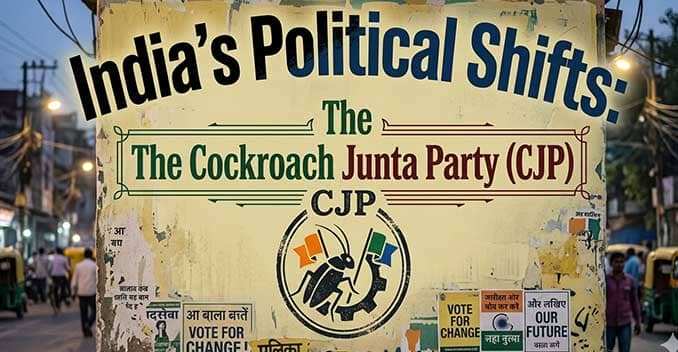
A bizarre political phenomenon has rapidly jumped from the volatile matrix of Indian social media into the physical architecture of national dissent. Named the “Cockroach Junta Party” (CJP), this self-described Gen Z political movement has mobilised a staggering digital following. Its sudden rise highlights a profound, deeply felt undercurrent of youth rage directed at India’s established political class. What began as a digital pushback against economic anxieties and institutional failures has evolved into a standoff involving state censorship, international asylum, and constitutional litigations.
Historically, satire has repeatedly served as a gateway to serious political defiance under strict regimes. In the 1980s, the Orange Alternative movement in communist Poland deployed surrealist street art and elfish imagery to successfully subvert state authoritativeness, making it impossible for the regime to suppress them without appearing ridiculous. Similarly, the modern “Cockroach Junta” weaponises internet memes, digital solidarity, and self-deprecating irony to build a broad base of support that traditional opposition structures have failed to capture.
Yet, as the state apparatus reacts with heavy-handed legal mechanisms, the border between parody and physical sedition has entirely dissolved. The transformation into a formal political threat raises significant questions about the resilience of democratic dissent in contemporary India. It challenges an environment increasingly shaped by algorithm-driven state security and systemic crackdowns on digital speech.
Who Are They
The Cockroach Junta Party (CJP) is a fast-growing Indian youth and student movement. It functions as a hybrid political collective, combining digital-native anti-establishment satire with targeted, real-world structural activism. Rejecting traditional party politics, its members adopt the moniker of “cockroaches” to symbolise their capacity to survive systemic pressures, institutional glitches, and economic adversity.
When Were They Founded
The CJP surfaced as a unified digital entity in May 2026. The movement expanded at an exponential rate across global platforms like X (formerly Twitter) and Reddit, transforming from an isolated online community into a highly organised nationwide phenomenon within mere weeks.
How Were They Founded
The movement was sparked by public outrage and systemic frustration surrounding structural abnormalities in India’s highly competitive national examination structures, specifically the recent Maharashtra Common Entrance Test (MH-CET) merit list controversies. Frustrated by extreme score normalisations, high fees, and server glitches, Gen Z students adopted the “Cockroach Junta” meme to mock the system. The satirical community quickly formalised its identity after its platform infrastructure faced aggressive state digital blockades and censorship.
4. Who’s Their Leader
The founder and central figure of the Cockroach Junta Party is Abhijeet Dipke, a prominent digital activist and political commentator. Operating under significant legal and security pressures, Dipke coordinates the movement’s domestic legal interventions and public mobilisation strategies.
Grievances and the State Apparatus
Why Are They Protesting
The CJP’s primary grievances are rooted in deep structural anxieties over India’s hyper-competitive education system, severe youth underemployment, and what they term “exam corruption.” They demand the immediate resignation of national education administrators following a succession of competitive paper leaks and percentile calculation irregularities. Additionally, their focus has expanded to encompass broader demands for government transparency, digital freedom, and protection against targeted state intimidation.
Who’s the Current Ruling Party
The movement operates under the political hegemony of the Bharatiya Janata Party (BJP), which governs India as the dominant coalition partner under Prime Minister Narendra Modi. The state’s response to the CJP has been characterized by sharp counter-narratives from ruling party functionaries, who have publicly labelled the movement an anarchic threat to domestic stability.
Implications for Freedom of Speech and Political Determination
The rapid state intervention against the CJP highlights a growing friction point regarding digital freedom of speech and youthful political determination in India. Following the movement’s rapid growth, its official website was taken down, and its primary social media communication channels were geo-blocked domestically. This aggressive containment approach demonstrates how easily digital boundaries can be deployed by a centralized state to isolate disruptive political groups before they can establish institutional momentum.
India’s Position on Human Rights and Liberties
Constitutionally, India guarantees fundamental human rights and liberties under Article 19, which explicitly protects the freedom of speech and expression. However, these liberties are systematically balanced by stringent national security laws, including the Unlawful Activities (Prevention) Act (UAPA) and Section 69A of the Information Technology Act. The latter grants the central government absolute authority to block public access to digital information in the interest of state sovereignty, public order, and national security, creating a complex legal landscape for modern digital dissidents.
Mobilisation, Suppression, and the Future
Who Is Signing Up to This Political Movement
The core demographics aligning with the CJP are Indian Gen Z citizens, competitive exam aspirants, undergraduate students, and young tech-literate professionals. The group has bypassed traditional regional and linguistic barriers, drawing significant support from major student populations across urban hubs like Delhi, Pune, and Mumbai.
1Why Are They Joining Up and What Is the Draw?
The primary draw of the CJP is its absolute rejection of stuffy, conventional political rhetoric in favour of highly relatable digital satire and meme culture. For a generation exhausted by relentless exam pressure and diminishing economic options, the party provides an accessible, non-traditional platform to vent collective systemic frustrations. Joining up offers both an emotional release and a feeling of shared resilience against an uncompromising system.
Implications of Over-Suppression
The intense pushback against the CJP—including digital blocks, legal threats, and extradition demands against its leadership—carries severe risks of political over-suppression. Historically, when peaceful, satirical avenues of youthful dissent are totally closed down, the underlying grievances do not disappear. Instead, over-suppression risks radicalising moderate student groups, driving digital networks underground, and turning a peaceful internet counter-culture into a much more confrontational, unpredictable political force. Also suppression shows weakness to not engage in real debate and can lend credibility, legitimacy and fuel to ignite the party even more.
Is There a Possibility of Coexistence Rather than Mutual Exclusion
A path toward systemic coexistence requires the Indian state to shift from viewing digital youth satire as a dangerous national security threat to treating it as a legitimate signal of institutional stress. If the governing administration addresses core student grievances—such as reforming exam transparency and standardising merit metrics—the CJP’s highly satirical edge would naturally soften. Conversely, if both sides maintain a stance of mutual exclusion, the confrontation will continue to escalate through continuous court battles and street demonstrations.
The Limits of Digital Political Sovereignty
The emergence of the Cockroach Junta Party marks a critical turning point in how a new generation of Indian citizens and netizens approach political dissent. By wrapping serious economic and institutional anxieties in layered, absurdist digital humour, the movement has exposed structural gaps in traditional political containment strategies. The state can delete website domains and block social media handles, but it cannot easily eliminate the underlying youth frustrations that drive these networks. As long as structural bottlenecks in education and employment persist, new mutations of digital defiance will inevitably surface, testing the precise legal and democratic limits of the state’s authority.
Although the Party is borne out of meme culture and political satire; for the party to get more recognition they must; move away from Satirical Manifestos to something more credible; a need to move away from AI generated Manifestos to something more structured. The party is in phase of shifting towards activism and call for regulation overhaul particularly around education, accountability and a crackdown on exam cheating.
Verified Facts
- The Cockroach Junta Party (CJP) is a prominent Indian digital youth movement led by activist Abhijeet Dipke.
- In May 2026, the Indian government utilized regulatory mechanisms to block access to the Cockroach Junta Party’s official X (formerly Twitter) account and website interfaces within India.
- In response to the censorship actions, founder Abhijeet Dipke formally approached the Delhi High Court in late May 2026, filing a legal challenge against the blocking orders.
- On 6 June 2026, the CJP held its first physical public rally in the national capital of New Delhi, drawing tight police deployment as leader Abhijeet Dipke arrived to address the student gathering.
- In late May 2026, a ruling BJP functionary approached the Allahabad High Court, seeking a judicial probe into the group’s financial operations and calling for the extradition of its founder.
- The legal mechanisms used by the Indian state to regulate digital content are anchored in Section 69A of the Information Technology Act, 2000.
Links
- LiveLaw – Legal Details of CJP’s X Account Challenge Before Delhi High Court
- Bar and Bench – Comprehensive Coverage of Allahabad High Court Plea Against CJP
- The Times of India – Report on Whatsapp Security Threats Received by Abhijeet Dipke
- Diaspora Journalism Discussion on India’s Cockroach Junta Movement



Be the first to comment