

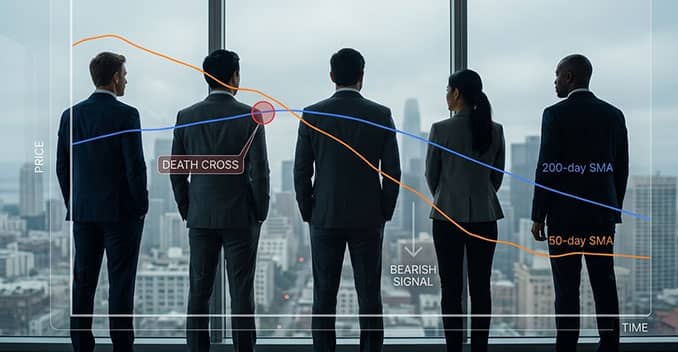
For the past eighteen months, global equity markets operated on a singular, almost religious conviction: that the expansion of artificial intelligence was an infinite revenue engine. Tech giants and hardware fabricators rode a wave of historic capital deployment, consistently pushing indices like the Nasdaq and S&P 500 to unprecedented peaks. However, the week of 22 June 2026 delivered a sharp structural reminder that even the most transformative technological revolutions are ultimately subject to the unyielding laws of macroeconomics. A coordinated tech sell-off swept across global boards from Wall Street to East Asia, wiping billions from enterprise valuations and forcing a stark re-evaluation of Big Tech’s capital expenditure pipelines.
The immediate catalyst for this contraction was not a sudden drop in consumer demand for artificial intelligence, but a compounding series of macroeconomic signals and localised corporate shifts. Hawkish forecasts from the Federal Reserve indicated that borrowing costs would remain elevated for longer to curb persistent inflation pressures, directly challenging the debt-heavy funding structures supporting massive data centre construction. Simultaneously, internal ructions at Alphabet—triggered by the high-profile departure of leading AI researchers—shattered the illusion of corporate stability, causing Google’s parent company to suffer its steepest single-day market decline in over a year. The market’s response was swift, clinical and aggressively corrective, leaving entrepreneurs and institutional investors wondering whether this correction is a temporary technical adjustment or the initial rupture of an over-leveraged tech bubble.
Hardware Bottlenecks
The current market friction highlights a profound shift in investor psychology. The era of awarding multi-trillion-pound valuations based purely on speculative compute capacity or flashy technical demonstrations is drawing to a close. Wall Street and the City of London are now demanding hard metrics: sustainable token economics, clear software margins and bulletproof supply chain resilience. As we analyze the individual components of this market shift, the overarching narrative is clear: commerce is forcing the architects of the digital frontier to justify their astronomical balance sheets. The Fundamental are becoming even more important.
The Mechanics of the ‘Death Cross’
The technical term dominating trading floors and analytical briefs during this correction is the “Death Cross.” Far from a mere sensationalist headline, this specific chart formation occurs mechanically when a security’s short-term moving average—typically the 50-day Simple Moving Average (SMA)—crosses cleanly beneath its long-term counterpart, the 200-day SMA. For institutional market participants, the crossover serves as a lagging historical confirmation that a stock’s upward momentum has thoroughly exhausted itself, signaling a broader transition from a structural bull run to a sustained bearish phase.
While technical analysis purists treat the formation of a death cross with immense gravity, its appearance across major technology names must be interpreted with nuance. In high-growth sectors, a death cross can frequently manifest at the absolute tail-end of a sharp corrective wave rather than at the genesis of a prolonged collapse. For agile entrepreneurs and corporate treasurers, the signal represents a classic distribution phase, indicating that institutional funds are actively rotating capital away from hyper-scaled growth equity into more defensive assets, resetting entry valuations for long-term players.
Bearing the Brunt Amidst High Demand
The most striking element of this mid-year correction is the severe penalty imposed on major companies at a time when macro-scale demand for AI silicon remains exceptionally high. Hyperscalers like Meta, Microsoft and Google continue to accelerate their multi-billion-pound infrastructure budgets, yet their stock prices have been aggressively corrected. This structural disconnect exposes a harsh reality: the market had priced these entities to absolute operational perfection, leaving no margin for rising capital costs.
The global nature of the sell-off became undeniable as the initial shockwaves crossed the Pacific. South Korea’s benchmark index dropped significantly following double-digit share contractions from the world’s premier memory and logic fabricators. Investors are no longer merely tracking whether these businesses can sell every piece of silicon they produce; they are calculating the escalating operational costs of power-hungry data centers and the growing geo-political friction points that threaten the underlying continuity of corporate earnings.
Volatility in the High-Bandwidth Supply Chain
The hardware correction has hit the memory semiconductor ecosystem with particular severity, exposing the complex, fragile dynamics of global supply and demand chains. High-Bandwidth Memory (HBM) and enterprise Solid State Drives (SSDs) form the non-negotiable infrastructure layer required to train and serve frontier AI models. Yet, because memory production is historically cyclical and requires massive upfront capital expenditure, manufacturers are highly exposed to shifting market sentiments.
When broader market liquidity tightens due to hawkish central bank outlooks, the memory tier feels the squeeze instantly. Fabricators must constantly balance the multi-year task of scaling manufacturing capacity against the immediate demands of enterprise software clients. If cloud service providers show even a minor hesitation in their infrastructure procurement rates, the market immediately prices in a threat of oversupply, triggering swift and punishing drawdowns across the entire memory sub-sector.
The Paradox of Micron’s Strategic Pivot
The primary casualty of this structural market re-pricing has been Micron Technology, illustrating the limits of corporate narrative against broader market momentum. On Monday, 22 June 2026, Micron announced a major, multi-faceted strategic agreement with frontier AI lab Anthropic. The collaboration was designed to scale next-generation infrastructure, linking Micron’s advanced data center portfolio directly to Anthropic’s multi-year compute strategy, while simultaneously deploying Anthropic’s Claude models across Micron’s global enterprise and manufacturing operations.
Despite the announcement of this high-profile partnership and a direct strategic investment in Anthropic’s Series H funding round, Micron’s stock was heavily penalised by the market sell-off. The immediate down-rating highlights a critical lesson for modern commercial enterprises: standalone corporate victories and blue-chip alliances can easily be overwhelmed by macro-level sector rotations. Investors focused squarely on systemic infrastructure spending limits, choosing to reduce exposure to memory producers regardless of individual architectural milestones.
The Compute Trinity: Nvidia, Broadcom and AMD
To understand the true landscape of the tech sector, entrepreneurs must analyze how the leading design houses—Nvidia, Broadcom and Advanced Micro Devices (AMD)—are performing relative to one another. Nvidia remains the uncontested bellwether of the generative boom, but its massive scale means its valuation is hyper-sensitive to institutional distribution, with its market cap experiencing sharp contractions during the June correction.
In contrast, Broadcom and AMD present entirely different risk profiles. Broadcom’s heavily diversified business model—spanning custom application-specific integrated circuits (ASICs) and infrastructure software—provides a partial cushion against pure hardware volatility. Meanwhile, AMD continues to position itself as the primary cost-effective alternative for cloud providers looking to break Nvidia’s monopoly. This three-way competitive dynamic means that while the entire sector has taken a short-term hit, the underlying commercial battle to optimise token economics for enterprise clients remains as aggressive as ever.
SpaceX and the Capital Intensification Trap
The market correction did not spare the private space and defense infrastructure sectors either, as evidenced by the dramatic post-listing performance of Elon Musk’s SpaceX. Debuting on public markets on 12 June 2026 to intense global fanfare, the company’s initial valuation surge evaporated culminating in a sharp 16 percent drop on Monday, 22 June. The sudden sell-off reflected a deeper structural concern regarding the immense cost of funding frontier infrastructure and whether the aspirations are actually achievable, like StarMind the intention to have 1million satelites in LEO (Low Earth Orbit).
The core anxiety crystallised when SpaceX announced its intention to raise $20 billion through a major bond sale, hot on the heels of securing over $85 billion through its initial public offering. Institutional analysts noted that the company’s reliance on debt markets to finance aggressive, long-term capital projects revived deep-seated market fears that modern tech empires are over-extending themselves. When marquee firms increasingly rely on debt leverage to fund capital-intensive projects, the market naturally reacts by discounting equity across the board.
The Margin Pressure on Consumer LLM Layers
Open AI, Google and Anthropic
As the hardware layer experiences severe financial compression, the consequences are flowing downstream to the consumer and enterprise Large Language Model (LLM) layers. The commercial entities operating at this tier—principally OpenAI, Google and Anthropic—are locked in an extraordinarily expensive race to deliver faster, more accurate and cost-effective inference solutions.
Because the capital cost of securing advanced compute clusters remains exceptionally high, any downward pressure on hardware valuations or constraints on capital access directly threatens their operational scaling models. These frontier labs are facing intense commercial pressure to transition away from subsidised, unprofitable consumer tools toward high-margin enterprise agent architectures. The market correction serves as a clear warning to software founders: the window for burning cheap capital to acquire unprofitable user growth is closing.
The Cyclical Reality of Equity Markets
While the current headlines maintain a distinctly grim tone, experienced entrepreneurs and commercial operators must remember that equity markets are inherently cyclical. Periodic corrections are a healthy, necessary mechanism to cleanse the financial system of speculative excess and unsustainable price-to-earnings multiples. Stocks go down, but they also rebound once valuations realign with fundamental balance sheet realities.
History demonstrates that structural technology shifts—such as the rollouts of the internet or mobile telecommunications—frequently experienced sharp market sell-offs before stabilising into long-term wealth creators. This correction should not be interpreted as the sudden death of artificial intelligence as a commercial force. Rather, it represents the market transitioning from an emotional, hype-driven phase into a mature, disciplined era where high-quality enterprises can be accumulated at far more reasonable valuations.
Geopolitical Protectionism
Navigating Tariffs, Chip Bans and Diffusion Regulations
Despite the potential for tactical market rebounds, the technology sector will continue to face lingering bearish headwinds due to an escalating matrix of regulatory and geopolitical obstacles. The global semiconductor landscape is no longer a purely free market; it is highly politicised, defined by aggressive chip bans, strict export controls and targeted AI chip tariffs designed to protect domestic supply chains.
Furthermore, emerging global rules regarding AI model diffusion and localised data sovereignty are forcing technology architectures to fragment regionally. For international businesses, these protectionist shifts create massive administrative friction, drive up supply chain redundancy costs and restrict access to key international consumer markets. Navigating this highly fragmented regulatory environment requires an entirely different style of corporate leadership—one that prioritises legal and geopolitical resilience over raw engineering speed.
The Wait-and-See Imperative
In the final analysis, the current market turbulence dictates a policy of strict strategic prudence for business leaders and startup founders alike. The coming months will reveal whether the recent equity drawdowns are an isolated technical correction or the opening phase of a deeper structural unwinding of the modern technology trade.
The most logical course of action for commercial operators right now is to adopt a deliberate wait-and-see posture. This is a time for optimisation rather than reckless expansion: focus heavily on improving unit economics, reducing dependency on external debt leverage and preserving corporate cash reserves. By letting the broader markets settle and allowing volatile tech valuations to find a natural, stable floor, agile businesses will be perfectly positioned to exploit the massive commercial opportunities that always emerge in the wake of a market storm.
Summary:
The Maturity of the Digital Frontier
The sharp market correction that shook technology indices in late June 2026 marks the definitive end of the speculative phase of the AI boom. The sudden re-pricing of global chipmakers, hardware infrastructure providers and high-profile listings like SpaceX should not be viewed as a fatal indictment of the technology itself, but as a mandatory structural realignment. Markets have forcefully demonstrated that no sector is immune to high interest rates, geopolitical protectionism, or the fundamental demand for real corporate profitability.
For the entrepreneurial ecosystem, this transition represents a net positive. As speculative capital exits the system, the focus shifts away from over-hyped corporate narratives toward material economic delivery. The tech sector is being forced to mature, trading empty valuation metrics for capital discipline and sustainable operational margins. The businesses that survive and thrive in this new landscape will be those that treat artificial intelligence not as a speculative financial instrument, but as a practical, highly optimised tool for solving real-world commercial challenges.
Have your say
Join the conversation and drop a comment below or follow us on facebook, instagram, youtube, TikTok, LinkedIn and X/Twitter or why not submit your own article! Or email at contribute@criticalmatters.net
Verified Facts
- On Tuesday, 23 June 2026, the tech-heavy Nasdaq index closed 2.2% lower, while the S&P 500 dropped 1.43%, driven by a sharp sector rotation away from high-growth technology names.
- Google’s parent company, Alphabet, experienced a 5% share price decline closing on Monday, 22 June 2026, following the high-profile departure of leading AI researchers the prior week.
- Elon Musk’s SpaceX debuted on public markets on 12 June 2026, subsequently experiencing a 16% share price decline on Monday, 22 June 2026, alongside an announcement of a proposed $20 billion bond sale to finance ongoing infrastructure.
- Following the Wall Street tech sell-off, South Korea’s benchmark stock index closed 10% down on Tuesday, 23 June 2026, led by sharp drops of over 12% in the country’s primary chip fabricators, Samsung Electronics and SK Hynix.
- Micron Technology and Anthropic formally announced a comprehensive strategic infrastructure agreement on Monday, 22 June 2026, spanning hardware supply chains, architecture design and a strategic investment in Anthropic’s Series H funding round.
Links
- The Guardian: US AI stock sell-off shakes markets from Wall Street to Asia
- Micron Technology Investor Relations: Micron and Anthropic Announce Strategic Agreement to Scale Next-Generation AI Infrastructure
- XTB Market Analysis: Is the market turning away from technology? Morning Wrap June 2026
- Bloomberg Business: Global Tech Rotations and the Semiconductor Supply Chain Realignment



Be the first to comment