

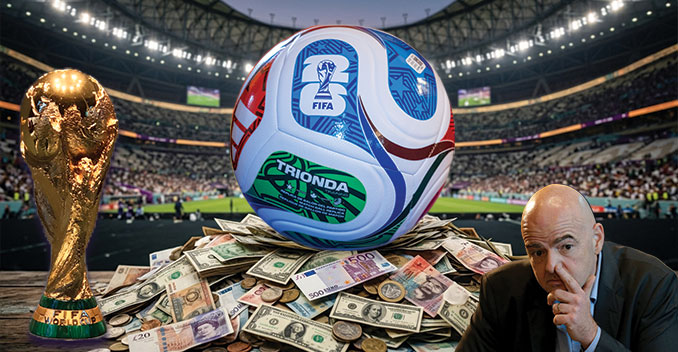
The corridors of international sports governance have long been fertile ground for the intoxicating allure of absolute authority. Power, when left unchecked, possesses a unique capacity to blind even the most calculating administrators to the institutional boundaries designed to keep them grounded. Across western democracies, the governance of global sport is frequently viewed through a prism of lofty ideals—fair play, democratic accountability and absolute transparency. Yet, when observed from a broader geopolitical standpoint, international sporting federations often function as sovereign entities unto themselves, balancing financial patronage with diplomatic leverage. The recent administrative tremors shaking Zurich reveal not merely a policy misstep, but an existential rift in how world football defines its soul, its ownership and its allegiance.
What began as a quiet administrative maneuver has escalated into a full-scale crisis for FIFA President Gianni Infantino. The institutional architecture of world football was designed to distribute influence across continents, offering an egalitarian counterweight to the economic dominance of Europe and South America. However, the centralisation of executive power has repeatedly tested the durability of these structural checks and balances. As western commentary quickens to condemn the centralisation of control, it is essential to appreciate the nuanced realities of global sports politics: for many developing member associations, cash injections represent tangible progress, whereas for established European hubs, privatised restructuring threatens the structural integrity of the global game.
The current controversy illuminates the delicate tightrope walked by FIFA’s leadership. When executive decision-making operates in shadow, bypassing established consultative frameworks, the democratic authority of the institution inevitably fracturing. Infantino now finds himself navigating a complex storm of domestic pushback, executive resignations and cross-confederation opposition. The balance between commercial expansion and sporting integrity has never been more precarious, raising fundamental questions about whether global institutions can withstand the magnetic pull of unaccountable influence.
The Architecture of Football’s Governing Body
Federation Internationale de Football Association (FIFA), founded in Paris in 1904, functions as a non-profit association registered under Swiss law, headquartered in Zurich. FIFA operates under a democratic umbrella comprising 211 national member associations. At its core, the governance structure is rooted in the FIFA Congress, an annual supreme legislative assembly where each member association possesses exactly one vote, regardless of economic clout, population size or national footballing pedigree. This “one association, one vote” model ensures that tiny island nations hold identical voting power to geopolitical heavyweights. Operational oversight between congresses is managed by the FIFA Council, a strategic body composed of 37 members elected by member associations across six regional confederations.
To safeguard its operations against corruption and improper influence, FIFA relies on statutory regulations, including an Independent Ethics Committee split into investigatory and adjudicatory chambers, robust audit and compliance committees and strict eligibility checks for senior officials. Meetings of the Congress take place annually, attended by delegates from all 211 member associations alongside confederation representatives, observers and international media. FIFA does not charge an annual membership fee indexed to a nation’s Gross Domestic Product (GDP); instead, the economic model is inverted. FIFA distributes funds to its members through programs like FIFA Forward, providing up to $1.25 million annually for operational running costs and $3 million per cycle for specific development projects.
Strategic Hierarchy and Confederation Balance
The administrative hierarchy of FIFA is led by the President, who serves as the public face and executive leader of the organisation, elected by the Congress for four-year terms. Positioned directly beneath the President is the Secretary General, who acts as the chief executive officer managing daily operations, supported by a Chief Operating Officer and various divisional directors spanning commercial, legal, compliance and tournament operations.
The global administration relies heavily on six regional confederations: UEFA in Europe, CONMEBOL in South America, CONCACAF in North and Central America and the Caribbean, CAF in Africa, the Asian Football Confederation (AFC) and the Oceania Football Confederation (OFC). While these confederations are autonomous entities that organise their own continental championships and club competitions, they work in tandem with FIFA. The confederations serve as regional power brokers, nominating candidates for the FIFA Council and coordinating voting blocs that frequently dictate the outcome of presidential elections and policy votes.
Jurisdictional Reach: From Grassroots to Domestic Leagues
A common misconception among the general public is that individual football clubs, professional players, referees and managers hold direct individual membership in FIFA. They do not. Membership is strictly limited to national governing bodies, such as the Football Association in England or the Brazilian Football Confederation. Players, coaches and clubs are affiliated with their respective national associations, which are in turn affiliated with FIFA.
Despite this indirect structural relationship, FIFA exerts immense authority over national and domestic football worldwide. Through the International Football Association Board (IFAB), FIFA regulates the official Laws of the Game, ensuring uniform application from local Sunday leagues to the World Cup final. Furthermore, FIFA enforces the Regulations on the Status and Transfer of Players, governing international transfers, registration windows, training compensation mechanisms and solidarity contributions. FIFA also maintains final disciplinary oversight, anti-doping regulations and international match calendar windows, compelling domestic professional leagues to release players for national team duties.
Commercial Powerhouse: Viewing Rights and Multi-Billion Revenue Streams
FIFA holds exclusive ownership over the broadcast, commercial and licensing rights for its international competitions, most notably the FIFA World Cup and the newly expanded FIFA Club World Cup. Regional continental tournaments like the Africa Cup of Nations fall under the commercial jurisdiction of their respective confederations (such as CAF), though FIFA collaborates on international calendar scheduling.
The financial scope of FIFA’s commercial operations is staggering. For the 2023–2026 World Cup cycle, total revenues are projected to reach $10.9 billion. Television broadcasting rights constitute the largest single revenue stream, projected to surpass $4.2 billion for the 2026 tournament hosted across Canada, Mexico and the United States. Sponsorship and licensing arrangements generate an additional $2.8 billion annually, with global corporate giants like Coca-Cola, Visa, Qatar Airways and adidas serving as primary commercial partners. Ticket sales and hospitality rights for the 2026 tournament were expected to yield up to $3 billion. The revenue from these contracts flows into FIFA’s central reserve before being redistributed globally to finance national team prize pools and grassroots development.
The $20 Billion Privatisation Crisis
The current crisis surrounding Gianni Infantino stems from a clandestine, last-minute initiative to privatise a significant stake in FIFA’s commercial operations. Reports surfaced revealing a proposal to spin off FIFA’s commercial businesses—encompassing future World Cups and Club World Cups—into a newly created $20 billion subsidiary dubbed FIFA Forward Enterprise (FFE). Under the proposed structure, a 20% equity stake would be sold to private equity investors for approximately $4.2 billion.
The prospective core investor group was led by Thrive Eternal, an investment firm directed by Joshua Kushner—brother to Jared Kushner, son-in-law to U.S. President Donald Trump. The secret nature of these negotiations, conducted without prior consultation across the FIFA Council, European football leaders or regional confederations, sparked widespread outrage. Critics viewed the move as an attempt to commercialise the fundamental governance of the world’s game, handing private financial entities leverage over global tournament structures and broadcast schedules.
Financial Incentives, Revolt and the Caribbean Stand
To secure rapid passage of the privatisation plan ahead of a September 19 deadline, FIFA member associations were offered an upfront cash payment of $20 million each, alongside a commitment to double their annual FIFA Forward operational stipend to $5 million. For financially strained associations across developing regions, where annual operating budgets are extremely modest, this sum represented a transformative windfall.
However, what was envisioned as a swift vote encountered significant political resistance. Despite the immense financial incentive, pushback emerged not only from wealthy European quarters but also across developing regions. Smaller footballing nations recognised that trading long-term institutional governance for short-term capital carried significant risk. Key governing bodies across the Americas and Asia publicly voiced serious concern over the process.
The Asian Football Confederation (AFC), CONCACAF and UEFA joined forces to formally condemn the lack of transparency, while Caribbean and South American delegates raised concerns over governance erosion.
The European Pushback and Boycott Threats
Strong economic federations within UEFA responded with swift, unequivocal condemnation. European football administrators categorised the handling of the privatised sell-off as “irresponsible and indefensible,” accusing FIFA leadership of attempting “governance by intimidation”.
The rift threatened to split global football entirely. Senior figures within UEFA openly discussed a total boycott of all FIFA-organised competitions, including future World Cups, if the privatisation plan moved forward. Given that European nations command the vast majority of commercial broadcast valuation and top-tier talent, a European boycott would have rendered any private equity venture commercially unviable.
Executive Resignations and Political Interference
Pressure on Gianni Infantino reached a boiling point as senior figures within his administrative circle distanced themselves from the proposal. Carlos Cordeiro, former Goldman Sachs banker and Infantino’s senior adviser who represented FIFA on the White House Task Force for the World Cup, publicly resigned. Cordeiro denounced the $20 billion venture as “a bad deal for football” and stated he was kept entirely in the dark. Simultaneously, FIFA Chief Operating Officer Kevin Lamour publicly stated that staff were “deceived” by Infantino’s lack of openness, describing the plan as “the project of one person”.
This administrative collapse followed lingering political scrutiny surrounding the 2026 World Cup. Concerns over institutional integrity had already erupted when a direct disciplinary intervention occurred regarding U.S. forward Folarin Balogun. After receiving a straight red card during the Round of 32 match against Bosnia and Herzegovina, Balogun was facing an automatic suspension for the Round of 16 tie against Belgium. Following a direct telephone call from U.S. President Donald Trump to Infantino, FIFA’s Disciplinary Committee applied Article 27 to place the suspension on hold under a one-year probation, allowing Balogun to play. The optics of executive interference, paired with secretive private equity dealings involving political families, severely undermined Infantino’s standing across the global game. Facing historic opposition, FIFA officially abandoned the $20 billion privatisation plan.
Echoes of the Past: The Shadow of Sepp Blatter
The current operational crisis inevitably invites comparisons to FIFA’s troubled history, most notably the tenure of Sepp Blatter, who served as FIFA President from 1998 until his downfall in 2015. Blatter’s reign ended amidst a massive corruption scandal exposed by the U.S. Department of Justice. In May 2015, federal indictments charged 14 high-ranking officials and sports executives with wire fraud, racketeering and money laundering involving over $150 million in bribes tied to media and marketing rights.
The structural vulnerabilities that enabled past corruption scandals remain a constant challenge for FIFA’s internal governance frameworks. It in part relates to having one person ultimately in charge.
Blatter was ultimately ousted following Swiss criminal investigations into a 2 million Swiss franc “disloyal payment” made to former UEFA President Michel Platini. The FIFA Ethics Committee found both men guilty of fiduciary breaches, resulting in multi-year bans from the sport. While Blatter and Platini were acquitted by a Swiss criminal court in 2022 on the basis of a verbal contract defence, the institutional fallout forced comprehensive structural reforms within FIFA. The recent secretive privatisation push suggests that systemic vulnerabilities surrounding executive authority remain persistent.
The Road Ahead: Safeguarding FIFA’s Integrity
The collapse of the $20 billion commercial sell-off demonstrates that checks and balances within global sports governance, though frequently strained, can still function when member associations unite. The quick mobilisation of confederations across continents proved that the commercialisation of football’s international crown jewels cannot be executed by executive decree.
As FIFA navigates the aftermath of this administrative rebellion, the imperative for genuine transparency, structural oversight and impartial leadership is clear. The sport belongs to billions of supporters, players and local communities worldwide. Ensuring that its governing body operates with accountability rather than opportunistic centralisation and control remains the fundamental challenge for the future of world football.
Summary of FIFA Governance Crisis
The table below outlines the structural components, key actors and outcome of the 2026 FIFA commercial privatisation controversy:
| Governance Category | Details & Specifications |
| Proposed Entity | FIFA Forward Enterprise (FFE) ($20 Billion Valuation) |
| Equity Stake Sale | 20% stake offered to private investors for $4.2 Billion |
| Lead Investor Group | Thrive Eternal (Led by Joshua Kushner) |
| Member Association Offer | $20 Million upfront payment + $5 Million annual stipend |
| Opposing Confederations | UEFA, CONCACAF, Asian Football Confederation (AFC) |
| Key Resignations / Rebukes | Senior Adviser Carlos Cordeiro (Resigned); COO Kevin Lamour |
| Final Resolution | Proposal officially abandoned by FIFA following global backlash |
Facing an unprecedented revolt from continental confederations, high-profile resignations within his inner circle and the existential threat of a European boycott, Gianni Infantino officially bowed to pressure and withdrew the controversial $20 billion FIFA Forward Enterprise proposal. In a formal statement conceding that the project had irreparably fractured the football community, Infantino acknowledged that the scheme had “created divisions of a nature that, regardless of the level of support, are no longer in the interest of the objective set out in the first place,” confirming unequivocally that the proposal would not proceed. The dramatic climbdown represents one of the most significant political setbacks of Infantino’s ten-year presidency, leaving the Swiss administrator’s authority severely diminished and his long-term position in question as member associations digest a week that brought global football governance to the brink of a historic schism.
Have Your Say
The boundary between commercial expansion and sporting governance remains one of the most hotly contested debates in modern athletics. Did the collective pushback against FIFA’s privatisation plan demonstrate the strength of global football democratic checks, or did it expose fundamental flaws in executive leadership?
If you were affected by or are interested in the subject, join the conversation or follow us on facebook, instagram, youtube, TikTok, LinkedIn and X/Twitter or why not submit your own article! Or email at contribute@criticalmatters.net.
Further reading
Facts
- May 27, 2015: U.S. Department of Justice unseals indictments against 14 FIFA officials and sports executives over $150 million in bribes.
- June 2, 2015: Sepp Blatter announces intention to resign as FIFA President following widespread corruption probes.
- May 11, 2026: ExploitGym cybersecurity benchmark released by researchers from UC Berkeley, Max Planck Institute, UC Santa Barbara and Arizona State University.
- July 19, 2026: 2026 FIFA World Cup Final held in East Rutherford, New Jersey, where Spain defeated Argentina.
- July 31, 2026: Senior FIFA Adviser Carlos Cordeiro resigns in protest over secret $20 billion privatisation deal.
- August 1, 2026: FIFA officially drops the proposed $20 billion FIFA Forward Enterprise investment plan following widespread global opposition.
Links
- Financial Times – FIFA abandons $20bn investment plan after global backlash
- CBS News – FIFA official resigns in protest over World Cup investment plan
- The Journal – Senior FIFA executive says staff were deceived over Infantino’s World Cup sell-off plan
- Sports Value – The 2026 FIFA World Cup will be the most lucrative in history
- FIFA – Revised Budget 2023-2026 Official Document

Be the first to comment