

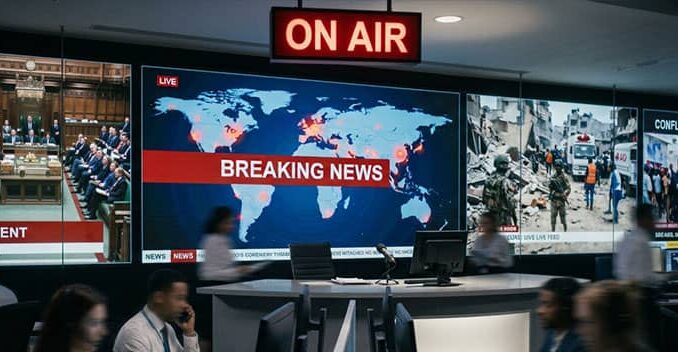
The rapid, relentless cadence of breaking news has again tested the global community’s apparatus for accountability, security and rule of law. What follows is an objective synthesis of major, fast-moving events—headlines with profound humanitarian, legal, and political ramifications—across the UK, the United States, Poland, and the Middle East. From the highest offices in Washington and the murky world of celebrity to the chaos of Port-au-Prince and Gaza, these diverse developments share an underlying tension: the struggle between established institutions and disruptive forces, and the resulting, often fragmented, pursuit of justice and order. Our broadcast provides the crucial, nuanced context, moving beyond the sensational to analyse the verifiable facts and the challenging questions they pose.
GLOBAL HEADLINES: A SYNOPSIS
- Accountability
- Legal Cases: Russel Brand, David Walliams
- Humanitarian
- Gaza Floods
- Political/Order
- Trump
Russell Brand and David Walliams: The Legal Front, and Celebrity Accountability in the Post-Me Too Era
In the United Kingdom, high-profile figures from the entertainment industry are navigating distinct legal challenges that raise profound questions regarding power, predatory behaviour, and the accountability mechanisms within celebrity culture, particularly around historic allegations and the protection of potential victims versus due process:
Russell Brand, long a disruptive figure, now faces the tangible, severe consequences of his actions following a conviction including one count of rape, which served him with a 10 year custodial sentence. This development isn’t just a verdict on an individual; it is a critical litmus test for justice systems handling sexual violence. Questions still remain for enablers and institutions who protect the “talent” and allow such behaviour to go unchecked, It forces a public reckoning with the systemic enabling of predatory behaviour and challenges institutions and audiences to accept that a person’s public work cannot insulate them from accountability. The zeitgeist that supported Russell Brand’s image as a counter-cultural, licentious ‘rebel’ is colliding with contemporary ethical standards regarding consent and the absolute abuse of power. The challenge now is to scrutinise how and why multiple institutions, globally, failed potential victims for decades, demonstrating that ‘rebellion’ can too easily mask exploitation. The conviction must catalyse a comprehensive review of safeguarding, rather than being treated as an isolated incident.
Simultaneously, the allegations against David Walliams are distinct in nature, primarily concerning alleged grooming and sexual relations with girls as young as 15. The distinction is crucial, demanding unique legal and investigative scrutiny regarding consent laws and child protection in the context of extreme power imbalances. However, a problematic overriding thread has emerged: Walliams’ reported successful application for an injunction to suppress information, seemingly predicated on a credible risk of suicide. While mental health is a genuine and serious issue, the broadcast standard must ask whether using the potential for self-harm to halt accountability processes is a legitimate legal shield, or if it constitutes another layer of institutional failure to address the ‘predatory actions’ and ‘abuse of position’ of powerful individuals. The ‘nuance’ requires protecting a person in crisis while also rigorously investigating serious allegations of harm to others, including minors. The question becomes: how can the state and media objectively and responsibly navigate both imperative duties?
Multinational Support, Krakow Shootings: Seeking Order amidst Crisis
Turning to Europe, the reporting on a recent shooting in Krakow, Poland, where one person was killed and another injured, requires a matter-of-fact tone. This rare, shocking act of violence, reportedly occurring at a bar near the bustling main square, immediately triggers significant local disruption and deep-seated fears about urban security, particularly given its historical and touristic significance. The primary journalistic challenge here is to report the verified facts without sensationalism, focusing on the official investigation, identifying the motives, and accurately contextualising the rare nature of such events within the city’s contemporary reality. This headline reminds us that even when focusing on massive global conflicts, smaller, isolated incidents profoundly shape the localised zeitgeist of safety and order for citizens and institutions alike.
Middle East Crisis: Gaza Flooding, and the Human Cost amidst Stalemate
The ongoing humanitarian catastrophe in Gaza has been compounded by environmental crisis, revealing a new dimension of vulnerability and demonstrating how natural events intersect with prolonged military conflict to exacerbate immense human suffering:
In Gaza, the recent severe flooding, particularly around areas like the Sheikh Radwan water reservoir and major streets in Gaza City, has become a literal breaking point for displaced populations already enduring catastrophic living conditions due to conflict. It is ignorance to view this only as a weather event; it is a failure to acknowledge how the deliberate or consequential destruction of civilian water, sanitation, and hygiene (WASH) infrastructure—including pumping stations and drainage networks—collapses a population’s resilience. According to visual reports and multiple local and international aid agencies, including the UN, the floodwaters are heavily contaminated with raw sewage due to wastewater system failures, creating a perfect incubator for deadly waterborne diseases. This is not merely a logistical problem; it is a critical violation of humanitarian standards. We must objectively state the facts from the ground while simultaneously challenging the operational reality: aid delivery is almost entirely obstructed, and international law mandates the protection of essential infrastructure. In a conflict defined by asymmetric urban warfare and a profound accountability vacuum, the question isn’t which environmental trigger caused the flood, but which combination of human decisions and military actions made the human toll so devastatingly preventable.
Transition in Washington: Miller Appointment, and Trump’s Shifting Posture
In the United States, breaking political news has focused on key staffing decisions for the next administration and a volatile communication strategy from Donald Trump that simultaneously signals a complex internal processing of defeat and a doubling-down on previous rhetoric:
Donald Trump’s recent comments conceding the ICE (Immigration and Customs Enforcement) was flawed, only to then reverse course and demand recounts, has exposed an unstable and reactive political position. This isn’t a simple strategy; it is a reflection of intense internal and external conflict as his team navigates both practical reality and his public image of invulnerability. While one side might see tactical flexibility, another interprets it as fundamental insincerity and a failure to commit to a coherent and objective approach. The journalistic duty is to report both the concession and the immediate retraction and to highlight the misconception that this signals a strategic pivot. Trump’s consistent overriding thread has always been to prioritise personal narratives and to keep all parties, including his base and opposition, strategically unmoored by constantly shifting positions. The demand for recounts, therefore, isn’t necessarily about a genuine belief in fraud but about maintaining control of the narrative and creating perpetual distraction from other substantial issues.
Simultaneously, the appointment of Stephen Miller, a long-term Trump advisor known for his hardline immigration and nationalist policies, as the potential new Chief of Staff, is a watershed development. Miller was the driving force behind many of the previous administration’s most aggressive immigration and border enforcement policies. This appointment, therefore, must be reported not just as a typical staffing change but as a definitive statement of intent, signalling that the central focus will be on radical policy implementation rather than pragmatic governance or bridging divides. We must ask challenging questions and challenge assumptions from all perspectives: does this create unified, efficient governance for Trump’s priorities, or does it signal inevitable and immediate legal, institutional, and international opposition that will hinder, rather than help, his second term, particularly on international policy where Miller’s domestic focus could clash with complex diplomatic realities?
Round up
In summary, these disparate developments, spanning five continents, are profoundly interconnected by three overriding, multifaceted threads. First, is the enduring, critical test of established global, legal, and state institutions—from the UK’s justice system, the US Electoral College and the Kenyan police, to international bodies like the UN and ICC—to uphold accountability for powerful individuals and states alike. Second, is the question of genuine sovereignty and order, highlighting the inherent limits of state control, the Gaza, and even within the localised space of a European city. Finally, the most pervasive theme is the unique, immense human vulnerability of the average citizen to forces entirely beyond their control—whether through predatory behaviour, natural disasters compounded by conflict, systemic gang violence, or unilateral, powerful political shifts. The broadcast must objectively acknowledge the distinct realities while simultaneously challenging the global governance structure, the lack of effective response, and the profound humanitarian and political failures that link these fragmented headlines.
Have Your Say
Which of these breaking stories—celebrity legal challenges, international interventions, political transitions, or the human-made dimension of natural disasters—do you find the most pressing in terms of long-term global stability?
From the UK’s accountability crisis for its public figures to the high-stakes implementation of hardline domestic policies in Washington, and the immediate humanitarian catastrophe unfolding in Gaza and how should the global community prioritise resources and political capital? Join the conversation or follow us on facebook, instagram, youtube, TikTok, LinkedIn and X/Twitter or submit your own analysis on a specific subject and email it to contribute@criticalmatters.net. We value diverse, fact-based perspectives on all current affairs and invite you to contribute to a deeper understanding of our multifaceted and fragmented world.
If you were affected by these subjects join the conversation or follow us on facebook, instagram, youtube, TikTok, LinkedIn and X/Twitter or why not submit your own article! Or email at contribute@criticalmatters.net
Facts & Analytical Context
- Gaza Flooding: The flooding has affected displaced populations. The critical point is that key infrastructure—like WASH facilities and pumping stations—has been damaged. According to the UN and humanitarian reports, this failure has led to widespread contamination with untreated sewage, increasing the immediate risk of waterborne diseases. International law requires parties to conflict to respect and protect objects indispensable to the survival of the civilian population.
- UK Legal Cases: We must strictly adhere to the matter-of-fact details of the legal processes and specific charges or allegations. For context, UK sexual offence laws regarding consent are codified primarily in the Sexual Offences Act 2003, emphasising that consent must be given freely and that extreme power imbalances are relevant to that determination.
- US Politics: Donald Trump’s communication regarding ICE and recounts represents contradictory public statements on matters of public policy and electoral integrity. The journalistic duty is to capture the complete public record, not to speculate on psychological states, but to analyze the impact of changing communication on the political process. Stephen Miller’s role in the previous administration is public record; any subsequent appointments would carry the weight of that operational and policy history.
Reference Links
- Kenyan National Police Service (Information regarding International Police Missions)
- World Health Organisation (WASH Infrastructure and Public Health in Gaza)
- UK Judicial Office (Guidance on Legal Reporting, Anonymity and Injunctions)
- UK Sexual Offences Act 2003 (Codification of Consent Law)
This broadcast provides a critical perspective on the multifaceted challenges facing our world, from high-level political transitions to the human-made dimensions of environmental disaster.


Be the first to comment