

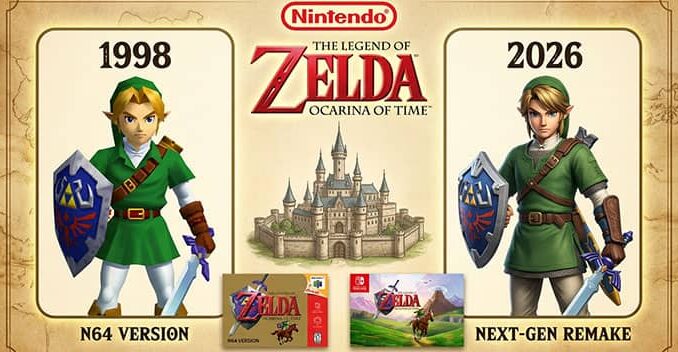
There is an exquisite poetry in how hardware architecture evolves to catch up with visionary software design. When Nintendo first shipped The Legend of Zelda on the Famicom Disk System back in 1986, Shigeru Miyamoto and his engineering cohort were working against punishing silicon constraints. Fast-forward nearly forty years, and the gaming landscape has transformed beyond recognition—shifting from crude 8-bit tile maps to sprawling, physics-driven sandboxes running on advanced system-on-chip architectures. Yet, through every generational leap, the DNA of Hyrule has remained an unyielding bedrock of interactive design.
With the release on Nov 5th 2026 of the remastered iteration of Ocarina of Time, we aren’t just looking at a nostalgic cash-grab; we are examining a masterclass in software porting, asset reconstruction, and systems engineering. And nearly 30 years on from the original (released 1998) For those of us who’ve been gaming for decades, watching Nintendo re-architect a true genre defining classic for the modern consoles is like shining a brighter light into a dim memory only to bring it back with more detail. This is a good thing! So Just how did the consoles evolve during that time. We’ve gone from the Famicom / NES in 1986 with 8-bit CPU, and 2KB RAM, right through to the 64bit Nintendo Switch 2 in 2025 with RAM: 12 GB LPDDR5X (9 GB available for games, 3 GB reserved for the system. And let’s not forget the Nintendo 64, released 1996 (30 years ago – wow) it had a tiny, RAM: 4 MB RDRAM (expandable to 8 MB with the Expansion Pack). That’s an almost unfathomable step change in that time.
Ideation and the Folklore and Hyrule
The Legend of Zelda didn’t just appear; it was forged from the childhood explorations of co-creator Shigeru Miyamoto (born 1952), who spent his youth wandering the dense forests, caves, and countryside surrounding Sonobe, Japan. Miyamoto and co-creator Takashi Tezuka (born 1960) channelled that raw sense of untamed discovery into a digital medium. The mythos borrows heavily from European folklore, Celtic mythology, and traditional heroic quest archetypes, fusing them into a cohesive digital whole.
For the uninitiated, the core dynamic centers on our protagonist, Link—the silent, green-clad swordsman embodying courage—and the perpetual antagonist, Ganon (or his human sorcerer form, Ganondorf), the embodiment of power. They are bound together across millennia by the Triforce, a sacred relic left behind by the golden goddesses. Alongside them, key recurring characters like Princess Zelda (wisdom) and fan-favourite supporting races such as the subterranean Gorons, the aquatic Zoras, the forest-dwelling Kokiri, and eccentric NPCs like Talon and Malon have become cultural touchstones across the global gaming community.
Decades of Innovation
The franchise has officially existed for over forty years, evolving from its 1986 origins into a multi-billion-dollar merchandising and entertainment behemoth. Zelda’s Nintendo’s official portfolio spans dozens of core console and handheld releases:
- The Legend of Zelda (1986 – Famicom/NES)
- Zelda II: The Adventure of Link (1987 – Famicom/NES)
- A Link to the Past (1991 – Super Famicom/SNES)
- Link’s Awakening (1993 – Game Boy)
- Ocarina of Time (1998 – Nintendo 64)
- Majora’s Mask (2000 – Nintendo 64)
- Oracle of Ages & Oracle of Seasons (2001 – Game Boy Color)
- The Wind Waker (2002 – Nintendo GameCube)
- Four Swords (2002 – Game Boy Advance)
- The Minish Cap (2004 – Game Boy Advance)
- Twilight Princess (2006 – GameCube/Wii)
- Phantom Hourglass (2007 – Nintendo DS)
- Spirit Tracks (2009 – Nintendo DS)
- Skyward Sword (2011 – Wii)
- A Link Between Worlds (2013 – Nintendo 3DS)
- Breath of the Wild (2017 – Nintendo Switch/Wii U)
- Tears of the Kingdom (2023 – Nintendo Switch)
Beyond software, Zelda operates as a massive merchandising engine. From trademarked apparel like hoodies and caps to replica collector mugs, keychains, and fully playable ceramic ocarinas, the intellectual property generates immense commercial turnover worldwide, proving that high-fantasy branding has virtually limitless consumer appeal. And there is an actual film coming out in April 2027 according to reliable sources. The cast features 2 UK actors in lead roles as well as Sam Neil (1947-2026).
Why Ocarina of Time Redefined 3D Space
When Ocarina of Time dropped on the Nintendo 64 in November 1998, it wasn’t just a game; it was a foundational text for three-dimensional game design. Directed by a multi-person team including Toru Osawa, Yoichi Yamada, Eiji Aonuma, and Yoshiaki Koizumi under Miyamoto’s supervision, the title solved the intractable problem of camera control and spatial combat in 3D.
Its introduction of Z-targeting (locking the camera and combat focus onto targets) was a stroke of engineering genius that countless developers subsequently copied. Targeted at young adults and core gamers alike, the title combined cinematic storytelling, environmental puzzle-solving, and atmospheric audio by composer Koji Kondo. It captured a fiercely loyal fanbase by respecting the player’s intelligence, treating exploration as an intellectual reward rather than a chore.
Backward Compatibility, and Sandbox Mechanics
Fast-forward to the contemporary hardware ecosystem. The newly remastered edition of Ocarina of Time arrives fully optimised for current-generation Nintendo hardware, leveraging high-level abstraction layers that make native backporting to older legacy architectures impossible due to severe memory and shader pipeline limitations.
While the original map retains its iconic labyrinthine structure, this modern version integrates mainly reimagines the detail and camera allows you to see more first person detail (the game is now approx 24gb) for example when walking up stairs. Other improvements include quality of life upgrades like a jump button, quick equip boots and faster swimming, diving and climbing. There are a few new puzzles as well.
More Tweaks
What else is lurking beneath the textures of this new remaster? Nintendo’s engineers have completely overhauled the graphics, moving away from fixed-function polygon rendering to modern physically based rendering (PBR) workflows, dynamic lighting, and real-time shadows. Running at a locked 60 frames per second, the game features modernised UI overlays, reduced load times via high-speed asset streaming, and refined inventory management.
Puzzles have received minor tuning to remove archaic friction points, and hidden easter eggs nod to decades of speedrunning culture and developer lore. The map has been retrofitted with high-resolution texture arrays, while spatial audio engines deliver fully dynamic orchestral arrangements of Koji Kondo’s timeless compositions.
From 93,000 Polygons to Teraflops
It is worth pausing to appreciate the sheer velocity of semiconductor evolution between the original Nintendo 64 release and today’s modern platforms. The original N64 operated on a 64-bit NEC VR4300 RISC processor clocked at 93.7 MHz, paired with a meager 4MB of Rambus DRAM (expandable to 8MB via the Expansion Pak). It pushed roughly 100,000 polygons per second.
Contrast that with modern gaming handhelds and consoles, which boast multi-core ARM or custom AMD Zen/RDNA system-on-chip architectures, unified memory pools exceeding 8 to 16 gigabytes, and compute capabilities measured in teraflops with hardware-accelerated ray tracing. Where programmers in 1998 had to squeeze every asset into strict cache limits and manual memory heaps, today’s hardware allows for breathtaking asset streaming and uncompressed audio fidelity—a staggering testament to Moore’s Law in action.
Release, Pricing, and Launch Cadence
The remastered edition is slated for a simultaneous global rollout, hitting shelves in the United Kingdom, Europe, North America, Japan, and Australasia. Priced competitively at standard modern AAA tiering (approximately £59.99 / $69.99), Nintendo is positioning the title as both a holiday tentpole and a technical showcase for their hardware capabilities. Pre-orders feature digital art books and classic soundtrack bundles, ensuring that the commercial rollout matches the immense cultural gravity of the franchise.
The Triumph of Hyrule Reborn
Ultimately, the resurgence of Ocarina of Time in a fully remastered form demonstrates that great software design outlives its native hardware. By marrying the peerless gameplay loops of 1998 with contemporary PBR pipelines, modern quality-of-life frameworks, and subtle physics-based mechanics, Nintendo has proven that innovation can be recursive, it can go back to move forward. We are witnessing a masterclass in how to respect gaming heritage while boldly embracing the compute power of the modern era.
Have Your Say
Does remastering Ocarina of Time represent a brilliant preservation of interactive art, or should industry resources be entirely funnelled into uncharted intellectual properties?
Join the conversation or follow us on facebook, instagram, youtube, TikTok, LinkedIn and X/Twitter or why not submit your own article! Or email at contribute@criticalmatters.net
Facts & Technical Context
- Original Release: The Legend of Zelda: Ocarina of Time was released on the Nintendo 64 in Japan on 21 November 1998, in North America on 23 November 1998, and in Europe on 11 December 1998.
- Key Creators: Developed by Nintendo EAD, directed by Toru Osawa, Yoichi Yamada, Eiji Aonuma, and Yoshiaki Koizumi; produced by Shigeru Miyamoto; music composed by Koji Kondo.
- Hardware Specifications (N64): NEC VR4300 CPU at 93.7 MHz, Reality Coprocessor GPU at 62.5 MHz, 4MB Rambus DRAM.
- Franchise Milestone: The Zelda franchise has spanned over 40 years since the original Famicom Disk System release in February 1986.


Be the first to comment