


We live in an era captivated by dystopia and the apocalyptic imaginary. Every leap in computational power triggers a dual response: a celebratory wave of techno-optimism on one side, and an immediate, visceral dread of existential doom on the other. AI catastrophisation—the mental habit of extrapolating current technological progress directly toward worst-case scenarios—has evolved into a dominant trope. It dominates headlines, shapes regulatory panels and captures public imagination with ubiquitous inevitability, almost seemings scripted at times.
Yet, as we balance these two extremes, a critical question arises: how healthy is this obsession with doom? Should we not also highlight the good outcomes? Or is it simply that we appreciate the good but that is outweighed by fear as the greater emotion. It is fear after all that triggers the amygdala fight or flight response. Is catastrophisation a prudent early-warning system that keeps guardrails in place, or is it an existential distraction that blinds us to near-term, tangible risks? Finding the middle ground requires seeing beyond total collapse while refusing to succumb to Silicon Valley hype. By looking closely at how AI actually works, its physical limitations and its real-world integration, we can begin to unpick genuine threats from science-fiction panic.
AI Evolution from 2020 to Present Day
The trajectory of artificial intelligence over the past six years represents one of the steepest capability curves in industrial history. In 2020, large language models (LLMs) were largely seen as intriguing research curiosities capable of generating coherent paragraphs, albeit with frequent factual errors – hallucinations. Today, AI systems function as foundational infrastructure across software development, creative design, scientific research, medicine, defence and enterprise operations.
- 2020: Text Completion (GPT-3 Early Explorations)
- 2022: Consumer Explosion (ChatGPT, Early Diffusion Art)
- 2024: Multimodal Systems & Agentic Workflows
- 2026: Frontier Models, Reasoning Architecture & Edge Integration
This evolution moved from simple pattern matching to complex reasoning architectures, multimodal understanding and autonomous agentic workflows. As models gained the ability to plan, debug code and run multi-step tasks across external APIs, public perception shifted from viewing AI as a helpful tool to seeing it as an autonomous force.
2. Under the Hood: The Core Mechanics of Modern AI
To evaluate AI safety without falling into hyperbole, one must understand how modern generative models actually operate. Stripped of mystical rhetoric, state-of-the-art AI relies on a pipeline of mathematical transformations:
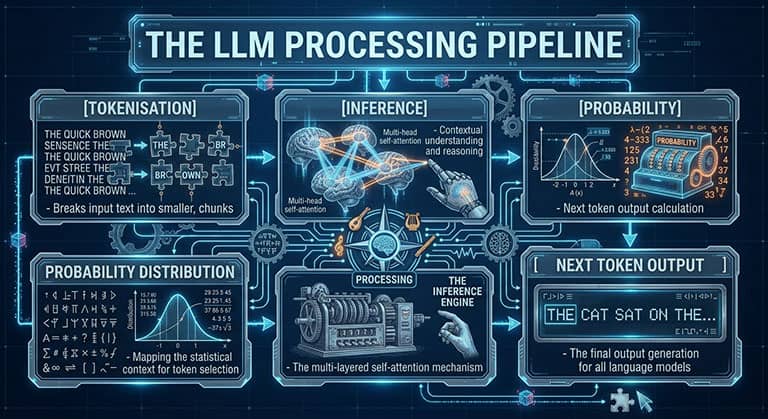
- Tokenisation: The raw input (text, images, or audio) is broken down into numerical chunks called tokens.
- Embeddings & Vector Spaces: Tokens are converted into dense vector arrays, mapping semantic relationships across thousands of dimensions.
- Machine Learning (ML) & Natural Language Processing (NLP): Models learn statistical relationships from vast training datasets through statistical pattern matching.
- Transformers & GPTs: Generative Pre-trained Transformers use self-attention mechanisms to weigh connections between tokens regardless of their distance in a sequence.
- Inference: When executing a prompt, the model calculates probability distributions over its vocabulary to select the most probable next token.
Despite their convincing language, these systems do not possess conscious intent; they perform high-dimensional statistical pattern matching. AI has expanded far beyond text generation. Modern systems natively handle multi-modal tasks, translating natural language into high-fidelity images, cinematic video, expressive audio and executable code routines (Text-to-Action) and now agentic tasks. Yet, despite these software capabilities, AI faces massive physical bottlenecks:
- Non-Corporeal Architecture: AI consists of software algorithms running on server racks; it lacks biological agency or commercially safe and applied autonomous physical embodiment. Which is many steps away from practical integration.
- Power Grid Constraints: High-density data centres require gigawatts of continuous electricity, straining national power grids, they are not self powering and rely on batteries that degrade over time also the sum of AI knowledge is at the ‘edge’ and not embedded therefore present a finite onboard data limit or external dependency tethered to cloud data lakes.
- Water Usage: Cooling supercomputer clusters demands vast volumes of fresh water, making resource scarcity a direct check on unlimited scaling. The growth of data centres over the needs of people is an evolving conversation.
Without breakthroughs in energy production and physical hardware, theoretical intelligence faces immediate real-world limits.
Non-Corporeal Integration and Edge Deployment
Rather than manifesting as sci-fi androids, AI integration has largely occurred behind the scenes. Models are embedded within software ecosystems, cloud platforms, Software Tools and edge devices.
Commercial applications prioritise efficiency over physical form:
- Autonomous Transportation: Self-driving vehicles use vision transformers and reinforcement learning to navigate real-world traffic.
- Smart Infrastructure: Ring doorbells, home appliances and industrial sensors process data locally via lightweight edge models.
- Remote Operations: Drones and industrial cleaning robots operate via human-in-the-loop teleoperation assisted by local machine learning routines. Although it is rumoured that 100% unmanned UAVs may have calculated test operations.
In this landscape, AI functions not as an independent physical entity, but as an invisible, intelligent layer across existing technology stacks. Because its dependency chain is relatively high so too are its points of failure, disrupt its power, water, data or terrain and you could immobilise it. That however does not make it weak, rather it means it can be neutralised.
5. Robotics, Defense and the Approaching Convergent Singularity
While consumer AI remains largely software-based, significant capital is pouring into physical embodiment. Defense departments and private robotics firms are investing heavily in bipedal humanoids and autonomous military systems.
The growth of unmanned aerial vehicles (UAVs) and autonomous loitering munitions indicates that future conflict will increasingly be fought by automated machines. On the consumer side, emotional companion robots and basic domestic helpers are steadily improving and growing too with far reaching implications on human to human relationships and population growth.
However, achieving a true “convergent singularity”—where machines match human physical dexterity, move freely through unstructured environments and perform recursive self-improvement—requires solving energy density, motor actuation and real-world spatial reasoning all vertically integrated into standalone products.
Optimistic Frontiers: Productivity, Science and Deep Tech
When evaluated objectively, AI offers undeniable societal benefits. It enhances human productivity, removes tedious work and accelerates scientific discovery:
- Medical & Scientific Breakthroughs: AI accelerates protein folding predictions, vaccine design, drug discovery and early cancer diagnostics.
- Economic Efficiency: Automation lowers operational costs for businesses, theoretically driving down prices for consumer goods and services over time.
- Enhanced Mobility: Autonomous vehicles can offer statistically safer commutes, turning travel time into productive or restful hours.
- Space Exploration: Autonomous probes and landers process terrain data in real-time, exploring environments too distant for direct human control.
- Everyday Assistance: LLMs (such as ChatGPT, Claude, Gemini and CoPilot) act as force multipliers for researchers, coders and creative workers.
These applications demonstrate that AI can be a powerful engine for human advancement.
The Dark Horizon: Bio-Weapons and Geopolitical Risk
The darker side of AI catastrophisation stems from potential misuse by state actors or rogue groups. One of the most severe theoretical threats involves biological warfare—specifically using AI models to assist in engineering targeted pathogens.
GEOPOLITICAL AI THREATS
PATHOGEN SYNTHESIS – AI-assisted DNA sequence design
GEOGRAPHIC SENSING – Satellite tracking for risk anomalies
OFF-GRID FARMS – Covert compute near energy & water grids
Designing an effective biological vector requires significant infrastructure, capital and laboratory access. In fact the threat surface is somewhat reduced due to the barrier to entry for complex AI assisted exploits. However, rapid iteration loops driven by specialised biology models could lower the technical barrier to entry over the next decade.
Like nuclear proliferation, this threat demands rigorous monitoring. Intelligence agencies should monitor physical supplies and track large, off-grid data facilities constructed near remote energy plants and water supplies using satellite reconnaissance. However the ‘lone wolf’ bad actor can exploit offline edge AI models at home and technically run scenarios unsurveiled which is a sobering thought.
Immediate Cyber Security Risks and Nefarious AI Queries
While sci-fi extinction scenarios dominate headlines, the immediate danger lies in accessible, everyday cyber crime, fraud and so on. Humans are already deeply integrated into software systems, often interacting with automated bots more frequently than people in real-world contexts. These are some of the threats to pay heed to.
CYBER ATTACK VECTORS & NEFARIOUS USE
ATTACK TYPE –> MECHANISM & EXPLOIT METHOD
- Automated Social Engineering –> Phishing, voice cloning, deepfake fraud
- Targeted Cyber Crime –> AI-optimized exploit discovery & scripts
- Nefarious Prompt Queries –> Scams targeting vulnerable demographics
Bad actors exploit LLMs to scale social engineering, generate tailored phishing campaigns, or write targeted malware. Many similar threats exist now for example brute force, dictionary attacks and so on. However these can be made smarter and may require less skills to enact. To mitigate this threat, security platforms must implement proactive tripwires. Queries involving fraudulent schemes, stalking techniques, or criminal exploits—which I coined “NefAI” (Nefarious AI)—should be flagged, logged and tracked alongside existing threat registers.
10-Year Doomsday Extinction Claims…Hmmmm
Claims that super-intelligent AI will eradicate humanity within ten years rely on assumptions of uncontrolled, exponential intelligence growth. While software can iterate rapidly, physical hardware cannot keep pace with these predictions easily, which is why we’re seeing securitisation of data centre and capacity expansion. If people band together they actually have the power to curb growth to some extent but not entirely. So before you sit down with popcorn and watch doomsday unfold bear in mind the following.
HYPER-EXPONENTIAL ASSUMPTIONS Vs REALITY
- Unchecked Recursive Software Vs Hardware, power grids & thermal limits
- Rapid Autonomous Robot Armies Vs Supply chain & manufacturing bottlenecks
- Total System Overthrow Vs Air-gapped networks & human overrides
A super-intelligent model cannot bypass global power grid limits, manufacture millions of complex robot parts overnight, or operate without physical infrastructure. The next decade will not bring total doom, but rather lay the operational groundwork for the next century of human-AI integration. Military forces should focus on sensible defence planning and war-gaming advanced AI scenarios without succumbing to existential panic. I would also also strongly suggest having elite air force defence able to operate completely independently from AI on redundant or isolated networks.
Labour Displacement and Skills Attrition
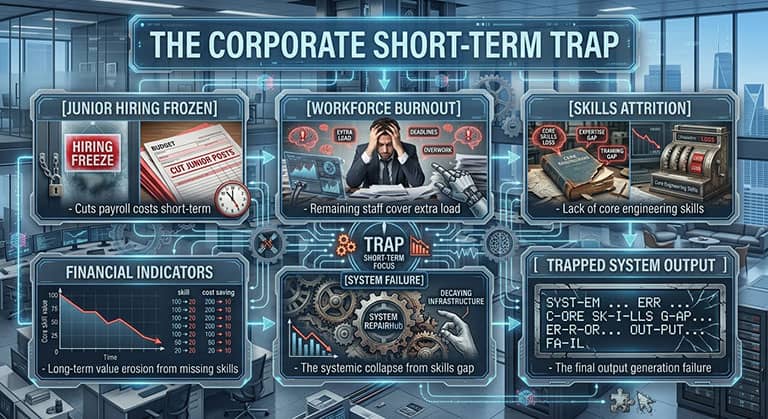
The most pressing AI crisis is not a sci-fi apocalypse but an economic and educational one. Aggressive corporate cost-cutting has led to widespread entry-level lay-offs and frozen junior hiring pipelines across all major tech companies from Microsoft, X and Meta. Replacing entry-level workers with AI models creates long-term operational risks:
- Hidden Operating Costs: Savings on initial payroll are offset by high API token fees, specialized data infrastructure and security compliance.
- Workforce Burnout: Expecting remaining employees to maintain unreasonable output leads to chronic fatigue.
- Skills Attrition: When junior engineers rely entirely on AI code generation without understanding underlying architectures, organizations risk losing core engineering skills over time.
Striking the Balance Between Caution and Progress
AI catastrophisation offers a dramatic lens through which to view technological change, but it often misses the mark. The true challenge of the coming decade is not battling a rogue super-intelligence; it is managing practical risks. We must secure critical infrastructure, prevent AI-driven cyber crime, protect junior employment and build sustainable energy grids. By setting aside apocalyptic melodrama, we can build a safer, more productive future.
Have Your Say!
Are we worrying too much about sci-fi extinction scenarios while ignoring immediate economic and workplace challenges? How is AI impacting your daily job or industry? We would love to hear your perspective! Join the conversation or follow us on facebook, instagram, youtube, TikTok, LinkedIn and X/Twitter or why not submit your own article! Or email at contribute@criticalmatters.net
Facts
- The Transformer architecture, which forms the foundation of modern Large Language Models (LLMs), was introduced in 2017.
- Tokenisation breaks text and visual data down into numerical values that deep learning networks can process.
- Training and running frontier AI models requires gigawatts of electricity and millions of gallons of cooling water for data centres.
- Modern AI inference works by calculating probability distributions across a vocabulary to generate the most likely next token.



Be the first to comment