

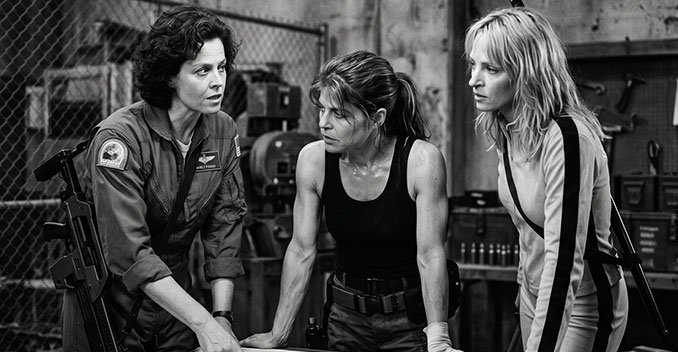
Right, let’s get into it. There’s a lazy conversation that’s been doing the rounds in film. The well-meaning but ultimately reductive chat about how we finally have strong female characters. It’s usually framed like this: before, Wonder Woman or Captain Marvel, women in cinema were just damsels waiting for a rescue, or objects purely for the male gaze typified by actresses like Marilyn Monroe. People nods sagely, everyone agrees this is a massive step forward.
Except… is it? As someone who’s practically memorised the IMDb entries for every major blockbuster released since, well, forever, I can safely tell you that this idea is steeped in pure myth.
Rewriting history isn’t useful for anyone. We see enough a retcon in movies so let’s not start altering debate to fit narratives we want to see. The idea that females continuing throughout cinema were always portrayed as helpless objects to be ogled at and rescued is a lazy truism steeped in myth. It ignores decades of creativity, foresight and incredible execution that gave us some of the most enduring icons, actresses and directors in entertainment history.
So, instead of just repeating a hackneyed narrative, let’s actually use some common sense and a bit of journalistic rigour. What we’ve actually witnessed is how attitudes change with time. Yes, women in older films were objectified—absolutely but definitely not entirely, let’s not withstand Joan Crawford’s Mildred Pierce (1945). But objectification and agency are not mutually exclusive. The general trope of female objectification no longer holds up, or rather, the pure male gaze is essentially redundant now. That doesn’t mean it didn’t exist, but it doesn’t mean it was the only thing. We were and are, complex enough to have both. The traditional male gaze is occupying space with prism of views consisting of many object cathexis’. Furthermore, it is possible to be objectified and have agency like Marilyn Monroe in Gentleman Prefer Blondes who was the director of her own life and ambition.
So, let’s stop pretending strong female leads are a modern achievement and the result of feminist disruption (with or without allies). Its not new and we’ve had female heroes running around since Alien in 1979 and The Terminator in 1984 and before. The core creative energy—that fierce, capable spirit—has always been there. We’re just finally talking about it now in a way that respects it, perhaps? Or perhaps a big enough echo chamber has reverberated on the subject. Let’s dive deeper into what this historical landscape really looks like.
Okay, let’s talk facts. If you think strong female characters are a recent invention, I need you to go and watch Alien (1979) and Aliens (1986). Sigourney Weaver as Ellen Ripley didn’t just survive; she became the ultimate action icon of the 80s. When she commands, “Get away from her, you BITCH!” to the Alien Queen in Aliens, it’s a defining moment of sheer capability, standalone grit and maternal fury all in one. She was smart, technically proficient and utterly terrifying. Where was the ogling? Where was the rescue? Spoiler: there wasn’t any. The studio (20th Century Fox) and director James Cameron absolutely foresaw that audiences wanted this type of protagonist and the creative spirit behind that choice was groundbreaking. Ironically, Sigourney stars in the Avatar Series, also directed by James Cameron! A winning combination.
Then you have Linda Hamilton’s Sarah Connor. If The Terminator (1984) saw her as a slightly overwhelmed target, her transformation in Terminator 2: Judgment Day (1991) was astonishing. She wasn’t saved by the Terminator; she used it. She was muscular, disciplined and focused solely on protecting her son ergo saving the literal world, not on being anyone’s romantic interest. Let’s not forget Kill Bill: Volume 1 (2003) and Volume 2 (2004), where Uma Thurman’s The Bride (Beatrix Kiddo) carved a bloody path of revenge that was neither dainty nor helpless. Jodie Foster’s Clarice Starling in The Silence of the Lambs (1991) won an Oscar because she was a brilliant, a capable agent navigating a terrifying world—she didn’t need to punch her way out to be a force of nature in a masculine dominated world of the FBI, she was the star asset a mixture of courage and brains.
And it wasn’t just movies! Buffy Summers from Buffy the Vampire Slayer (1997-2003) single-handedly turned the “blonde victim tripping while running away from monsters” trope on its head for an entire television generation. Laurie Strode in Halloween (Jamie Lee Curtis, 1978) was a quintessential ‘final girl’ not because she hid, but because she fought back, a theme that Neve Campbell’s Sidney Prescott carried triumphantly throughout the Scream franchise (1996–present). That’s three decades. We’ve more authors and more voices and even greater representation of female leads now. But that’s kind of always been the case.
Even in something as historically problematic as the Bond franchise, the characters have evolved. They went from being pure visual objects to intricate partners, agents and villains, culminating in characters like Michelle Yeoh’s Wai Lin in Tomorrow Never Dies (1997) or Naomie Harris’ Moneypenny or Lashana Lynch who played Nomi a fellow ’00’ agent just as effective as Bond himself. This proves that even within a traditional masculine canon, the vision for capable female characters has always existed. This history is crucial context; it’s the solid, creative spirit upon which modern success is built. However to write a Bond spin off about a female Bond would be a death knell. If people want greater representation they SHOULD write more original ideas with their desired lead as the protagonist. You can’t just retroactively insert your chosen demography or ethnicity into a role and expect it to work. This is shoehorning is quite frankly lazy, it does a disservice to the franchise, original creators, audience and also any talent brave or short sighted enough talent to sip from such a poisoned chalice. Essentially viewers don’t want movie casting to become weaponised by identity or representation politics.
It’s interesting, actually. Right now, there’s this fascinating cultural detournement happening. Instead of the helpless heroine, we have the ‘female saviour.’ It’s the dominant storyline in so many franchises, where the female lead is the cool, competent core and the men… well, the men are often painted as relatively one-dimensional supporting characters. The female lead is dominating a lot of story lines, which, on one hand, is incredible for creative spirit and representation. The execution is slick, the tech, production, CGI and tools used are top-tier.
The female saviour is leading in every situation surrounded by relatively incompetent men usually boyfriends, romantic interest or father in some low key supporting role. If its a Dad you can bet it show’s the father as the divorced partner that isn’t moving on or coping with the ex-wife who is generally doing great – its very one sided. Anyway, we’ll save that for another time. Let’s take a closer look at Scream (2022) and Scream 6 (2023), for instance. By the way, this franchise was always a female-led, meta-horror masterpiece with Neve Campbell (Sidney Prescott), Courteney Cox (Gale Weathers) and later Hayden Panettiere (Kirby Reed). The creative spirit behind that vision was incredibly strong from the start. Although we should note the male cast were generally the baddies and of course you had Dewey the relatively incompetent, bumbling, naive but likeable police officer who nevertheless became a fam favourite.
But the recent entries—the requels —focus heavily on the characters of Sam (Melissa Barrera) and Tara Carpenter (Jenna Ortega). And Scream 6 and the upcoming Scream 7 (2026) show them leading the charge against Ghostface. They are sharp, capable and they don’t need any of the men in the film, who often seem to be there mostly to make a poor romantic choice or just look kind of… confused. The franchise has always been about its incredibly capable final girls and that remains the fierce, core vision that keeps fans coming back. It also did not deter male viewers from watching.
The problem, though, is that this shift isn’t always well executed like in previous epics like Alien, Silence of the Lambs and so on. Sometimes, the direction is basic and not well thought out. Instead of creating brilliant female leads, studios seem content to just make the male characters around them buffoons or outright antagonists (the ‘douche bag’ guys, if you will). They also seek to subvert traditional canons. It’s a very common trope used to elevate the heroine and villianise men, but it often lacks artistic maturity or authenticity. We’re going from one stereotype to another and it can feel a bit repetitive and slightly masculine in its voice—like, “Aha! Look how nasty and stupid the boys and men are!”
You don’t have to look too far into the 2026 blockbuster landscape—yes, I’m talking about films that haven’t even been released yet, because this is a trend—to see this ‘one-dimensional bloke’ device in action. I’m looking at the list and it’s quite something. Notable examples of these prosaic, one dimensional or douche bag male casting include films like, Send Help, 2026 and The Housemaid 2026. In fact I’m going to keep a tally for every such film and do a write up next year.
In Jurrasic Park Rebirth (2026), you know the male cast will either be corrupt scientists, dumb muscle types or corporate rich guys, or completely oblivious while the female lead takes charge of the tactical team with perhaps one plucky subordinates. Also films like Primate, They Will Kill You, The Strangers —that’s just 2026! It’s the prevailing vision – but why? The dominant creative spirit driving production. And it’s so retrograde.
Do men care about this one-dimensional portrayal, or unrealistic representation? Generally not. It’s not a major point of discussion in the way that, say, female objectification was for decades. The audience for these blockbusters is often heavily engaged in just enjoying the culture and a good movie, they just want incredible action, explosive vision and a solid story. When the female saviour trope becomes unrealistic, it kind of gets repetitive. Like in these movies. It feels like a very lazy creative choice, an easy way to show that your heroine is brilliant and capable without actually, you know, writing complex characters. If everyone around you is a bumbling fool, or an emotionally unavailable douche bag, being the saviour isn’t exactly a massive achievement, is it?
And this brings us to the actual execution of this trend, the moment where the creative spirit collides with filming, cinematography, acting and so on. But where it gets a bit… boring, maybe, is when the action design leans so heavily into this reductive ‘female saviour’ trope that it completely ignores reality. We regularly see movies where petite women are one punching conventional strong guys. Or all women who are now all of a sudden cyber hackers and master minds. No one is saying that woman can’t be hackers or master minds however in reality this is not the case. I mean, aside from trinity which was handled realistically and well casted, I can’t remember the name of the female hacker in the FF franchise but it felt vapid and shoehorned in – but then again the FF franchise is not really all about depth – it’s about insane stunts and yes, family of course. Maybe a lot of women felt great from such depictions however all cinema goers do tend to prefer some levels of plausability. The execution might be stylish, the creative vision might be bold, but the common sense just goes right out the window. Now, I’m all for suspension of disbelief. It’s the entire point of going to see a blockbuster, isn’t it? But there are limits. There is a certain kind of knowing nod in watching a character like Black Widow (Scarlett Johansson) elegantly take down a dozens of bulky Hydra agents, using agility and technique. We accept it because the creative execution within the established world of the MCU is so strong.
But in other films—like some of the 2026 slate I was mentioning—the style is different. They seem determined to prove not just that the female is a saviour but moreover the males around her are fairly incapable. And when that happens, you lose the emotional core. It doesn’t celebrate a fierce, capable woman; it just creates an unrealistic, slightly cartoonish figure. It replaces complex storytelling with easy action beats. The original Alien’s Ellen Ripley was a strong, technical expert and she survived. The Bride in Kill Bill was a trained killer with a brilliant, single-minded vision. But this new style feels less about creative vision and more about checking a box. The action design should support the character’s unique capabilities, not ignore them in service of a trendy statement. Like the film says we need a woman saviour and that’s the starting point, not the actual story.
Let’s Stop Pretending
Look, however you think on this matter, next time you watch a movie, have a look and see what you think. Strong female characters have always existed in entertainment. The problem isn’t that they are new; the problem is that we’ve often failed to recognise the fierce, enduring creative spirit and vision that created them. They aren’t novel; I would like to think the reception has changed to allow the creation of new characters, franchises and universes. Let’s not be afraid and create something, especially to the Hollywood machine.
Final thoughts. Celebrating characters like Captain Marvel and Wonder Woman is incredible and we should do it! They are massive blockbusters that require incredible foresight and execution. But let’s do it in a way that respects the legends who came before them. Let’s respect Sigourney Weaver’s Ripley, Linda Hamilton’s Connor and even Neve Campbell’s Prescott, whose Scream franchise has always been about its strong, capable final girls and Scream 6 and Scream 7 in 2026 will no doubt continue that powerful, core creative vision. Not doing so can lead to a harsh drubbing at the Box Office, the latest Captain Marvel and Super Girl movies didn’t and are not doing so great.
Have Your Say
What do you think? Do we have stronger female leads now, or are we just recognising the incredible creative spirit that has always been there? Have we swung the pendulum too far in the opposite direction with incompetent male supporting characters? Join the conversation or follow us on facebook, instagram, youtube, TikTok, LinkedIn and X/Twitter or why not submit your own article! Or email at contribute@criticalmatters.net
More Facts and Links
Facts Section
- Alien: Released in May 1979 (USA). Directed by Ridley Scott. Starring Sigourney Weaver (Ellen Ripley). Global box office gross: $104.9 million (approx. $400 million adjusted for inflation). Produced by Brandywine Productions and released by 20th Century Fox.
- Aliens: Released in July 1986 (USA). Directed by James Cameron. Starring Sigourney Weaver (Ellen Ripley). Global box office gross: $131.1 million. Sigourney Weaver was nominated for an Academy Award for Best Actress for her role, which was unprecedented for an action-oriented female character in a science fiction film.
- Terminator 2: Judgment Day: Released in July 1991 (USA). Directed by James Cameron. Starring Linda Hamilton (Sarah Connor) and Arnold Schwarzenegger (Terminator). Global box office gross: $520.8 million, making it the highest-grossing film of that year.
- Kill Bill: Volume 1 & Volume 2: Released in October 2003 and April 2004 (USA), respectively. Directed by Quentin Tarantino. Starring Uma Thurman (Beatrix Kiddo/The Bride).
- The Silence of the Lambs: Released in February 1991 (USA). Directed by Jonathan Demme. Starring Jodie Foster (Clarice Starling) and Anthony Hopkins (Hannibal Lecter). The film won Oscars in all five major categories: Best Picture, Best Director, Best Actor, Best Actress and Best Adapted Screenplay. Jodie Foster’s portrayal of Clarice Starling remains a landmark for female capability in cinema.
- Buffy the Vampire Slayer (TV Series): Aired from March 1997 to May 2003. Created by Joss Whedon. Starring Sarah Michelle Gellar (Buffy Summers).
- Halloween: Released in October 1978 (USA). Directed by John Carpenter. Starring Jamie Lee Curtis (Laurie Strode). The film made Jamie Lee Curtis a major icon and defined the ‘final girl’ archetype.
- Scream: Franchise began with the original film in 1996, directed by Wes Craven (deceased 1939-2015). Starring Neve Campbell (Sidney Prescott), Courteney Cox (Gale Weathers) and David Arquette (Dewey Riley). Scream 6 was released in March 2023. Scream 7 is slated for a 2026 release.
- Bond Franchise Evolved Women: Characters such as Michelle Yeoh as Wai Lin in Tomorrow Never Dies (1997), Halle Berry as Jinx Johnson in Die Another Day (2002) and Naomie Harris as Moneypenny in Skyfall (2012) and subsequent films are recognised as having greater agency and capability than earlier “Bond girls.”
- Upcoming 2026 Releases: While specific casting and plot details can change during production, current announcements for the 2026 slate—including The Mummy 2026, The Housemaid 2026, Mortal Kombat 2026, Jurrasic Park Rebirth 2026, Primate, They Will Kill You, The Strangers and Send Help—do fit the described trend of female protagonists leading alongside one-dimensional supporting casts. Scream 7 is also currently scheduled for a 2026 release.
Header text
Links Section
- Alien IMDb Entry
- Aliens IMDb Entry
- Sigourney Weaver’s Oscar Nomination Fact
- The Silence of the Lambs IMDb Entry
- Jodie Foster’s Oscar Win for The Silence of the Lambs
- Terminator 2: Judgment Day IMDb Entry
- Kill Bill: Vol. 1 IMDb Entry
- Buffy the Vampire Slayer IMDb Entry
- Halloween (1978) IMDb Entry
- Scream (1996) IMDb Entry
- Scream (2022) IMDb Entry
- Scream 6 IMDb Entry
- Tomorrow Never Dies IMDb Entry
- Upcoming films scheduled for release in 2026 on IMDb


Be the first to comment