


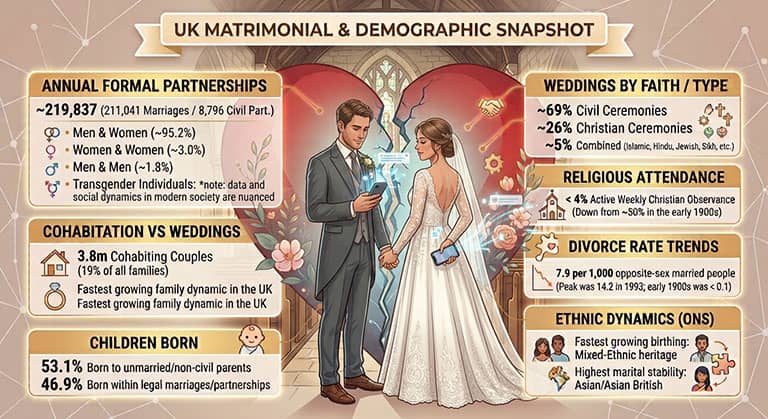
Love in twenty-first century Britain presents a fascinating paradox. Whilst traditionalists lament the decline of formal matrimony, the human desire for deep connection, intimacy and companionship remains as vibrant as ever. The modern landscape is not one of romantic despair, but rather one of profound transformation. We are redefining what it means to build a life together, stripping away societal obligation in pursuit of authentic, self-directed partnerships. The perspective or regression or progression depends on where you stand.
Modern British relationships operate nowadays more on choice rather than societal coercion or expectation. The decline in traditional weddings is matched by a surge in committed cohabitation, showing that commitment itself is not dying. It is simply taking on flexible, egalitarian shapes suited to the demands and freedoms of the modern era. However these changes are not without some real implications especially for children.
How Constant Connectivity erodes Commitment
The modern pocket holds a constant stream of novel interactions, notifications and algorithmic lures. This digital ecosystem creates an environment where sustained focus on a partner requires conscious effort. When friction arises in a relationship, the immediate gratification offered by digital media provides an effortless escape hatch.
This dynamic cultivates a “me-first” posture where individual convenience supersedes the patient, unglamorous labor of relationship maintenance. Cultivating a life together requires compromise, shared silence and working through difficult emotional terrain. When a culture prioritises immediate gratification and zero-friction convenience, the perseverance needed to sustain a lifelong partnership feels increasingly burdensome.
Microcheating, Parasocial Escape and Social Media Strain
Beyond simple distraction, digital platforms actively alter how intimacy is expressed and protected within modern marriages. Social media platforms, extra-marital sites and dating apps make boundary crossing easy to hide. Actions that once required deliberate effort now occur effortlessly through a direct message or a discreet profile.
Parasocial relationships, online communities and accessible adult content to cam sites and content creators like OnlyFans create implicit standards that real-world partners struggle to match. These digital channels provide an easy emotional exit when dynamic challenges arise at home. The resulting secrecy creates mistrust, turning subtle boundary violations into significant relational fractures.
Rising Expectations and Late-Life Splits
The middle-class ideal of the twentieth century—a modest semi-detached home, two children and a predictable routine—no longer satisfies many contemporary couples. Modern society encourages continuous personal growth and career achievement, reshaping what individuals expect from romantic partnerships.
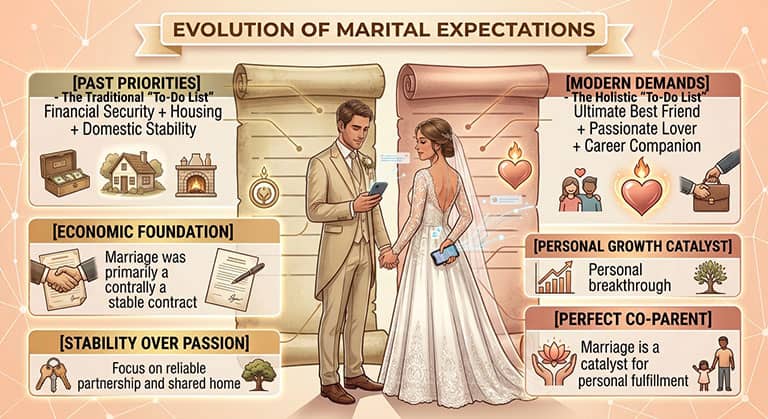
Couples today expect their partner to fill multiple complex roles simultaneously. While this high standard can foster deep connections, it also creates vulnerability. When a partner fails to meet these extensive needs, individuals increasingly choose to leave, seeking personal fulfilment elsewhere regardless of whether they are five or twenty-five years into a marriage and very often become unfulfilled in subsequent relationships.
The Impact of Career Growth on Partnership Timelines
The widespread availability of oral and implanted contraceptives, along with expanded legal and social equality, transformed female autonomy over the past sixty years. Women no longer depend on marriage for financial stability or social standing, enabling them to pursue higher education and professional careers on equal terms.
   1960s Traditional Path                     Modern Egalitarian Path
 +---------------------------+          +-------------------------+
 | Age 18-22: Marriage             |          | Age 18-25: Higher Ed    |
 | Age 20-25: Childbearing.    |          | Age 22-32: Career Growth|
 | Age 25+: Domestic Life        |          | Age 30-35+: Partnership |
 +---------------------------+          +-------------------------+
However, structural challenges persist within corporate environments. Workplace culture often struggles to accommodate pregnancy and early childcare without imposing career penalties. Consequently, many women delay long-term commitments or opt out of traditional family structures altogether to safeguard their professional trajectory.
Mobility and Independence: Education, Personal Growth and Overcoming Taboos
The expansion of university education and affordable student loans has reshaped transition milestones into adulthood. Leaving one’s hometown for university disrupts regional patterns, fostering independence and encouraging personal exploration during key developmental years at a time when many previous generations were settling down. Modern generations are out pursuing their dreams.
Without past social pressures surrounding pre-marital relationships, young adults feel comfortable deferring marriage. Dating serves as a period of personal discovery rather than a direct path to a wedding. As a result, formal marriage is viewed less as an essential threshold into adulthood and more as a potential capstone to be considered after achieving personal and financial stability.
Add to this, modern career paths frequently require geographical mobility, pulling individuals away from established family networks and tight-knit local communities. Living in large, fast-paced cities offers diverse opportunities, potential mates and novel experiences, but it can also reduce the traditional support systems that helped previous generations navigate marital stress.
In high-cost, fast-moving environments, long-term legal commitments can feel restrictive. Ambitions involving international relocations, late-night career demands and flexible lifestyles often conflict with the stability marriage requires, leading many to view early formal unions as a potential hindrance to personal progress.
Modern Uncertainty: Economic Pressures and Existential Anxiety
Younger generations navigate distinct socio-economic challenges, including elevated housing costs, wage stagnation and substantial student debt. The traditional milestones achieved by earlier generations, such as straightforward homeownership, require significantly greater financial resources today and are more and more difficult to attain.
Compounding these material pressures are broader existential concerns, from economic volatility to geopolitical tension and technological change. In an unpredictable economic environment, the financial and emotional commitment of marriage—and the cost of raising children—presents a barrier that leads many couples to delay or forgo these traditional milestones altogether, this needs to be urgently addressed.
Redefining Human Connection
The transformation of marriage in the twenty-first century reflects shifting priorities rather than a decline in human affection. As traditional obligations recede, modern relationships are built on shared values, clear communication and mutual consent and not binary trad roles. The reduction in social pressure allows couples to structure their lives intentionally, whether through formal marriage, civil partnerships or committed cohabitation.
Navigating this environment requires adaptability and strong digital boundaries. The modern challenge involves protecting physical presence amidst digital distractions, balancing individual aspirations with shared goals, and maintaining emotional connection through shifting economic conditions. The future of love belongs to those who view partnership, cohabiting and marriage not as a rigid social expectation, but as a dynamic, evolving collaboration built on mutual trust. However, marriage as an institution still provides the best foundation for growth as a family unit.
Have Your Say
The modern relationship landscape is evolving rapidly, raising important questions about the role of traditional marriage today. Are digital distractions actively undermining long-term commitments, or have elevated expectations simply made us less willing to settle for unfulfilling partnerships? Has economic uncertainty reshaped your personal timeline for buying a home, marrying or starting a family?
We invite you to share your thoughts, personal experiences and perspectives in the comments section below.
Join the Conversation
If you were affected by or are interested in the subject, join the conversation or follow us on facebook, instagram, youtube, TikTok, LinkedIn and X/Twitter or why not submit your own article! Or email at contribute@criticalmatters.net


Be the first to comment