

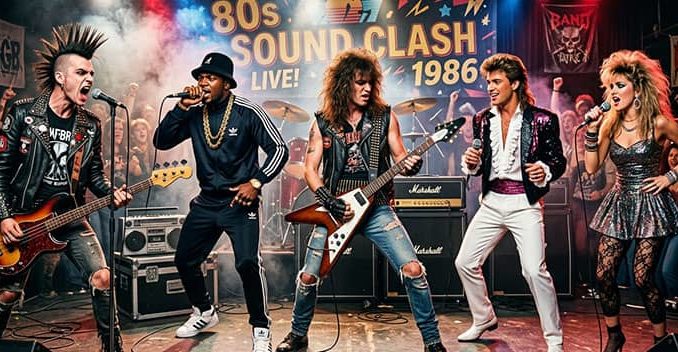
Music remains humanity’s most immediate medium of expression—an ephemeral tapestry constructed from tones, cultures, production, history, memory, emotion and sheer musical expression. Yet a persistent anxiety haunts contemporary cultural discourse and the latest charts: the lingering suspicion that we have breached the zenith of musical innovation. As musical formulas and production toolkits become increasingly modular, democratised and algorithmic delivery mechanisms govern our listening habits, one must ask whether the art form is collapsing under its own hyper-commercialised weight, or simply morphing into an entirely new paradigm – is this musical entropy hitting a final contrapuntal note?
How did our relationship with music begin? Long before formal composition existed, early hominids engaged with rhythm as an innate biological reflex. Whether derived from the cadence of flint knapping, the timber-splitting crack of early toolmaking, or a primitive attempt to imitate animals via early mimetic mystical or shamanistic ritualistic practices. These offered a primal glimpse into the musical expression and vocabulary before formal syntax began. Conventional wisdom suggests music gestated as an adjunct to early linguistic development—a sort of proto-speech designed to convey emotion, coordinate group labour, or simply alleviate the profound isolation of pre-historic existence.
Music evolves in lockstep with human ingenuity. Every generation alters the medium, refashioning techniques, performance styles, instruments, and technologies to reflect its immediate sociopolitical climate. The transition from oral folk traditions to hand crafted, mechanical, and subsequently digital, mediums of production, consumption and reception highlights a perpetual dialogue between technological capability and artistic intent. What is true of music is its universality, an old lute can still ignite the senses much the same as a full synth-guitar passed through multiple effect banks.
From Bone Flutes to Graphical User Interfaces and DAWs
The structural evolution of musical instruments represents one of humanity’s most understated material triumphs. From Palaeolithic bone flutes—such as the Divje Babe flute, crafted from a cave bear femur over 40,000 years ago—to the complex mechanical engineering of Renaissance harpsichords, the physical tools of music-making have continually pushed technological boundaries.
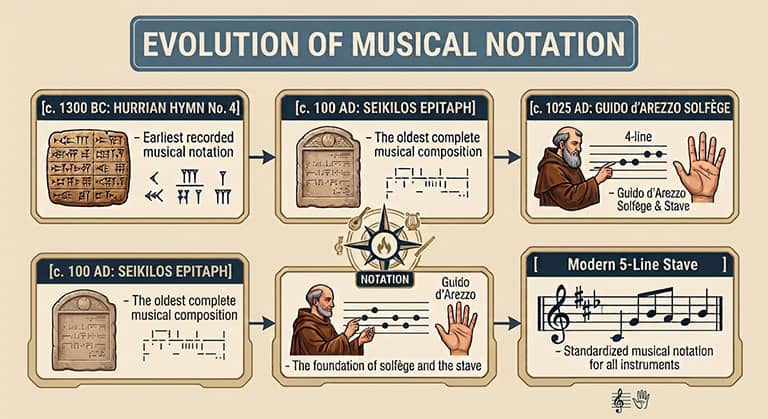
The notation of music altered the art form forever. Early iterations, such as the Hurrian Hymn No. 4 (c. 1400 BC) and the Ancient Greek Seikilos Epitaph (c. 1st–2nd Century AD), relied on primitive neumes or stone carvings. By the 11th century, Benedictine monk Guido d’Arezzo laid the groundwork for modern western musical notation with the introduction of four-line staves and solfège pitch organisation. This system eventually matured into the standardised five-line staves, clefs (treble, bass, alto), and strict bar lines we recognise today, allowing complex polyphonic ideas to be preserved, analysed and reproduced across centuries with exacting fidelity and now musical scores can be generated digitally with a prompt.
Mechanisation of Music
The advent of audio reproduction dissolved the requirement for music to be strictly acousmatic or tied to live, temporal events. Prior to playback technology, music was inherently diegetic—bound strictly to a specific physical room, time, and performer. The playback progression loosely looks like this: Music Boxes, Phonograph, Jukebox, Walkman, MP3 / Peer-to-Peer, Mobiles, Algorithmic Streaming & AI Algorithms.
Thomas Edison’s 1877 phonograph rendered sound repeatable and detached from physical presence, allowing listeners to experience soundscapes on demand. This shift transformed music from an ephemeral event into a commodity. As delivery platforms evolved from the public jukebox to the personal isolation of the Sony Walkman, digital compression formats like the MP3, and contemporary streaming services, listener agency changed dramatically. Today, predictive algorithms and generative artificial intelligence curate our emotional states, delivering automated playlists designed to optimize focus or manage mood. Not only did each generation shrink and allow us to listen to more variety to the point where we could theoretically listen to all the music ever created in our pockets.
The Hardware Timeline
The music playing devices shifted alongside media formats, dictating both the scale and nature of public engagement and consumption:
- 1877–1920s: Phonograph cylinders and 78 RPM shellac discs introduce mechanical home listening.
- 1930s–1950s: The commercial Jukebox democratises social listening in public spaces.
- 1979: The Sony Walkman (TPS-L2) detaches audio consumption from physical architecture, making music mobile.
- 1984: The Sony Discman (D-50) brings high-fidelity digital audio to the street via the Compact Disc.
- 1996: MiniDisc provides portable, re-writable digital storage, finding a niche market before mass digital adoption.
- 1999: MP3 Players and peer-to-peer file-sharing services (e.g., Napster) decouple recorded music from physical mediums entirely.
- 2001: The Apple iPod consolidates vast musical catalogs into a handheld device (“1,000 songs in your pocket”).
- 2008–Present: Cloud-based streaming infrastructure (Spotify, Apple Music) replaces ownership with access, mediated by data-driven recommendation algorithms.
Commercial Homogenisation
Back to the question, is music actively losing its depth, individuality, and uniqueness, or are we simply succumbing to the age-old cynical posturing of older generations dismissing the new? To declare all contemporary output inferior is reductive, yet empirical evidence suggests a shift in how commercial music is engineered and also a lesser timbre or texture.
The aggressive hyper-commercialisation of pop music has flattened distinct regional subgenres into streamlined, highly profitable templates designed for rapid mass consumption. Much like the modern cinematic landscape—dominated by recycled intellectual property, superhero franchises, and predictable narrative arcs—major record labels minimize risk by funding proven formulas.
Yet, parallel to this mainstream homogenisation, independent, non-commercial, and art-house music continues to thrive in digital subcultures, occasionally crossing over to reshape the mainstream canon. So its true to say that while commercial music dominates the soundscape, there’s always indie, grass roots music that eventually the commercial machine catches onto that eventually feeds back into the machine.
The Ghost in the Machine: Production and Formulaic Flattening
The perceived loss of sonorous texture and lyrical depth in pop music is not merely an optical illusion. Academic investigations—such as the landmark 2012 study conducted by the Spanish National Research Council—analysed over 500,000 recordings across five decades and confirmed a measurable decrease in timbral variety and harmonic diversity alongside a rise in average loudness (the “Loudness War”).
This dynamic is reinforced by the industry’s reliance on centralised writing and production teams. Or hit-factories, in some cases even a single song writer penning hits for multiple artists in the case of Max Martin who’s written hits for Brittney Spears, The Backstreet Boys, Ariana Grande, The Weekend, Taylor Swift, Katy Perry and others. This enables a small network of hitmakers who frequently craft tracks for dozens of top-charting artists across diverse genres, leading to structural uniformity.
Modern digital means of production directly influence musical composition. Sound engineers and producers operating across genres—whether crafting drill, mumble rap, contemporary K-pop, Country or pop-punk—rely on identical Digital Audio Workstations (DAWs) like Pro Tools, Ableton Live, Logic Pro, Cubase and FL Studio.
When producers utilise the same third-party virtual instruments, stock drum kits, auto-tune plugins, and grid-based quantisation tools, structural similarities naturally emerge. Freelance session musicians, sound designers, and mixing engineers cycle through the same talent pool, further blurring the aesthetic boundaries between nominally distinct genres.
From Feudal Courts to Tech Monopolies
Before critiquing contemporary commercialisation, one must recognise that music has rarely existed in a vacuum. Historical compositions were frequently tied to patron funding:
- Medieval Era: Wandering troubadours and minstrels depended on local nobles and village leaders for room and board.
- Renaissance & Baroque Eras: The Catholic Church and European aristocratic courts funded major liturgical and secular works.
- Classical & Romantic Eras: Royalty and wealthy private patrons commissioned symphonies, operas, and chamber music from composers like Mozart and Beethoven.
- Modern Era: Global media conglomerates, venture-backed streaming platforms, and brand sponsorships serve as the primary financial ecosystem for artists.
The key difference lies in scale. Where historic patronage supported local elites or specific institutions, modern digital infrastructure reaches billions of global listeners simultaneously, vastly amplifying the financial incentives for mass-market appeal and subsequently profits.
The Quest for Purity in Sound
Art made purely for self-expression often carries an authenticity that highly commercial projects struggle to replicate. This explains the enduring appeal of early field recordings, bootlegs, demo tapes, and unpolished studio outtakes.
When creative output is detached from immediate market pressures, it retains a distinct ‘authentic’ raw quality. Ironically, modern commercial media frequently searches for this exact authenticity, licensing independent music to grant films, ad campaigns, and television projects a sense of grounded realism. Art generated without a commercial audience in mind often possesses an unvarnished purity that hyper-sanitised and curated pop productions cannot easily fake.
The infrastructure of pop culture—comprising charts, celebrity scandals, music video channels, and algorithmic feeds—has generated distinct youth subcultures and online fandoms. Social media platforms like TikTok, X (formerly Twitter), and Instagram foster parasocial relationships, transforming casual listeners into organised fan communities. This can often become tribal and adversarial and lead to online bullying or even IRL altercations.
Ironically each generation tends to view its own youth culture as a definitive peak, dismissing subsequent movements as derivative while romanticising the eras that came before. Despite these cyclical debates, inventive compositions and compelling sonic ideas continue to emerge as long as artists have access to tools and a platform.
Nostalgia and the Allure of the 1980s
Contemporary pop culture exhibits a persistent fascination with the 1980s, treating the decade as a golden age of musical innovation. This period represented a pivotal intersection where analogue songwriting collided with groundbreaking digital technology. Below we’ll include some of the greatest hits of the decade and artists and you can see the influence in our culture today in many shows typified in the Netflix hit show, Stranger Things and Kate Bush’s ‘Running Up That Hill’ which topped the charts again decades after its original release.
The 1980s witnessed the widespread introduction of synthesizers, digital sampling (e.g., Fairlight CMI, E-mu Emulator), programmable drum machines (LinnLM-1, Roland TR-808), and MTV’s music video infrastructure. Larger-than-life icons like Michael Jackson, Prince, David Bowie, and Kate Bush redefined public persona alongside the rapid rise of hip-hop’s Run DMC, NWA, heavy metal Metallica, Iron Maiden and more, synth-pop, and new wave. This era established the templates for pop stardom, visual branding, and production techniques that continue to influence contemporary artists today. There were many other subcultures including Ska, New Romantics and their own acolytes.
Chronological Canon: Decades of Cultural & Sonic Milestones
Plug in, turn up the volume, and explore the definitive tracks of the 80s an era of cultural shifting and creative evolution. Full licensed lyrics for all tracks can be found via a quick search on Google or dedicated lyrics databases.
3. The 1980s: The Synth Era and MTV Paradigms
1980s – [Click to Expand]
The 1980s were defined by synthesizers, gated-reverb drum sounds, music video aesthetics, and the emergence of hip-hop as a dominant cultural force.
“Billie Jean” – Michael Jackson (1982)
- Creator: Michael Jackson (August 29, 1958 – June 25, 2009)
- Style/Genre: Post-Disco / Funk / Synth-Pop
- Album: Thriller
- Inspiration & Meaning: Based on obsessive fan letters Jackson received claiming he had fathered one of their children.
- Standout Stanza:“Billie Jean is not my lover / She’s just a girl who claims that I am the one / But the kid is not my son”
- Trivia Point 1: Producer Quincy Jones disliked the iconic intro bassline and thought the title should be changed to “Not My Lover” to avoid confusion with tennis star Billie Jean King.
- Trivia Point 2: Jackson debuted his famous Moonwalk dance during a televised performance of “Billie Jean” on Motown 25: Yesterday, Today, Forever.
“Like a Virgin” – Madonna (1984)
- Creator: Billy Steinberg (b. February 26, 1950) & Tom Kelly
- Style/Genre: Dance-Pop / Synth-Pop
- Album: Like a Virgin
- Inspiration & Meaning: Written by Steinberg about overcoming romantic disillusionment and feeling emotionally renewed by a new relationship.
- Standout Stanza:“Like a virgin / Touched for the very first time / Like a virgin / When your heart beats next to mine”
- Trivia Point 1: Nile Rodgers produced the track, initially feeling the main bass synth hook was too simple before realizing its pop appeal.
- Trivia Point 2: Madonna’s performance of the track on the 1984 MTV Video Music Awards in a wedding dress atop a wedding cake sparked widespread media coverage.
“Purple Rain” – Prince (1984)
- Creator: Prince (June 7, 1958 – April 21, 2016)
- Style/Genre: Power Ballad / Gospel / Rock
- Album: Purple Rain
- Inspiration & Meaning: Combines gospel elements with rock soloing, explaining the concept of the end of the world accompanied by divine guidance.
- Standout Stanza:“I never meant to cause you any sorrow / I never meant to cause you any pain / I only wanted to one time see you laughing / I only wanted to see you laughing in the purple rain”
- Trivia Point 1: The track was recorded live during a benefit concert at First Avenue club in Minneapolis in August 1983.
- Trivia Point 2: Prince originally wrote the song as a country duet intended for Stevie Nicks, who turned it down because she felt overwhelmed by the arrangement.
“Sweet Child O’ Mine” – Guns N’ Roses (1987)
- Creator: Axl Rose (b. February 6, 1962), Slash (b. July 23, 1965), Izzy Stradlin (b. April 8, 1962), Duff McKagan (b. February 5, 1964), Steven Adler (b. January 22, 1965)
- Style/Genre: Hard Rock
- Album: Appetite for Destruction
- Inspiration & Meaning: Axl Rose wrote the lyrics as a poem for his girlfriend Erin Everly, set against Slash’s guitar exercises.
- Standout Stanza:“She’s got a smile that it seems to me / Reminds me of childhood memories / Where everything was as fresh as the bright blue sky”
- Trivia Point 1: Slash originally dismissed his famous opening riff as a joke “circus” exercise before the band developed it into a song structure.
- Trivia Point 2: The “Where do we go now?” vocal bridge arose literally because Axl Rose didn’t know how to conclude the verse section during rehearsals.
“Don’t Stop Believin'” – Journey (1981)
- Creator: Jonathan Cain (b. February 26, 1950), Steve Perry (b. January 22, 1949), Neal Schon (b. February 27, 1954)
- Style/Genre: Arena Rock / Synth Rock
- Album: Escape
- Inspiration & Meaning: Inspired by keyboardist Jonathan Cain’s struggles as a musician in Sunset Boulevard, urging listeners not to give up on their goals.
- Standout Stanza:“Just a small town girl, livin’ in a lonely world / She took the midnight train goin’ anywhere / Just a city boy, born and raised in South Detroit / He took the midnight train goin’ anywhere”
- Trivia Point 1: “South Detroit” is a geographically inaccurate term—south of Detroit lies the Canadian city of Windsor, Ontario—which Steve Perry chose because it sounded poetic.
- Trivia Point 2: The song does not feature its actual chorus until the final 50 seconds of the track.
“Livin’ on a Prayer” – Bon Jovi (1986)
- Creator: Jon Bon Jovi (b. March 2, 1962), Richie Sambora (b. July 11, 1959), Desmond Child (b. October 28, 1953)
- Style/Genre: Glam Metal / Arena Rock
- Album: Slippery When Wet
- Inspiration & Meaning: Follows working-class couple Tommy and Gina as they navigate economic hardship during the Reagan era in the United States.
- Standout Stanza:“We’ve got to hold on to what we’ve got / It doesn’t make a difference if we make it or not / We’ve got each other and that’s a lot for love / We’ll give it a shot / Woah, we’re half way there / Woah, livin’ on a prayer”
- Trivia Point 1: Jon Bon Jovi originally didn’t like the track and omitted it from the initial album tracklist until Richie Sambora persuaded him to re-record it.
- Trivia Point 2: Richie Sambora utilized a Heil Talkbox on his guitar to generate the signature “ooh-wah” riff.
“With or Without You” – U2 (1987)
- Creator: Bono (b. May 10, 1960), The Edge (b. August 8, 1961), Adam Clayton (b. March 13, 1960), Larry Mullen Jr. (b. October 31, 1961)
- Style/Genre: Post-Punk / Arena Rock
- Album: The Joshua Tree
- Inspiration & Meaning: Explores Bono’s feelings of duality between his settled domestic life and his touring artist persona.
- Standout Stanza:“See the stone set in your eyes / See the thorn twist in your side / I’ll wait for you / Sleight of hand and twist of fate / On a bed of nails she makes me wait / And I wait, without you”
- Trivia Point 1: Features The Edge playing the Infinite Guitar, a custom guitar designed by Michael Brook allowing sustained note feedback.
- Trivia Point 2: The band considered dropping the song from The Joshua Tree until producer Brian Eno saved the arrangement.
“Blue Monday” – New Order (1983)
- Creator: Bernard Sumner (b. January 4, 1956), Peter Hook (b. February 13, 1956), Stephen Morris (b. October 28, 1957), Gillian Gilbert (b. January 27, 1961)
- Style/Genre: Synth-Pop / Electronic / Dance-Rock
- Album: Released as a standalone 12-inch single
- Inspiration & Meaning: Formed from the grief following the death of Joy Division frontman Ian Curtis, blending club dance rhythms with post-punk songwriting.
- Standout Stanza:“How does it feel to treat me like you do? / When you’ve laid your hands upon me and you told me who I am? / I thought I was mistaken, I thought I heard you speak / Tell me how do I feel”
- Trivia Point 1: The 12-inch sleeve, designed by Peter Saville to resemble a floppy disk, was so expensive to manufacture that Factory Records lost money on early copies.
- Trivia Point 2: The stuttering kick-drum intro was programmed using an Oberheim DMX drum machine, hand-coded via hexadecimal numbers.
“Take On Me” – A-ha (1984)
- Creator: Pål Waaktaar (b. September 6, 1961), Magne Furuholmen (b. November 1, 1962), Morten Harket (b. March 6, 1959)
- Style/Genre: Synth-Pop
- Album: Hunting High and Low
- Inspiration & Meaning: An uptempo pop romance track built around keyboard hooks and Morten Harket’s falsetto vocal range.
- Standout Stanza:“We’re talking away / I don’t know what I’m to say / I’ll say it anyway / Today’s another day to find you / Shying away / I’ll be coming for your love, okay?”
- Trivia Point 1: The song failed on two initial single releases before being remixed and paired with its pencil-sketch rotoscope music video.
- Trivia Point 2: Morten Harket hits a falsetto high E note (E5) during the chorus bridge.
“Every Breath You Take” – The Police (1983)
- Creator: Sting (b. October 2, 1951)
- Style/Genre: New Wave / Soft Rock
- Album: Synchronicity
- Inspiration & Meaning: Written by Sting following his separation from Frances Tomelty, often mistaken for a love song despite lyrics focusing on surveillance and obsession.
- Standout Stanza:“Every breath you take / And every move you make / Every bond you break, every step you take / I’ll be watching you”
- Trivia Point 1: Sting wrote the lyrics at Ian Fleming’s Goldeneye estate in Jamaica on the same typewriter Fleming used for James Bond novels.
- Trivia Point 2: Guitarist Andy Summers created the guitar line in a single take, inspired by Béla Bartók’s violin exercises.
“Thriller” – Michael Jackson (1982)
- Creator: Rod Temperton (October 9, 1948 – October 5, 2016)
- Style/Genre: Synth-Pop / Funk / Disco
- Album: Thriller
- Inspiration & Meaning: Homage to 1950s horror movies, crafted by Heatwave songwriter Rod Temperton.
- Standout Stanza:“It’s close to midnight / And something evil’s lurking in the dark / Under the moonlight / You see a sight that almost stops your heart”
- Trivia Point 1: The original working title for the song was “Starlight.”
- Trivia Point 2: Horror icon Vincent Price recorded his spoken-word voiceover in two takes at the studio.
“Back in Black” – AC/DC (1980)
- Creator: Angus Young (b. March 31, 1955), Malcolm Young (January 6, 1953 – November 18, 2017), Brian Johnson (b. October 5, 1947)
- Style/Genre: Hard Rock / Heavy Metal
- Album: Back in Black
- Inspiration & Meaning: Written as a tribute to former lead singer Bon Scott, who died in February 1980, serving as a celebration of his life.
- Standout Stanza:“Back in black, I hit the sack / I’ve been too long, I’m glad to be back / Yes, I’m let loose from the noose / That’s kept me hanging about”
- Trivia Point 1: The album cover was made entirely black out of mourning for Bon Scott.
- Trivia Point 2: The opening guitar riff was constructed by Malcolm Young while practicing in studio dressing rooms.
“Girls Just Want to Have Fun” – Cyndi Lauper (1983)
- Creator: Robert Hazard (August 21, 1948 – August 5, 2008), rewritten by Cyndi Lauper (b. June 22, 1953)
- Style/Genre: Synth-Pop / New Wave
- Album: She’s So Unusual
- Inspiration & Meaning: Originally written from a male perspective by Robert Hazard, Lauper modified lyrics to turn it into a feminist pop anthem.
- Standout Stanza:“Some boys take a beautiful girl / And hide her away from the rest of the world / I wanna be the one to walk in the sun / Oh girls just wanna have fun”
- Trivia Point 1: Lauper cast her actual mother, Catrine, to play her mother in the low-budget music video.
- Trivia Point 2: Professional wrestler Captain Lou Albano played Lauper’s father in the iconic video.
“Under Pressure” – Queen & David Bowie (1981)
- Creator: Freddie Mercury (September 5, 1946 – November 24, 1991), Brian May (b. July 19, 1947), Roger Taylor (b. July 26, 1949), John Deacon (b. August 19, 1951), David Bowie (January 8, 1947 – January 10, 2016)
- Style/Genre: Rock / Art Rock
- Album: Hot Space
- Inspiration & Meaning: Born from an impromptu jam session at Mountain Studios in Montreux, Switzerland, tackling themes of societal stress.
- Standout Stanza:“Pressure pushing down on me / Pressing down on you, no man ask for / Under pressure that burns a building down / Splits a family in two / Puts people on streets”
- Trivia Point 1: John Deacon created the two-note bassline, but briefly forgot it after the band went out for pizza, requiring Bowie to remind him.
- Trivia Point 2: Vanilla Ice sampled the bassline for his 1990 rap hit “Ice Ice Baby,” leading to a copyright settlement.
“Running Up That Hill” – Kate Bush (1985)
- Creator: Kate Bush (b. July 30, 1958)
- Style/Genre: Art Pop / Synth-Pop
- Album: Hounds of Love
- Inspiration & Meaning: Examines the empathy gap between men and women, proposing a pact with God to swap gender roles to foster mutual understanding.
- Standout Stanza:“And if I only could / I’d make a deal with God / And I’d get him to swap our places / Be running up that road / Be running up that hill”
- Trivia Point 1: Originally titled “A Deal with God,” EMI changed the title to avoid potential radio bans in religious markets.
- Trivia Point 2: The song experienced a resurgence in 2022 after being featured in Netflix’s Stranger Things, topping the UK Singles Chart 37 years after its release.
“Fight the Power” – Public Enemy (1989)
- Creator: Carlton Ridenhour (Chuck D, b. August 1, 1960), Eric Sadler, Hank Shocklee (b. 1953), Keith Shocklee
- Style/Genre: East Coast Hip-Hop / Political Rap
- Album: Fear of a Black Planet (Commissioned for Spike Lee’s Do the Right Thing)
- Inspiration & Meaning: Commissioned by director Spike Lee for his 1989 film, delivering a critique of institutional racism and traditional cultural icons.
- Standout Stanza:“Elvis was a hero to most / But he never meant shit to me you see / Straight up racist that sucker was / Simple and plain”
- Trivia Point 1: Built on layers of samples engineered by The Bomb Squad, including James Brown, Sly & the Family Stone, and the Isley Brothers.
- Trivia Point 2: The music video was filmed in Brooklyn as a staged political rally.
“Careless Whisper” – George Michael (1984)
- Creator: George Michael (June 25, 1963 – December 25, 2016) & Andrew Ridgeley (b. January 26, 1963)
- Style/Genre: Pop / Soul Ballad
- Album: Make It Big
- Inspiration & Meaning: Written by George Michael at age 17 on a bus ride, detailing remorse and infidelity.
- Standout Stanza:“I’m never gonna dance again / Guilty feet have got no rhythm / Though it’s easy to pretend / I know you’re not a fool”
- Trivia Point 1: Ten different saxophonists were audited in London studios before Steve Gregory produced the iconic saxophone line.
- Trivia Point 2: Released as a George Michael solo single in the UK, but credited to Wham! featuring George Michael in North America.
“Enjoy the Silence” – Depeche Mode (1989)
- Creator: Martin Gore (b. July 23, 1961)
- Style/Genre: Synth-Pop / Darkwave
- Album: Violator
- Inspiration & Meaning: Originally composed as a quiet harmonium ballad, suggesting that words are unnecessary compared to quiet connection.
- Standout Stanza:“Words like violence / Break the silence / Come crashing in / Like a dirty page / Words are very unnecessary / They can only do harm”
- Trivia Point 1: Producer Flood and bandmate Alan Wilder convinced Martin Gore to speed up the tempo into an uptempo dance track.
- Trivia Point 2: The music video features Dave Gahan dressed as a king walking with a deck chair through remote landscapes.
“Straight Outta Compton” – N.W.A (1988)
- Creator: O’Shea Jackson (Ice Cube, b. June 15, 1969), Lorenzo Patterson (MC Ren, b. June 14, 1969), Andre Young (Dr. Dre, b. February 18, 1965), Eric Wright (Eazy-E, September 7, 1964 – March 26, 1995)
- Style/Genre: Gangsta Rap / West Coast Hip-Hop
- Album: Straight Outta Compton
- Inspiration & Meaning: Documented street violence and police harassment in Compton, California, introducing gangsta rap to mainstream audiences.
- Standout Stanza:“Straight outta Compton, crazy motherfucker named Ice Cube / From the gang called Niggaz With Attitudes / When I’m called off, I got a sawed-off / Squeeze the trigger, and bodies are hauled off”
- Trivia Point 1: The track relies on samples of The Winstons’ “Amen, Brother” drum break along with Funkadelic riffs.
- Trivia Point 2: The album attracted an official warning letter sent by the FBI to Priority Records regarding its lyrics.
The Endless Cycle
We’ve definitely not reached a final creative peak; rather, on balance the mechanisms of musical creation, distribution, and consumption have shifted under corporate and technological pressures. While commercial engines continue to churn out standardised formats optimised for profit, original creative voices persist outside the mainstream pipeline. So long as individuals seek to communicate complex emotional states through sound, music will continue to adapt, subvert expectations, and regenerate and reintegrate.
Have Your Say
Are we living through an era of corporate sonic homogenization, or are algorithmically curated feeds simply obscuring genuine innovation? Which track best captures the spirit of its decade for you? Join the conversation by sharing your thoughts or contributing your own cultural reviews.
Join the conversation or follow us on facebook, instagram, youtube, TikTok, LinkedIn and X/Twitter or why not submit your own article! Or email at contribute@criticalmatters.net
Facts
- The Divje Babe flute, discovered in Slovenia, is carved from a cave bear femur and dates back approximately 50,000 to 60,000 years, making it one of the oldest known musical instruments.
- The Seikilos Epitaph (c. 1st–2nd Century AD) remains the world’s oldest surviving complete musical composition, including both lyrics and musical notation, carved onto a marble tombstone.
- A 2012 study by the Spanish National Research Council analyzing 500,000 pop music recordings from 1955 to 2010 demonstrated a statistical decline in harmonic and timbral diversity alongside an increase in average master volume.
- The Sony Walkman TPS-L2, released on July 1, 1979, was the first commercially successful portable personal stereo cassette player, decoupling music consumption from fixed locations.
- Kate Bush’s “Running Up That Hill” set a record in June 2022 by reaching number one on the UK Singles Chart 37 years after its initial 1985 release, driven by its placement in popular media.


Be the first to comment