

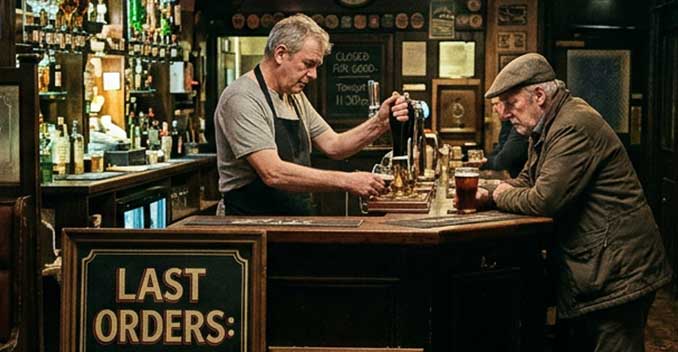
The Great British Pub is not merely an exercise in hospitality; it is a canvas of national identity, an architectural subculture, and arguably one of Britain’s finest contribution to the art of social infrastructure. For centuries, these institutions have operated as the democratic living rooms of the nation—spaces where class distinctions blur over a pint and the ambient crackle of a wood-burning stove. Yet, walking down any high street from Newcastle to Newquay reveals a sobering visual reality: boarded-up sash windows, stripped-out beer lines, and the clinical neon signs of upcoming flats. The local is vanishing and being forced to constantly reshape itself.
According to official figures released by the British Beer and Pub Association (BBPA) in May 2026, 161 pubs permanently shut their doors across Britain in the first three months of the year alone. That is a rate of nearly two pubs a day being wiped from the map, taking with them an estimated 2,400 jobs and an irreplaceable slice of cultural heritage. To treat this decline as a simple narrative of commercial failure is to miss the deeper, more complex transformation under way. The pub is a mirror to the British soul, and its steady erasure reflects a society undergoing a profound, sometimes clinical shift in how it congregates, consumes, and constructs community. This exploration cuts through the nostalgic sentimentality to examine the cultural, political, and generational forces currently dismantling Britain’s liquid landscape.
The Structural Anatomy of the Decline
To dissect the modern evolution and erosion of the British local, this cultural review organises itself around distinct themes:
- The Weight of Heritage and Literature: Tracking how an ancient institution evolved from a medieval sanctuary into a cornerstone of the Western artistic imagination.
- The Modern Erosion: Analysing the combination of aggressive corporate consolidation, shifting social policy, and the economic pressures of a changing world.
- The Post-Alcohol Frontier: Evaluating how a new generation’s embrace of wellness, hybrid spaces, and curated aesthetics is reinventing—or replacing—the traditional pub experience.
What is Killing the Local?
The Triple Threat to the Cellar
The ongoing decline of the British pub cannot be blamed on a single cultural villain. Instead, operators are facing a brutal combination of commercial pressures that leave little room for error. The primary factor is a massive cost-of-living squeeze that has altered consumer behaviour. With household finances stretched tightly, the casual, post-work ritual of buying three or four pints has rapidly become an expensive luxury, forcing a significant shift toward cheaper supermarket alcohol and home drinking.
Behind the bar, publicans are fighting a losing battle against hyper-inflationary operational overheads. The dramatic energy crises triggered by global tensions have sent utility bills for historic, poorly insulated pub buildings to unmanageable heights. When combined with substantial increases in the national minimum wage and rising ingredient costs, the break-even point for an independent pub has been pushed to a level that requires premium pricing—a reality that alienates the very working-class regulars who form the backbone of the institution’s community. When you combine this with more aggressive marketing to wellbeing, no smoking, no vaping, zero alcohol and lifestyle its a tinderbox that once ignited has been ever more hard to put out.
The Liquid Institution: A Brief History of the British Alehouse
From Roman Tabernae to the Public House
To truly comprehend the scale of what is being lost, one must understand that the pub is one of Britain’s oldest institutional designs. The lineage dates back to the Roman tabernae, established along military highways to provide wine and shelter to weary travellers. Following the collapse of Roman rule, these spaces evolved into Anglo-Saxon alehouses—domestic dwellings marked by a green bush on a pole, indicating that a fresh batch of ale had been brewed within.
By the arrival of the Victorian era, the modern “Public House” had fully solidified its status as an essential social anchor. As industrialisation packed populations into dense, urban environments, the pub emerged as a vital alternative to cramped, unheated housing. These spaces were deliberately designed with etched glass, elaborate mahogany bars, and distinct rooms—from the formal saloon lounge to the working-man’s public bar—creating an architectural ecosystem that democratised leisure and established the pub as a fundamental pillar of British civil society.
Pubs as the Creative Heart of British Culture
Where History and Fiction Meet over a Pint
The cultural significance of the British pub is immortalised across the pages of English literature and the turning points of national history. These spaces have long served as the incubators for Britain’s creative imagination. Geoffrey Chaucer set the opening of The Canterbury Tales at the Tabard Inn in Southwark, utilising the shared space of a medieval hostelry to bring together a diverse cross-section of society. Centuries later, Charles Dickens frequented and immortalised venues like the Ye Olde Cheshire Cheese on Fleet Street, weaving the smoky, atmospheric reality of London’s taverns directly into the fabric of his novels.
Beyond fiction, the British pub has functioned as a meeting ground for historic shifts in thought and politics. The Eagle and Child in Oxford served as the legendary weekly meeting place for “The Inklings”—a literary circle that included J.R.R. Tolkien and C.S. Lewis, who debated the contours of Middle-earth and Narnia over the waft of pipes and pints. To lose these spaces is not merely losing a retail business; it is to sever a physical connection to the creative lineage that has defined the Western world’s literary and social landscape.
Breaking Down the Closing Numbers
The Cold Math of a Changing High Street
The romanticism of the pub sign fades quickly when confronted with modern insolvency statistics. Data compiled by corporate restructuring specialists UHY Hacker Young reveals that pub and bar insolvencies across England, Scotland, and Wales climbed to 789 in the year ending 31 December, a figure that has more than doubled from the 367 closures recorded during the disrupted calendar year of 2020.
The geographic distribution of these failures highlights a widespread issue. While Scotland suffered a sharp 33% increase in insolvencies, traditional economic centers across London and the South East recorded the highest net losses in England. Notable corporate casualties, including the struggles of the cricket-themed Sixes group and the collapse of Oakman Inns, demonstrate that even well-funded, experiential hospitality concepts are finding it incredibly difficult to navigate the current financial climate.
Adapt: The Great Spatial Reinvention
The Evolution of the Public House
Faced with changing consumer habits, the pubs that manage to survive are undergoing a radical spatial transformation, moving far beyond the traditional model of a dark room serving standard lagers. The modern successful publican must be a chameleon. During daylight hours, historic drinking spaces are increasingly being converted into co-working hubs, offering high-speed Wi-Fi, premium coffee, and flexible seating to attract remote workers who have abandoned city-centre offices.
By night, these same spaces pivot into multi-functional cultural venues. The standard beer selection is being replaced or augmented by curated natural wine lists, locally sourced small plates, and specialised tasting events. This shift requires a total rethink of what a pub looks like inside. Out go the sticky carpets, heavy velvet curtains, and dim lighting; in come clean lines, local art displays, and open, flexible spaces designed to appeal to an audience that values aesthetic curation just as much as the quality of the drink in their glass.
Government Policy and the Rates Relief Battle
The Friction Between Rhetoric and High Street Reality
The political landscape offers a complex, often frustrating relationship for the hospitality sector. Publicans have long argued that the British tax system is fundamentally rigged against physical, community-focused businesses. For every three pounds spent across a British bar, approximately one pound goes directly to the taxman via a combination of alcohol duty, VAT, and business rates—a disproportionate tax burden that leaves independent operators incredibly exposed to market shocks.
In response to sustained pressure from organisations like CAMRA and the BBPA, the government implemented a temporary 15% pub-specific business rates relief scheme that came into effect in April. While the Treasury has promised a permanent overhaul of the business rates framework, the hospitality industry views these measures as a modest band-aid on a deeper structural wound. With national insurance contributions rising, operators argue that current government interventions are barely helping them keep their heads above water in a highly challenging commercial environment.
The Unquantifiable Social Value of the Local
The Pub as an Antidote to Modern Isolation
To measure the decline of the pub solely through GDP contributions and employment statistics is to misunderstand its true value and where it lies. The pub serves a vital, non-commercial conduit and purpose as a primary defence against the growing epidemic of loneliness and social isolation in modern British life. It is one of the few remaining physical spaces where entry does not require a formal ticket, membership, or an expensive commitment—a place where simply sitting at the bar opens the door to human connection.
For rural villages and peripheral urban estates, the closure of the local pub often signals the total collapse of the local community. It is the space that hosts the local football club meetings, organises charity quiz nights, and provides a watchful, informal support network for elderly or isolated residents. When a pub is demolished or converted into a generic convenience store, a vital piece of social glue is permanently removed, leaving communities fragmented and increasingly isolated behind individual digital screens.
The Rise of Generation Dry: Wellness Culture and the Sobriety Shift
The Changing Relationship with the Pint
The most significant long-term threat to the traditional pub model is a profound, generational shift in our cultural relationship with alcohol. The historic assumption that young adults will naturally adopt the drinking habits of their parents has completely broken down. Data from recent population health surveys shows that 39% of young people aged 16 to 24 across England now identify as complete non-drinkers, choosing instead to prioritise fitness, mental clarity, and active wellness.
This shift toward sobriety has stripped traditional pubs of their historical entry-level customer base. The modern wellness movement views the classic, smoke-stained imagery of the British drinking session (Think Hogarth’s the Rakes Progress) not as a comforting cultural ritual, but as an unhealthy habit to be avoided. For an industry that has spent decades relying on steady, volume-driven alcohol sales, this cultural pivot represents a structural challenge that cannot be solved by simply adding a token low-alcohol lager to the bottom of the menu.
The Domesticated High Street Pub
From Smoke-Filled Dens to Family Hubs
Step into a successful suburban pub on a Sunday afternoon, and the cultural transformation is immediately obvious. The historic, male-dominated atmosphere of the mid-twentieth-century drinking den—characterised by clouds of cigarette smoke, dartboards, and an unspoken hostility toward outsiders—has been systematically replaced by an open, family-friendly environment designed to appeal to affluent parents.
This normalisation of the pub space has opened up valuable new revenue streams, transforming the traditional weekend trade into a family-oriented experience complete with dedicated children’s menus, highchairs, and secure outdoor play areas. While this shift toward family-friendly spaces has successfully made the pub a more inclusive environment, some traditionalists argue that it has watered down the unique identity of the classic local, replacing its raw edge with a sanitised, suburban predictability.
The Wetherspoon Effect: The Sanitisation and Rise of the Chain Pub
The Economics of Scale vs. the Loss of Local Identity
The architectural and cultural variety of the British pub landscape is facing intense pressure from the relentless expansion of massive corporate pub chains. Outfits like JD Wetherspoon, Stonegate, and Mitchells & Butlers have completely rewritten the rules of high-street hospitality by utilising immense economies of scale. By buying beer, food, and real estate in massive quantities, these corporate giants can offer low prices that independent publicans simply cannot match.
The cultural cost of this corporate consolidation is a noticeable loss of local character. While a sprawling, converted bank operating as a chain pub provides cheap pints and reliable food, it frequently lacks the eccentric personality, local history, and intimate community connection that define an authentic independent local. The high street is left feeling increasingly generic, filled with identical menus, standardised interiors, and a corporate efficiency that strips away the unique charm of the traditional British drinking experience.
The Rise of Micro-Pubs and Independent Taps
The Counter-Rebellion Against Corporate Beer
In the face of widespread closures and corporate consolidation, a vibrant, independent counter-rebellion has emerged in the form of the micro-pub and craft brewery taproom. Pioneered by enthusiasts who reject both the corporate chain model and the gastro-pub concept, these compact venues are deliberately stripped-back spaces—often occupying converted high-street shops—that focus strictly on high-quality, locally sourced independent beer and genuine conversation.
By abandoning expensive commercial kitchens, television screens, and industrial commercial lagers, micro-pubs keep their operational overheads remarkably low. They represent a return to the foundational principles of the Anglo-Saxon alehouse: a small, welcoming room where the community gathers to enjoy fresh, locally crafted drinks. This craft resurgence proves that while the traditional, sprawling pub building may be struggling, the fundamental human appetite for authentic, small-scale social drinking remains incredibly strong.
2046, How Will the Pub Survive the Next Two Decades?
Predictive Evolution of the British Social Space
Projecting the survival of the British pub into the mid-twenty-first century requires moving past easy nostalgia. The pub will undoubtedly exist in 2046, but it will look and function in ways that would surprise a mid-century regular. The physical footprint of the sector will inevitably shrink, leaving behind a streamlined collection of highly specialised venues that have successfully adapted to a more digital, wellness-oriented society.
The future pub will likely be a hybrid space that seamlessly blends historic architecture with advanced technology. We can expect to see automated inventory management, hyper-local micro-brewing systems integrated directly into the cellar, and menus dominated by sophisticated, functional non-alcoholic elixirs and craft ferments. Yet, no matter how much the technology or the menu changes, the core asset of the pub will remain its physical space. In an increasingly digital world, the need for a physical sanctuary to connect with others will ensure that the pub survives as an essential anchor of British life.
The Resilient Hearth, Comfort when You’re Away from Home
Preserving the Living Rooms of Britain
The decline of the Great British Pub is a genuine cultural crisis, a structural shift that risks removing a vital social anchor from high streets and villages across the United Kingdom. The statistics are undeniably challenging, reflecting a complex world of shifting consumer habits, intense financial pressures, and changing generational values. To save this essential institution, we must look beyond easy nostalgia and recognise that the pub must be allowed to evolve if it is to survive.
Ultimately, the preservation of the pub relies on our collective willingness to value community spaces over pure digital convenience. Whether through supporting a local independent micro-pub, protecting historic buildings from aggressive property development, or backing fair tax reforms, ensuring the survival of the local is a vital investment in our shared social fabric. The pub has survived plagues, world wars, and economic revolutions for centuries; by embracing a flexible, modern approach to hospitality, we can ensure that this treasured institution continues to welcome regulars and strangers alike for generations to come.
Verified Facts
- Quarterly Closure Rates (Q1 2026): According to the British Beer and Pub Association (BBPA) data released in May 2026, 161 pubs permanently closed across England, Scotland, and Wales in the first three months of the year, representing a 26% increase compared to the same period in 2025.
- Long-Term Sector Attrition: Data from the House of Commons Library confirms that the total number of pubs in the UK has fallen steadily from approximately 60,800 in 2000 to roughly 45,000 by the mid-2020s.
- Insolvency Volume Spike: Analysis of official insolvency data by tax and business advisory firm UHY Hacker Young showed that the number of pub and bar companies falling into insolvency rose to 789 in the year ending 31 December, more than double the 367 recorded in 2020.
- The Youth Sobriety Shift: Academic and market data from recent hospitality reviews indicates that approximately 39% of young adults aged 16 to 24 in England identify as non-drinkers, fundamentally altering traditional beverage market dynamics.
- The Smoking Ban Impact: Historical ONS business registry data indicates that between 2004 and 2024, London alone lost an estimated 930 pubs, with the vast majority of those closures occurring in the seven years immediately following the 2007 indoor smoking ban.



Be the first to comment