

British television advertising is amongst the most creative in the world and is generally considered a market leader. For a generation raised on linear broadcasting, the ad break was not merely a convenient interlude to boil the kettle; it was a curated gallery blending high-concept filmmaking, luxury, wit and often literal slapstick. While cinema required a ticket to ride and art galleries demanded a certain performative reverence, the commercial break smuggled genuine artistic creation directly into the nation’s living rooms, sandwiched somewhere between the local evening news and a prime-time soap opera.
Let’s look back at the golden eras of commercial broadcasting to chart a history of visual culture itself. The standard thirty-second slot became a pressure cooker for creativity. Directors who would go on to reshape Hollywood cut their teeth wrestling with the constraints of selling soap, cars, or stout, discovering along the way that the most effective path to a consumer’s wallet was through their imagination. It was an ecosystem where technology and creative vision did not merely co-exist; they actively catalysed one another. Computer-generated imagery, innovative editing techniques and avant-garde sound design often found their first mainstream testing grounds not in feature films, but in the frantic pursuit of market share.
The following selections represent the absolute zenith of this medium—pieces of work that transcended their brief, warped the cultural landscape and left an indelible mark on the British and global consciousness. These are the adverts that didn’t just sell products; they defined eras.
1. Guinness: Surfer (1999)
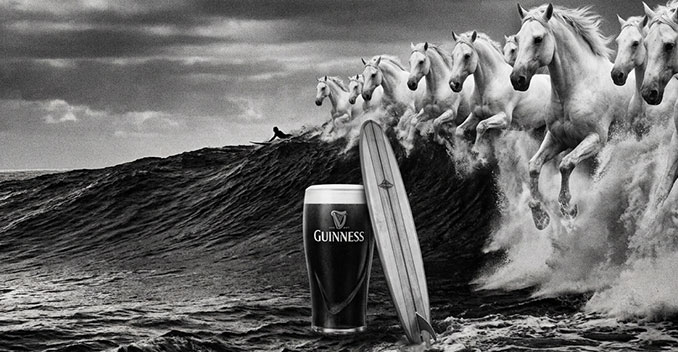
Few pieces of moving image have ever captured the sublime terror of nature quite like Jonathan Glazer’s 1999 masterpiece for Guinness. Anchored by Leftfield’s pounding electronic track ‘Phat Planet’ and a pseudo-Melvillian monologue delivered with grizzled gravitas, the commercial transforms the simple act of waiting for a pint of stout into an epic, mythological struggle between man and the ocean.
Financed by Diageo and orchestrated by the creative agency Abbot Mead Vickers BBH, the advert was a massive gamble. It spent an unprecedented amount of its budget on state-of-the-art post-production to seamlessly blend charging Polynesian surfers with CGI white horses erupting from the crest of a monstrous wave. Released on 17 March 1999, the commercial tapped directly into the late-nineties zeitgeist of cinematic, high-budget storytelling. It sweepingly won the Clio Awards and D&AD Pencils, routinely topping polls as the greatest television commercial ever made. It proved that commercial art could achieve the status of high cinema.
2. Levi’s: Odyssey (2002)
Following his triumph with Guinness, director Jonathan Glazer teamed up with agency Bartle Bogle Hegarty (BBH) in 2002 to create an ethereal, gravity-defying narrative for Levi’s Engineered Jeans. The premise was deceptively simple yet technically staggering: a young man and woman sprinting flat-out through a sequence of empty rooms, utterly unbothered by physical constraints as they smash directly through solid brick walls before running up trees and launching themselves into the night sky.
Set to the haunting strains of Handel’s Sarabande, ‘Odyssey’ was an engineering marvel of its time. The production relied heavily on a mixture of physical set-building—using brittle, pre-scored plaster walls—and cutting-edge digital compositing to give the actors an uncanny, weightless velocity. Released in January 2002, the advert captured a post-millennial thirst for freedom and structural disruption. It remains an extraordinary marriage of classical high art and raw, youthful rebellion, treating denim not as mere apparel, but as an armour of absolute liberation.
3. MoneySuperMarket: Epic Strut (2015)
Stepping firmly away from the cinematic sublime into the realm of the gloriously absurd, Mother London’s 2015 campaign for financial comparison site MoneySuperMarket remains an object lesson in viral audacity. The advert features Dave, an ordinary businessman who is feeling “epic” after saving money on his car insurance. He celebrates by strutting down a gritty London street clad in a suit jacket, denim hotpants and sky-high stiletto heels, soundtracked by The Pussycat Dolls.
Directed by Noam Murro and released in February 2015, ‘Epic Strut’ was a masterclass in subverting expectations. It weaponised sheer visual shock value, contrasting a mundane suburban backdrop with an incredibly well-choreographed, fluid dance routine performed by actor Michael Van Schoick. The public reception was immense, sparking endless internet memes and late-night talk show parodies. It was brilliant precisely because of its commitment to the bit—unapologetically camp, internalised absurdity and undeniably memorable. For me it was a bit much, but the advert leaves us talking about it to this day.
4. Cadbury’s Dairy Milk: Gorilla (2007)
If you asked a marketing focus group in 2007 whether a ninety-second tracking shot of a hyper-realistic gorilla waiting to play the drum solo from Phil Collins’ ‘In the Air Tonight’ would sell milk chocolate, you would have been laughed out of the boardroom. Yet, director Juan Cabral and agency Fallon London did exactly that, creating an existential triumph that completely reinvented the rules of modern branding.
Airing on 31 August 2007 during the finale of Big Brother, the commercial famously didn’t show the product until the final fleeting seconds. It relied entirely on mood, anticipation and the collective cultural affection for a classic pop music crescendo. Actor Garon Michael donned the sophisticated, animatronic gorilla suit, delivering a performance of quiet, contemplative focus before exploding into rhythmic fury. The commercial was an absolute phenomenon, credited with a 9% increase in Cadbury sales that autumn and winning the prestigious Grand Prix at the Cannes Lions in 2008.
5. Tango: Orange Man / You Know When You’ve Been Tangoed (1992)
In the early 1990s, soft drink advertising was largely dominated by glossy, aspirational American tropes. Enter HHCL (Howell Henry Chaldecott Lury) in 1992, who tore up the rulebook with a lo-fi, surrealist assault on the senses. The premise involved a man drinking a can of Tango, only for a portly, bright orange figure to appear out of nowhere and violently slap him across the cheeks, accompanied by two enthusiastic commentary boxes analysing the impact.
Premiering in 1992, the “Orange Man” advert, directed by cyclic visionary Simon Delaney, captured the raw, anti-establishment irony of the early-nineties youth culture. The public reception was so enthusiastic that it led to a widespread playground craze of children slapping each other’s ears, prompting the advert to be eventually banned and replaced with a modified version where the orange man delivers a kiss instead. It remains a legendary benchmark for edgy, confrontational, yet deeply funny British satire.
6. Old Spice: The Man Your Man Could Smell Like (2010)
In 2010, creative agency Wieden+Kennedy Portland achieved the near-impossible: they made a legacy, somewhat dated grooming brand explicitly cool for an internet-native generation. Starring the effortlessly charismatic Isaiah Mustafa, the commercial is a relentless, single-take monologue where the speaker transitions seamlessly from a bathroom to a yacht, onto a horse, all while maintaining unblinking eye contact with the camera.
Directed by Tom Kuntz and launched in February 2010 during the Super Bowl, the technical execution of this advert was an absolute marvel of practical theatrical set pieces, wires and rotating backdrops, with minimal digital intervention. The digital zeitgeist swallowed it whole; the ad racked up millions of views on YouTube within days, transforming into one of the earliest examples of a television commercial operating as a fully interactive internet phenomenon. It was logical, incredibly fast-paced and brilliant in its structural engineering.
7. Moneysupermarket: Dancing Man / Epic Wolf (2016)
Building upon the structural framework of ‘Epic Strut’, MoneySuperMarket and Mother London returned in 2016 to escalate their universe of financial euphoria. This iteration brought back the iconic Dave in his heels, but introduced a rival: Colin, a builder who channels his inner street-dancer to the soundtrack of ‘brilliant’ noughties pop, culminating in an epic dance-off that felt like a localised, council-estate version of Step Up.
Released in 2016, the ad perfectly understood the power of rhythmic movement to evoke joy. The execution relied heavily on superb physical comedy and sharp, crisp editing to contrast the mundane reality of British infrastructure with the soaring, flamboyant creativity of its working-class and white collar protagonists. It proved that a great creative concept could be extended into a broader, episodic narrative without losing its initial bite.
8. Renault Clio: Papa and Nicole (1991–1998)
For nearly a decade, the British public was utterly transfixed by a fictional, sun-drenched French family. The ‘Papa and Nicole’ series for the Renault Clio, orchestrated by Publicis, was structured like a chic, high-end soap opera, tracking the romantic escapades of Nicole (played by Estelle Skornik) and her wealthy father (Max Douchin) in rural Provence, all set to various acoustic arrangements of Robert Palmer’s ‘Johnny and Mary’.
Launching in 1991 and running until a cinematic finale on 29 May 1998—where Nicole leaves comedian Vic Reeves at the altar to drive off with Bob Mortimer—the campaign was a towering commercial triumph. It sold over 300,000 Clios in the UK alone. By 1996, surveys revealed that Nicole was more widely recognised by the British public than Prime Minister John Major. It transformed the automotive ad from a dry showcase of technical specifications into an aspirational, emotionally resonant cultural narrative.
9. Coca-Cola: Holidays Are Coming (1995)
Few corporate entities have successfully managed to monopolise the visual language of a global holiday quite like Coca-Cola. In 1995, agency W.B. Doner debuted the ‘Holidays Are Coming’ campaign, featuring a luminous convoy of literal “Christmas Trucks” winding through snow-covered landscapes, illuminated by thousands of fairy lights and driven by a jolly, animated Santa Claus.
The visual effects were handled by the legendary Industrial Light & Magic, making the trucks look like majestic, glowing vessels of seasonal cheer. First broadcast in November 1995, the advert fundamentally altered how the commercial calendar operates; for millions of viewers across the United Kingdom, winter does not officially begin until this specific piece of film, accompanied by its iconic, driving choral jingle, appears on screen. It is an extraordinary testament to the power of myth-making within a purely commercial framework. It should be noted there were approximately six versions in total, 1995, 1997, 1999, 2020, 2024 & 2025. The last three were AI iterations that received mixed reactions. Also, you may notice a sound at the beginning not too dissimilar to the ‘Simpsons’.
10. Diet Coke: Diet Coke Break / 11:30 (1994)
In 1994, Lintas took a sharp, irreverent look at office dynamics and gender roles, turning the traditional gaze of commercial advertising completely on its head. The premise was delightfully simple: a group of female office workers regularly gather at a window at precisely 11:30 AM to watch a handsome, rugged construction worker (played by model Lucky Vanous) take off his shirt to enjoy a refreshing beverage to the tune of Etta James’ ‘I Just Want to Make Love to You’.
Launching in 1994, the commercial was a massive cultural hit that perfectly captured the changing, confident media landscape of the mid-nineties. It was cheeky, self-aware and intentionally playful, shifting the paradigms of soft drink marketing away from family picnics toward sophisticated, urban adult humour. The ad was so successful it spawned numerous sequels and imitations over the subsequent two decades, cementing the “Diet Coke Break” as a permanent fixture in the lexicon of British workplace culture. We also look at the 2026 version released alongside the Devil Wears Prada movie 2026.
Honourable Mentions
While the top ten represent the absolute pillars of the medium, a few other magnificent works deserve a brief nod for their cultural foresight and creative execution:
- Red Bull: Gives You Wings (1992) – A masterclass in minimalist, witty line-animation that built a global energy empire on a single, surrealist promise.
- De Beers: A Diamond is Forever (1993) – Using sweeping silhouettes and classical scores to turn a geological mineral into the ultimate symbol of romantic permanence.
- Yellow Pages: J.R.R. Hartley (1983) – A deeply touching, melancholic British narrative tracking an elderly man looking for his own out-of-print book on fly fishing.
- 118-118: Got Your Number (2003) – A brilliant retro-pastiche using twin, mustachioed 1970s distance runners to make a directory enquiries number utterly unforgettable.
- Werther’s Original: Grandfather (1993) – An unapologetically nostalgic, amber-hued exploration of family lineage and confectionery.
- Johnson’s Baby: Clean & Fresh (1990s) – A gentle, emotionally grounded look at parental care that defined the acoustic, soft-focus aesthetic of nineties domesticity.
- Budweiser: Whassup? (1999) – Directed by Charles Stone III, this absolute cultural juggernaut turned a casual, authentic urban greeting into a global linguistic shorthand.
- Reebok: Belly’s Gonna Get You (2000) – A brilliantly surreal, slightly terrifying horror-comedy short tracking a man being chased through town by his own giant, sentient beer gut.
- R. White’s: Secret Lemonade Drinker (1973) – A wonderfully quirky musical number featuring Ross MacManus in his pyjamas sneaking downstairs for a late-night fizzy drink.
- Walkers Crisps: Gary Lineker (1995) – The brilliant beginning of a multi-decade partnership that playfully subverted the clean-cut image of the England footballing icon into a cheeky, crisp-stealing anti-hero.
There are many many others, like Man Bear Pig, The British Airways adverts featuring choreographed participants shifting into shapes, Scottish Widows and Cheltenham and Gloucester’s deep sea pearl diving adventure.
The Lasting Legacy of the Thirty-Second Canvas
The trajectory of British and international television advertising reveals a medium that was always at its best when it treated its audience with absolute intellectual respect. The commercials that truly broke the mould were never those that simply shouted their product’s benefits at the viewer; they were the ones that understood the delicate architecture of human emotion, rhythm and visual storytelling. Whether through the cinematic poetry of Jonathan Glazer or the unmitigated, structural joy of a drumming gorilla, these pieces of film functioned as brief, vibrant oases of artistic experimentation within the broader broadcast landscape.
They succeeded because they recognised that drama, humour, storytelling, technology and creative vision are not opposing forces, but deeply complementary ones. Complex CGI, advanced animatronics and sophisticated sound design were never deployed as cheap gimmicks; instead, they were marshalled to serve a distinct, singular creative idea. As the media landscape continues to fracture into localised algorithms and skippable digital banners, this golden era of shared, nation-stopping commercial art feels increasingly precious—a testament to a time when a thirty-second slot could capture the imagination of an entire country.
Have Your Say
Which iconic ad break moment always sticks in your memory? Did the cinematic power of the Guinness surfers leave you awestruck, or did you find yourself tapping along to the Cadbury gorilla? Perhaps there is an obscure regional classic you feel we have criminally overlooked.
Join the conversation or follow us on facebook, instagram, youtube, TikTok, LinkedIn and X/Twitter or why not submit your own article! Or email at contribute@criticalmatters.net
Facts and Links
Supported Facts
- Guinness ‘Surfer’: Directed by Jonathan Glazer, created by Abbott Mead Vickers BBH, released on 17 March 1999, featuring the track ‘Phat Planet’ by Leftfield.
- Levi’s ‘Odyssey’: Directed by Jonathan Glazer, agency Bartle Bogle Hegarty (BBH), released in January 2002, set to Handel’s Sarabande.
- MoneySuperMarket ‘Epic Strut’: Directed by Noam Murro, agency Mother London, released in February 2015, starring Michael Van Schoick.
- Cadbury ‘Gorilla’: Directed and written by Juan Cabral, agency Fallon London, premiered on 31 August 2007 during the Big Brother finale, starring Garon Michael.
- Tango ‘Orange Man’: Created by agency HHCL, directed by Simon Delaney, debuted in 1992, subsequently banned from screens due to playground safety concerns.
- Old Spice ‘The Man Your Man Could Smell Like’: Directed by Tom Kuntz, agency Wieden+Kennedy, premiered in February 2010, starring Isaiah Mustafa.
- Renault Clio ‘Papa and Nicole’: Created by Publicis, starred Estelle Skornik (Nicole) and Max Douchin (Papa), ran from 1991 to 20 May 1998, drawing over 23 million viewers for its final broadcast episode.
- Coca-Cola ‘Holidays Are Coming’: Launched in November 1995, special effects created by Industrial Light & Magic.
- Diet Coke ‘Break’: Created by agency Lintas, debuted in 1994, starring model Lucky Vanous, featuring Etta James’ recording of ‘I Just Want to Make Love to You’.

Be the first to comment