


When transatlantic leaders stood side-by-side to unveil the landmark US-UK Technology Prosperity Deal, it was hailed as a generational leap forward. Promising an eye-watering pledge of over £31 billion in cross-border capital, the agreement was engineered to transform the United Kingdom into Europe’s premier extension of Silicon Valley. Pledged by American tech giants alongside UK innovators, the multi-year deal was designed to fund cutting-edge artificial intelligence, quantum computing infrastructure and massive data centre hubs from London to the North East.
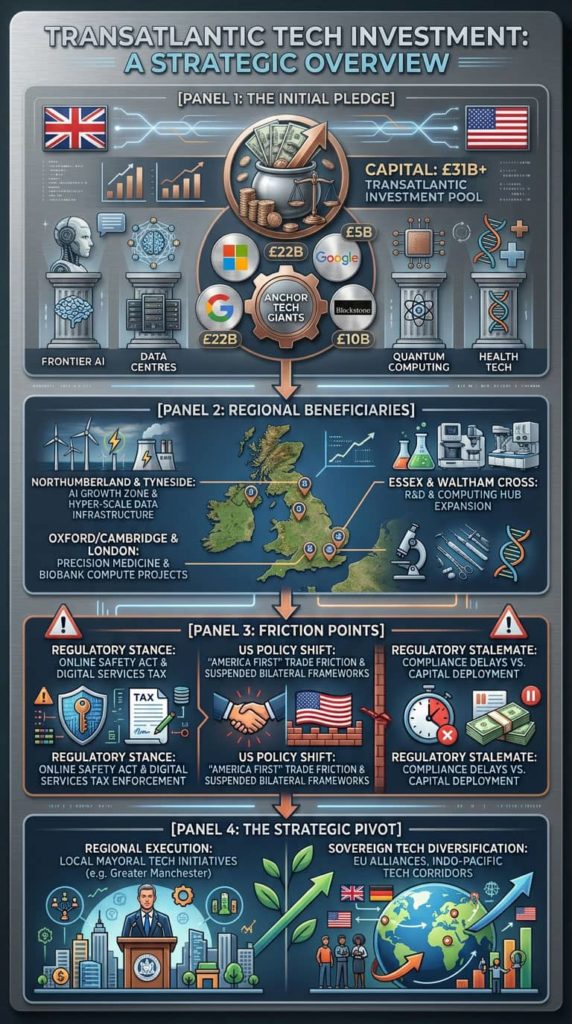
The initial momentum was driven by unprecedented headline figures: Microsoft pledged £22 billion over four years toward cloud infrastructure and national AI supercomputing, Google committed £5 billion to expand its data footprint and engineering operations, Nvidia touted £11 billion in end-to-end hardware value, and Blackstone backed a £10 billion AI Growth Zone at Blyth in Northumberland. In return, the UK promised streamlined planning approvals, expedited grid connections and direct public-private research access.
Yet, despite grand announcements, the momentum surrounding this multi-billion framework has run into a wall of geopolitical friction and diplomatic manoeuvring. Capital deployment has slowed to a crawl as broader trade disputes, tariff volatility and clashes over UK digital regulation took centre stage. Implementation encountered severe friction following disagreements over the UK’s Digital Services Tax and online platform governance. Understanding what happened to this flagship alliance reveals a story of grand promises colliding with the unpredictable nature of modern international relations.
Practical Impact: Who Was the Pledge Designed to Help?
The Technology Prosperity Deal was framed not merely as a corporate handshake, but as an engine for widespread economic development. At its core, the capital commitments—led by hyper-scale investments like Microsoft’s expansion and Blackstone’s AI growth zone in Blyth—were mapped directly to domestic infrastructure. The practical beneficiaries were intended to span several distinct tiers of the British economy.
At the regional level, local communities in Tyneside and Northumberland were set to gain over 5,000 high-skilled operational roles, alongside secondary windfalls for civil construction, cooling technology and local renewable energy grids. For the UK’s startup and SME ecosystem, the deal promised domestic access to sovereign compute clusters, reducing reliance on overseas cloud resources. Furthermore, public research institutions—such as the NHS and UK Biobank—were earmarked to receive high-performance compute access to accelerate drug discovery, precision medicine and nuclear fusion research. Had capital flowed without friction, regional economies would have seen direct windfalls; instead, localized supply chain benefits remain partially frozen while corporate boardrooms await political stability.
Core Tenets: Has the Transatlantic Pact Stalled?
The framework of the US-UK deal rested on four primary tenets: AI infrastructure scaling, joint quantum computing acceleration, civil nuclear and fusion power alignment, and shared security protocols for critical tech. It sought to align standards so that a British tech firm could scale seamlessly into the American market, backed by vast state-side capital.
However, the state-backed deal hit severe turbulence when Washington formally paused its implementation. American negotiators cited frustration over the UK’s refusal to repeal its Digital Services Tax, along with philosophical disagreements regarding the UK Online Safety Act. While private firms like Microsoft and Blackstone continue individual site construction where commercially viable, the overarching, state-sanctioned bilateral trade and technology corridor is largely stalled. Joint research taskforces on quantum computing and AI safety remain active in theory, but lack the frictionless trade protections originally envisioned.
Political Realities: Reviving the Deal Under Local vs. National Leadership
The challenge facing Prime Minister Burnham’s government is balancing national regulatory sovereignty with the demands of volatile international partners. While Westminster remains locked in high-stakes diplomatic wrestling over trade terms, digital taxation and tariffs with Washington, regional leaders like Mayor’s and local communities may forge different paths.
National diplomacy under Burnham is bound to macro-policy negotiations, making national frameworks vulnerable to sudden political shifts or trade suspensions from the White House. In contrast, regional mayoral combined authorities focus on direct sub-national economic development. By bypassing national trade disputes, regional mayors can court private US investors directly, offering ready planning permission, localised power tie-ins and direct links to university research clusters. Decoupling local economic growth from national diplomatic friction allows individual infrastructure projects to proceed even when the national pact stumbles.
Diversification: Should the UK Look Beyond Volatile Alliances?
Relying heavily on bilateral deals with a taciturn US administration—where policy directions can change unexpectedly overnight—presents structural risks to national economic stability. Sudden shifts in Washington’s trade policy and unilateral tariff adjustments highlight the peril of placing all strategic tech eggs in one transatlantic basket.
To hedge against diplomatic volatility, Britain is increasingly pursuing a multi-track sovereign technology model. This involves deepening semiconductor and quantum research pacts with Indo-Pacific partners like Japan and South Korea, re-engaging with European supercomputing grids, and securing sovereign wealth investment from the Middle East for clean-energy data centres. Building resilient, multi-partner alliances alongside sovereign domestic investments ensures that British innovation is not left vulnerable to political mood swings in a single foreign capital.
The Horizon: Delivering Real Net Benefits to the Public
For the average citizen, multi-billion headline pledges mean very little if they only serve to bolster the Exchequer’s balance sheets or corporate PR campaigns. The real test of any tech agreement lies in tangible outcomes: better public services, faster healthcare diagnostics and localized job creation.
The timeline for delivering measurable benefits unfolds across three distinct phases. The current infrastructure phase centers on ground-level civil engineering, grid capacity expansion and data centre construction in areas like Blyth and Essex. The integration phase will see public sector compute allocation, applying new processing power directly to NHS backlogs and drug discovery trials. Finally, the maturity phase is expected to yield broad-based productivity gains for local businesses and shortened medical research cycles. As physical sites come online, the true value of these investments will finally move from policy memos onto the factory floors and hospital wards of Britain.
The Path Ahead: From Headlines to Real Capability
The turbulent trajectory of the UK-US Technology Prosperity Deal serves as a masterclass in modern realpolitik. Headlines and historic signing ceremonies may capture public attention, but long-term economic resilience requires patience, domestic sovereignty and political flexibility.
As Britain navigates an increasingly fractured geopolitical landscape, success will not be measured by the size of foreign pledges alone, but by our ability to turn those commitments into permanent infrastructure, home-grown expertise and tangible public good.
Have Your Say
The shifting dynamics of the UK-US tech alliance highlight the delicate balance between courting foreign investment and preserving regulatory independence. Should the UK government bend on domestic digital regulations to keep big US tech capital flowing? Or should we focus on building sovereign tech capabilities alongside European and Asian partners?
If you were affected by or are interested in the subject, join the conversation or follow us on facebook, instagram, youtube, TikTok, LinkedIn and X/Twitter or why not submit your own article! Or email at contribute@criticalmatters.net
Here is a breakdown of the verifiable facts, corporate commitments and references surrounding the US-UK Technology Prosperity Deal:
Key Corporate Commitments & Figures
- Microsoft (£22 billion): The largest single private investor in the package, committing £22bn over four years. This capital is targeted at expanding UK cloud infrastructure, securing power supply agreements, building AI supercomputers and funding research hubs.
- Google / DeepMind (£5 billion): Pledged £5bn over two years toward advancing DeepMind’s scientific research capabilities and expanding the main data centre campus at Waltham Cross in Hertfordshire.
- Blackstone & Nscale (£10 billion–£11 billion): Focused on developing an “AI Growth Zone” in the North East of England (Blyth in Northumberland and Cobalt Park in North Tyneside) to house hyper-scale data centre infrastructure.
- Nvidia: Deployment of up to 120,000 GPUs across UK compute sites to power research and commercial AI applications.
- Salesforce (£1.4 billion): Part of a multi-year investment plan positioning its UK business as an AI hub for UK and European operations.
- CoreWeave (£1.5 billion): Capital targeted at building high-density AI data centre capacity in partnership with UK hosting providers like DataVita.
Core Tenets of the Deal
The official Memorandum of Understanding (MoU) focuses on five strategic collaboration pillars:
- Frontier Artificial Intelligence: Joint research between the UK AI Security Institute and the US Center for AI Standards, deployment of supercomputing infrastructure and joint space-AI applications.
- Civil Nuclear & Fusion Power: Streamlining licensing timelines for Advanced Modular Reactors (AMRs), securing nuclear fuel supply chains independent of Russian sources by 2028 and co-developing commercial fusion energy.
- Quantum Computing: Establishing a US-UK Quantum Benchmarking Taskforce and exchange programmes for algorithm deployment in defence, finance and healthcare.
- Telecommunications & 6G: Cooperation on supply chain resilience, open RAN technologies and 6G standards.
- Research Security: Protecting critical national infrastructure and establishing shared university guidelines against foreign espionage.
Key Documentation & Policy Links
For verified policy documents, trade analysis and official announcements regarding the agreement, consult the following sources:
- Official UK Government & Industry Overview: Read techUK’s Analysis of the MoU for a complete breakdown of strategic priorities and industry working groups.
- Policy Analysis & Geopolitical Impact: Review the British Institute for the Study of Iraq / BISI Trade Report detailing bilateral negotiations, policy conditionality and diplomatic friction.
- Legal & Regulatory Infrastructure Breakdown: Examine Reed Smith’s Legal Insights on the Deal covering cross-border private equity, data centre planning and UK-US regulatory alignment.



Be the first to comment