

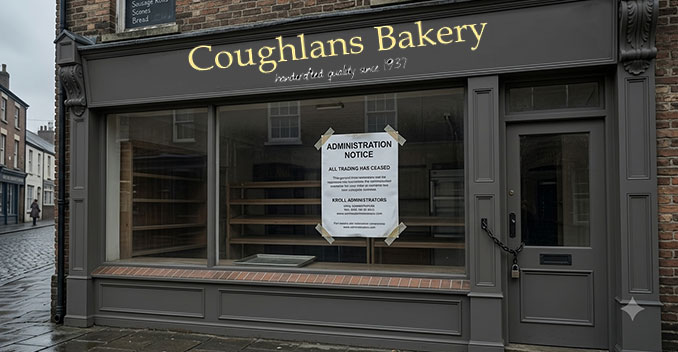
The sudden and dramatic collapse of Coughlans Bakery into voluntary liquidation is a stark reminder of today’s economic fragile realities. For decades, the high street retail sector has been treated by successive governments as a reliable source of Tax and more importantly prosperity, jobs and wealth creation. Yet, as any seasoned business owner who has sat on a corporate board will tell you, a company’s survival does not depend on optimistic long-term projections. It hinges entirely on weekly cash flow. When small and medium sized businesses are hit by a trifecta capped off by Labour’s cynical anti-business and essentially unsound National Insurance contributions hikes, what did anyone think would happen? Many high street stalls on British High Streets are closing. Including Pubs who have been amongst the worst hit. These, state-mandated costs coming at the exact moment consumer footfall is at an all time low and with the heatwave falling, continues to lower. There’s even another heatwave right now for this week. The shocking end of Coughlans is a vital case study in modern economic strain, proving that when the margin for error becomes very thin and the thin end of the wedge can become a knife edge looking for its pound of flesh, even the most beloved community institutions can vanish seemingly overnight. This is a shame for the high street and local communities.
The Story of Coughlans
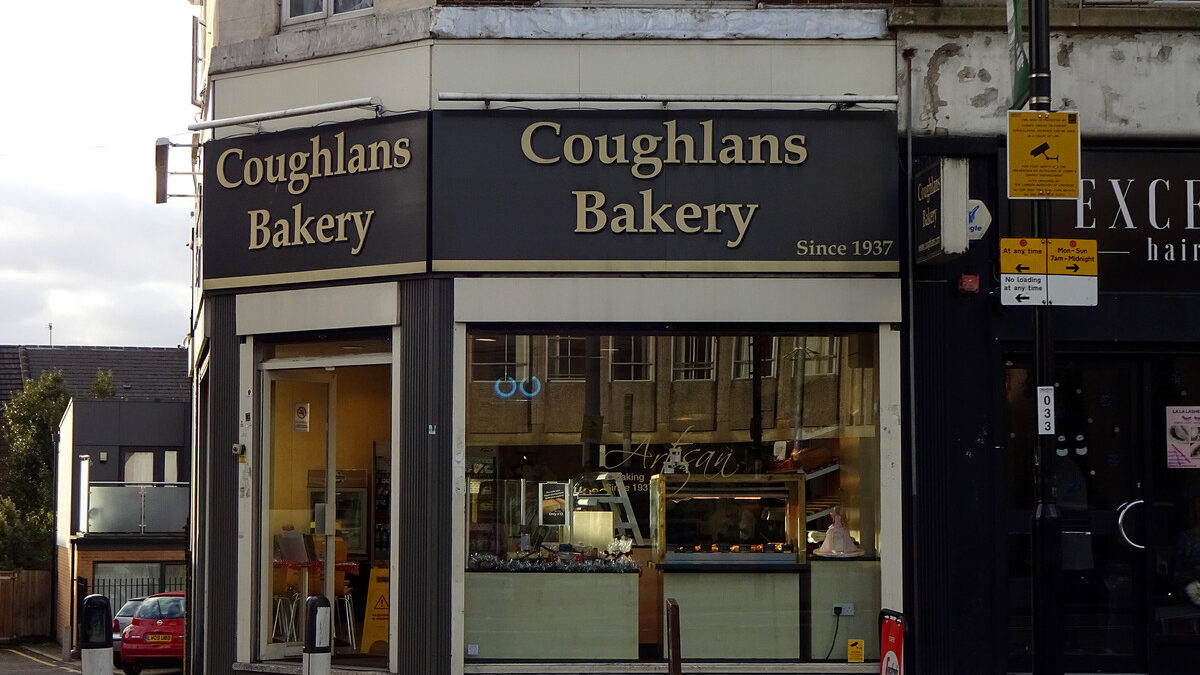
To understand what has been lost let’s look back to the start. Coughlans was originally established in Croydon back in 1937 by its pioneering founder, Jack Coughlan. What began as a single local shop—initially trading under the name Farmers Bakery on Mayday Road—was built on relatively modest but wholesome food at good value: providing affordable, high-quality, freshly baked staple goods to a working-class community navigating the difficult economic tailwinds of the 1930s.
| The Coughlans Historical Timeline |
| 1937: Founded by Jack Coughlan on Mayday Road, Croydon. |
| 1950s: Second generation (Peter, Christopher, Maureen) joins the business, expanding the shop footprint. |
| 1971: Headquarters and main bakery hub established at Thornton Heath, utilising a historic 200-year-old production site. |
| 1990: Third generation under Sean Coughlan takes full operational control, steering into the modern era. |
| 2024: Comedian Romesh Ranganathan buys into the company as a co-owner and active shareholder. |
| 2026: Sudden collapse into voluntary liquidation after swingeing NI contributions, lower footfall and summer heatwaves. |
When Jack married his wife Elsie, whose own family possessed deep baking roots, the young couple pooled their resources, integrated multiple family shops and officially rebranded the expanding enterprise under the family name. Over the next eight decades, the operation evolved into a massive, multigenerational regional powerhouse. By expanding systematically across South London, Surrey, Kent and West Sussex, Coughlans successfully scaled up its artisan presence without losing its core identity. At its peak, the brand operated 32 distinct retail branches and an expansive event catering arm, supported by a central manufacturing hub in Thornton Heath that had functioned as an active bakery site for nearly two centuries. This was a business run by the people, for the people, employing between 165 and 176 dedicated staff members. Over its 89-year history, 41 distinct members of the Coughlan family worked within its walls.
Enter Romesh Ranganathan
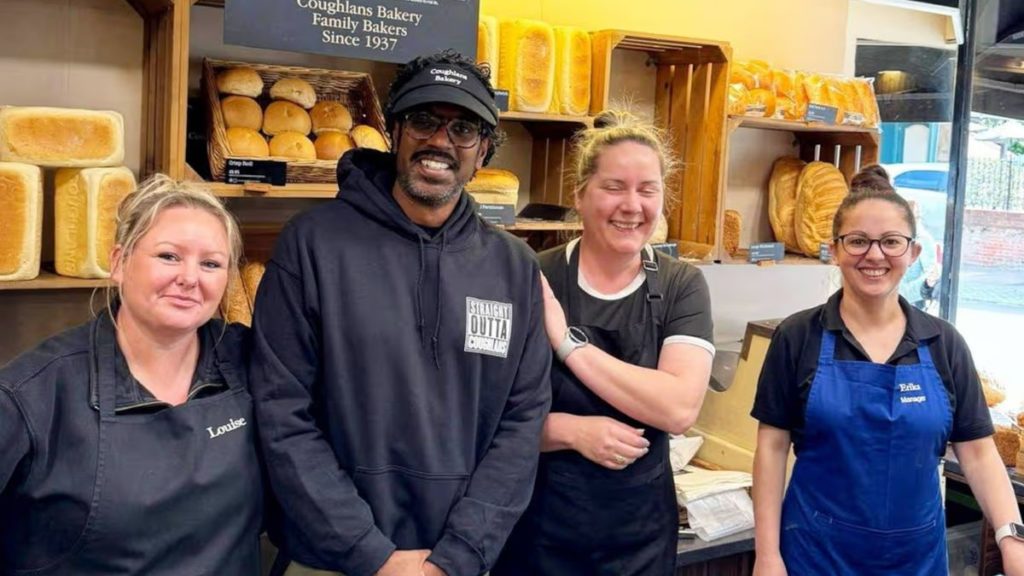
In 2024, the traditional family business underwent a fascinating, highly publicised cultural evolution. Acclaimed British stand-up comedian and television presenter Romesh Ranganathan bought into the brand, becoming a co-owner, active shareholder and the first individual outside the immediate family bloodline to sit on the company’s board since its 1937 inception. This was far from a superficial celebrity endorsement deal; it was a genuine creative partnership born out of shared values and a mutual love for the region.
Ranganathan, a proud local resident with an immense social media platform, threw himself directly into the operational culture of the company. He frequently stepped behind the bakery counters in locations like Oxted to serve customers, championing the high street and helping the business transition into a modern pop-culture favorite. Crucially, the partnership accelerated Coughlans’ development of a highly successful, contemporary plant-based menu. By creating premium vegan doughnuts, artisan sourdoughs and wild mushroom sausage rolls, they transformed the traditional bakery into an inclusive, trendy destination that appealed directly to a younger, food-conscious demographic. Managing director Sean Coughlan felt such a profound bond with the comedian that he officially updated the family ledger, declaring Romesh the 42nd honorary member of the baking family.
The Perfect Storm
What makes the sudden closure of Coughlans so shocking is how remarkably secure the enterprise appeared just months prior to its collapse. Financial accounts filed for the year ending 30 September 2025 revealed an enterprise successfully navigating its post-pandemic recovery. Turnover had jumped by 9% to an impressive £6.8 million, while annual losses had been slashed from £229,600 down to £98,800. Sean Coughlan reported that March 2026 had been a fantastic month of solid growth. The business wasn’t dying of natural causes; it was actively expanding.
Then, April arrived, bringing a catastrophic convergence of unconnected financial pressures that altered the high street landscape overnight:
- The Employer National Insurance Hike: The primary catalyst was the government’s sudden increase in employer National Insurance Contributions (NICs). This highly controversial tax adjustment hit low-margin, labor-intensive retail models with devastating force, adding an estimated £20,000 per week in pure operational overhead to Coughlans’ bottom line.
- The Minimum Wage Escalation: Occurring alongside the NIC hike, the sharp statutory increase in the National Minimum Wage immediately drove up baseline payroll costs across all 32 branches.
- The Middle East Energy Spike: Geopolitical escalations involving Iran triggered a sudden surge in global fuel prices. Overnight, Coughlans’ weekly corporate fuel and distribution bill doubled from £3,000 to £6,000.
- The Double Summer Heatwave: To seal their fate, two intense summer heatwaves hit the South East, sending temperatures soaring to 35°C. For a traditional bakery reliant on ambient high street footfall, this was the final blow. Footfall plummeted overnight, cutting store revenues by a staggering 50% while fixed outgoings remained entirely unchanged.
The Aftermath
The end came with startling, brutal speed. On Tuesday 30 June 2026, Coughlans officially entered voluntary liquidation, closing all 32 branches with immediate effect. There was no gradual wind-down period, no transition phase and no celebratory farewell tour. The decision was made abruptly by the directors to ensure that staff and long-term local suppliers could still be paid in full, rather than risking an chaotic insolvency where workers would be left entirely empty-handed.
For the 165+ loyal employees, the closure is an unmitigated disaster. While the liquidation preserves their immediate final pay packets, these workers have been thrust into a highly volatile, contracting retail job market. Concurrently, the business community is engaged in an intense debate regarding the government’s proposed employment law reforms, specifically around day-one worker rights and the newly revised six-month probation limits. While designed to protect staff, multiple business editors argue these rigid structures are having a chilling effect on hiring, making independent firms terrified to take on displaced workers due to the sheer weight of immediate legal liabilities.
Is There Life After Liquidation?
Is this the definitive end of the Coughlans name, or is there a viable future – we hope so! From a realistic commercial perspective, the traditional model of operating dozens of stores may need to be rethought or reduced to a smaller collection. However, the valuable brand name recognition and intellectual property, the beloved bakery recipes and the incredibly strong brand equity built up alongside Romesh Ranganathan still hold significant commercial value.
The future of the brand likely lies in a radical structural pivot. By abandoning the costly retail shopfronts completely, a streamlined iteration of Coughlans could emerge as a pure wholesale digital brand. By operating out of a singular, highly efficient dark kitchen or distribution hub, they could leverage their legendary plant-based recipes to supply premium vegan baked goods directly to major supermarkets, independent coffee boutique chains and regional festival events. Ranganathan himself took to Instagram to share his devastation with his 1.4 million followers, but dropped a tantalising hint for the future, writing: “Fingers crossed we can do something in the future as our partnership is very special.”
A Warning to the High Street
The voluntary liquidation of Coughlans Bakery should prick up ears and focus eyes on the British economy. This was not a failing, obsolete business model; it was a profitable, growing, three-generation family institution that was systematically crushed in less than ninety days by an unsustainable combination of state-imposed tax burdens, sudden energy inflation and volatile weather patterns and doubtless other factors.
When the state implements sweeping changes like the National Insurance hike without considering the narrow margins of labor-intensive high street sectors, it risks permanently erasing the cultural fabric of our local towns. If independent commerce is to survive, future fiscal policy must move away from rigid, punitive taxation and focus on creating a supportive environment where local enterprise can breathe.
Have Your Say
Were you a regular visitor to one of Coughlans’ 32 regional stores and are you devastated by the sudden loss of their artisan plant-based doughnuts? Do you believe the government’s employer National Insurance hike is systematically destroying the British high street, or is this closure simply the reality of doing business in a changing climate? Join the conversation or follow us on facebook, instagram, youtube, TikTok, LinkedIn and X/Twitter or why not submit your own article! Or email at contribute@criticalmatters.net to share your thoughts on the future of local retail.
Facts and Links
Facts Section
- Company Incorporation: Coughlans Bakeries Limited was officially incorporated as a private limited company on 4 October 1937, under its original registered name John Coughlan (Bakers) Limited, before updating its corporate name in December 1978.
- The Liquidation Date: The business officially entered voluntary liquidation and closed all of its active retail locations on 30 June 2026.
- Financial Metrics (2025): Corporate accounts filed up to 30 September 2025 showed a 9% increase in annual turnover to £6.8 million, with net losses successfully reduced from £229,600 to £98,800.
- Board Composition: Comedian Romesh Ranganathan officially joined the corporate board as a director and co-owner in 2024, representing the first non-family appointment in the firm’s history.
- Regional Network: The company operated 32 physical properties spanning South London, Surrey, Kent and West Sussex, managed from their long-term headquarters established in Thornton Heath in 1971.



Be the first to comment