

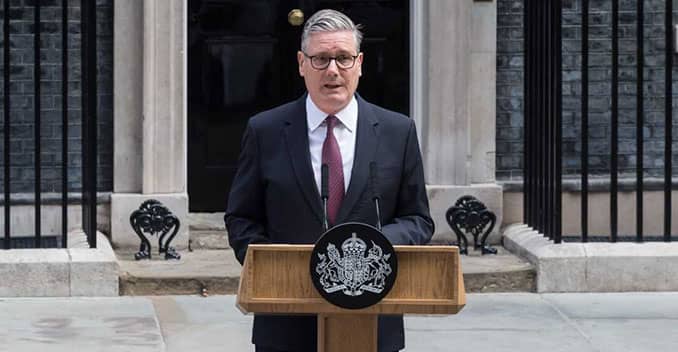
The Resignation of Prime Minister Starmer
On the morning of Monday, 22 June 2026, the short-lived era of technocratic leadership came to an abrupt, unceremonious end. Standing before a damp Downing Street, Keir Starmer announced his resignation as Prime Minister and leader of the Labour Party. It was an exit that had felt mathematically inevitable for months, yet its arrival delivered a profound systemic shock to the British political establishment. Elected in 2024 with a historic parliamentary majority, Starmer’s descent from an untouchable electoral juggernaut to a leader with a net approval rating of -46 represents one of the swiftest devaluations of political currency in modern British history. His departure marks Britain’s fifth prime ministerial transition in a mere four years, cementing an era of chronic institutional volatility.
The immediate catalyst for this executive collapse was a volatile cocktail of unforced errors, structural economic stagnation and a devastating surge by Reform UK in municipal contests. The appointment of Peter Mandelson as Britain’s ambassador to the United States—despite his publicised historical associations with Jeffrey Epstein—shattered the administration’s claims to ethical superiority. Coupled with a public backlash against the “Family Farms Tax” and a rolling series of policy reversals, the Parliamentary Labour Party found itself trapped in an existential panic. The myth of the discipline-first, human-rights-lawyer-turned-statesman was decisively broken, leaving behind a party that had won power by default but failed to define what it actually stood for.
Power, Principles and the Brutal Calculus of Governance
As Labour plunges into a high-stakes transition period, the looming leadership contest represents a fundamental battle for the soul of the center-left. The central tension lies between the continuation of a tightly controlled, risk-averse managerial state and a return to a more communicative, emotionally resonant form of regional populism. The party now faces a hyper-disillusioned electorate that has completely lost its appetite for abstract structural promises or focus-grouped talking points. This article dissects the immediate roadmap, the contenders waiting in the wings and the deep systemic lessons a fractured Labour Party must absorb if it is to survive its self-inflicted crisis.
The Roadmap to Restoring Vision
Re-engineering the Narrative
The first, most critical task facing the Labour apparatus is the formulation of a coherent roadmap to restore a completely evaporated national vision. Under Starmer, the government functioned as an elite firefighting unit, reacting to successive policy crises with legalistic defence mechanisms rather than an ideological North Star. To recover, the party must move beyond the basic mechanics of crisis management and outline an expansive, generational project that reconciles green industrial transition with localised economic security, or better yet apply common sense thinking to energy policy and not keep reaching for unobtainable targets which are totally unrealistic plunging the country further into energy trading torrents where the nation and British people are at the mercy of global forces. We really need to be self sufficient.
Without a definitive, easily understood narrative, any subsequent policy rollout will simply be consumed by the hostile media ecosystem. The new leadership cannot afford to treat communication as an afterthought; it must be the core engine of the state. The immediate path forward requires a clean break from the opaque, centralised decision-making structures of the past two years, replacing them with a transparent, mission-driven legislative framework that backbenches and local authorities can actively champion.
The Brutal Materialism of the British Electorate
The modern British electorate has developed a profound, near-total immunity to political spin. Right now, everyday citizens care about an explicitly narrow matrix of material realities: tangible economic prosperity, upward social mobility, systemic equality, a stabilising economy and the basic return of good governance. The intellectual debates occupying Westminster think-tanks mean absolutely nothing to households currently squeezed into unfair tax bands by ongoing threshold freezes.
For the average voter, the metrics of a successful government are not measured in abstract GDP adjustments or credit rating upgrades, Offstead reports etc but in the operational efficiency of the National Health Service and the predictability of monthly mortgage payments, less on bills and at the pump and most importantly at the supper market when putting food on the table. Any leadership contender who frames their platform around complex bureaucratic re-organisations rather than direct, felt improvements to working-class standards of living will find themselves rejected with alarming speed. The public demand is simple: make the country function properly again. And in fact I believe the Labour Parliamentary party is only stalling for time. When you have leaders in quick succession it rarely ends well. For Burnham, it’s a poison chalice and his first year in office will be a year of the long knives, never mind a night. And in the media to my eye he looks very much like Starmer’s younger brother only slightly less dislikable.
The Revisionist Exit Speech
When Keir Starmer delivered his concise, emotionally restrained, laboured and rehearsed farewell address outside Number 10, the prose was meticulously engineered to preserve a highly specific legacy. He framed the entirety of his tenure around a noble, sacrificial effort to rescue a Labour Party he inherited as “politically, financially and morally bankrupt,” casting his administration as a stabilising force that put country before party. It was a narrative designed for the history books, focusing heavily on his early legislative intentions to build a fairer country rooted in dignity and respect. This is very characteristic as Starmer’s failure politically to not really own up to any of the blunders that pushed him out, of his own making.
What was entirely omitted, was the sprawling graveyard of his own policy platforms. The speech made zero mention of the deeply unpopular corporate tax adjustments, the abandonment of crucial welfare reform initiatives, or the highly damaging fallout from the Mandelson diplomatic appointment. By completely sanitising his record of these structural failings and frequent U-turns, Starmer attempted to position his downfall as the result of external political toxicity rather than the direct consequence of his own compounding strategic errors it was an exercise in technocratic cognitive indifference.
The Return of the King of the North
The Makerfield Breakthrough and the Westminster Return
The entire calculus of this leadership crisis was fundamentally reshaped by the events in the Greater Manchester constituency of Makerfield. Following the strategic resignation of incumbent MP Josh Simons, the seat became the focal point of an intense, globally watched by-election on 18 June 2026. Andy Burnham, exiting his high-profile role as Metro Mayor of Greater Manchester, secured a resounding victory, capturing 24,937 votes (54.8 percent) and decisively beating back a highly aggressive challenge from Reform UK’s Robert Kenyon, who finished second with 15,696 votes. It’s still difficult how to analyse the results, it is likely more a clear mandate for Starmer to step down than it is a reflection of political realities. However all other parties including the Conservatives and Liberals need to take heed.
This victory was a critical proof point for a party reeling from recent local election defeats where Reform UK had made sweeping gains. Burnham successfully squeezed the minor party votes and reversed Labour’s slipping margins in the post-industrial North. Sworn into office at Westminster on Monday, 22 June—the very same day Starmer announced his exit—Burnham’s return to the House of Commons after an almost ten-year absence provides him with the mandatory parliamentary status required to contest the party leadership, completely upending the internal balance of power.
The Impending Battle for the Succession
Factions, Loyalists and Challengers
With the nominations threshold opening on 9 July, Westminster is bracing for a fierce factional war over who will fill the executive vacuum. The looming question is whether the party will experience a genuinely open, competitive democratic contest or a managed coronation. Potential heavyweights are already calculating their positions; figures like Wes Streeting and Deputy Leader Angela Rayner possess formidable internal networks, while a core contingent of Starmer loyalists are desperately searching for a candidate who can preserve the policy architecture of the current Downing Street operation and scupper the would be candidates.
The central conflict will pit Burnham’s outer-regional, devolution-heavy brand of populist politics against the urban, metropolitan managerialism of the Starmerite core. Streeting, representing the modernising right of the party and Rayner, holding deep roots within the traditional trade union base, could split the electorate significantly. If multiple candidates manage to secure the necessary nominations from fellow MPs by the 16 July deadline, the party faces a protracted summer hustings period that will expose deep, lingering ideological divisions to the wider public.
The Interim Regime and the July Timeline
In accordance with established constitutional convention, Keir Starmer will remain in post as Prime Minister and party leader until a definitive successor is formally chosen. This arrangement ensures the basic continuity of the state, but it leaves the current administration operating in a state of suspended animation. Starmer will effectively shepherd the government through the final weeks of the parliamentary term before the summer recess begins on 16 July, but his executive authority has been completely hollowed out.
As the political calendar transitions into July, the formal leadership machinery will begin in earnest. The timeline dictates that the Parliamentary Labour Party will narrow down the field of contenders before the summer break, leaving the wider membership and affiliated trade unions to cast their ballots over the warm months. Observers fully expect this period to be defined by a relentless torrent of front-page headlines, weaponised internal leaks and breaking news as rival camps engage in the trench warfare of Leadership contest. They have to be careful not to self implode.
The Architecture of the Next Cabinet
Personnel and the Price of Alignment
The eventual winner of the leadership contest will not just inherit the keys to Number 10; they will face the immediate, delicate task of constructing an entirely new Cabinet. This process will serve as the first true indicator of the new leader’s governing style and factional alliances. Senior figures currently occupying major state roles are facing an incredibly uncertain future, with the incoming Prime Minister likely to demand absolute ideological alignment in exchange for front bench survival.
The reshuffle will inevitably produce a dramatic series of promotions, demotions and possible expulsions. Figures who tied their reputations completely to Starmer’s controversial fiscal choices may find themselves unceremoniously relegated to the backbenches. Conversely, regional allies and early backers of the successful leadership bid will expect rapid elevation to key delivery departments, such as Health, Energy and the Treasury, as the new executive attempts to signal a clean break from the previous administration’s failures.
Managing Reality and the Myth of the Honeymoon
The British public is entirely aware that managing a country caught in structural economic stagnation is an incredibly tough task and they know that genuine institutional change will not happen overnight. The vital question hanging over the next Prime Minister—particularly if it is Andy Burnham—is whether the electorate will grant them a traditional political honeymoon period and exactly how long that patience will last. Given the acute level of public cynicism, any grace period is likely to be remarkably short.
Voters will not tolerate a repeat of the early Starmer narrative that “things will get worse before they get better.” The next leader will be expected to deliver immediate, highly visible policy victories within their first hundred days to prove that the executive transition was worth the political chaos. If the incoming government fails to stabilise energy caps or reverse the effects of fiscal drag quickly, the public mood will curdle back into the same toxic disillusionment that destroyed Starmer’s premiership.
To avoid repeating the catastrophic errors of the recent past, the Labour Party must undergo a profound structural transformation in how it approaches both policy and power. The fundamental mistake of the Starmer administration was its over-reliance on an insular, technocratic inner circle that treated the wider parliamentary party and the public as elements to be managed rather than engaged. The party must immediately dismantle this culture of hyper-centralisation and rebuild its policy pipelines from the ground up.
Furthermore, the next administration must stop treating policy U-turns as simple tactical adjustments. Each reversal severely degraded the public’s belief in the party’s core integrity, creating a vacuum of conviction that Reform UK successfully exploited. Labour must establish a clear, unshakeable set of core economic principles and stick to them with absolute legislative discipline, proving to a skeptical electorate that the government possesses the courage of its own stated convictions.
The Blank Canvas Problem
Why was Keir Starmer so intensely, uniquely unpopular with the British public? The answers lie within the fundamental construction of his political persona. Throughout his rise to power, Starmer operated as a blank canvas onto which an exhausted electorate projected their varied frustrations with years of previous political chaos. However, once inside Downing Street, that absolute lack of defining political texture transformed from a strategic asset into a fatal governing flaw. And also, the public has become a lot less forgiving so for this one caveat emptor.
Voters quickly grew to perceive his calm, legalistic delivery as a profound absence of genuine conviction and political nous. His swift abandonment of the very pledges that won him the party leadership created an indelible public impression of a politician who lacked an authentic ideological anchor. When hit by major controversies—such as the Mandelson appointment and the implementation of regressive business adjustments—there was no deep reservoir of public affection or clear vision for him to fall back on, leaving his premiership to collapse under the weight of its own perceived empty technocracy.
The Final Opportunity for Centre-Left Governance
Labour has one last shot to learn from the errors of the last two years. A failure to act now will inevitably result in an absolute doomsday scenario for the party, especially at general election.
The dramatic events of June 2026 have stripped away the final remnants of complacency within the Labour Party. The transition currently underway is not a routine changing of the guard; it is an urgent, high-stakes rescue mission for a government that lost its way within twenty-four months of a landslide victory. The British public has made it perfectly clear that a massive parliamentary majority means absolutely nothing if it is not deployed in the service of a clear, transformative national project.
The incoming leadership faces an exceptionally narrow window of opportunity to repair its fractured relationship with the electorate. If the next Prime Minister can successfully channel the lessons of the Starmer collapse—replacing opaque managerialism with material economic delivery and an authentic, communicative vision—Labour can still salvage its mandate. If they fail, they will have paved a direct, unobstructed path for a destructive wave of right-wing populism that could reshape British politics for a generation.
Have your say
Join the conversation and drop a comment below or follow us on facebook, instagram, youtube, TikTok, LinkedIn and X/Twitter or why not submit your own article! Or email at contribute@criticalmatters.net
Verified Facts
- On Monday, 22 June 2026, Keir Starmer formally announced his resignation as Prime Minister and leader of the Labour Party outside 10 Downing Street.
- The 2026 Makerfield by-election occurred on Thursday, 18 June 2026, following the resignation of incumbent Labour MP Josh Simons.
- Andy Burnham won the Makerfield by-election with 24,937 votes (54.8%), defeating Reform UK candidate Robert Kenyon who received 15,696 votes (34.5%).
- Andy Burnham was officially sworn in as a Member of Parliament at Westminster on Monday, 22 June 2026, ending an absence from the House of Commons dating back to 2017.
- Nominations for the Labour leadership contest are scheduled to formally open on 9 July 2026, with the parliamentary stage concluding on 16 July 2026 before the summer recess.
- At the time of his resignation announcement, Keir Starmer’s public favourability tracking sat at a net approval rating of -46 according to YouGov political polling data.
Links
- The Guardian: Keir Starmer has quit as prime minister – what will happen next in UK politics?
- The Guardian Commentisfree: Keir Starmer’s fatal flaw? The blankness on to which voters projected their years of frustration
- YouGov: Snap poll: most Britons say Keir Starmer right to resign
- LabourList: Andy Burnham elected MP for Makerfield with over 54 per cent of the vote
- UK Parliament: Last election result for Andy Burnham MP for Makerfield
- Unite the Union: Keir Starmer’s resignation: Unite reaction and structural statement



Be the first to comment