

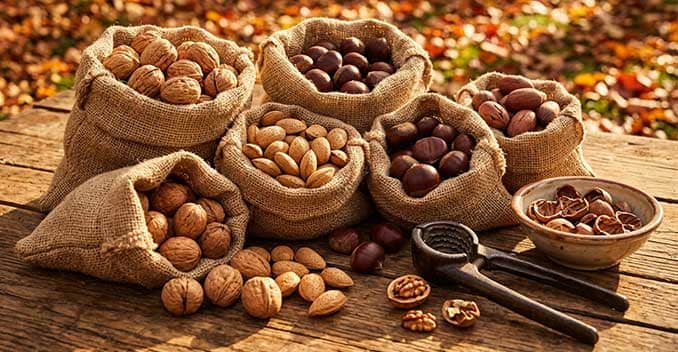
In our modern world of neon-coloured snacks and ultra-processed “energy bars”, it is easy to forget that humanity’s original power food didn’t come from a factory—it fell from a tree. For millennia, nuts have been the ultimate survival pack. They are compact, shelf-stable, and packed with the kind of high-density fats and proteins that fueled our ancestors through harsh winters and long migrations. Today, as we pivot back towards whole foods, the humble nut is reclaiming its throne as the pinnacle of nutritional value.
Nuts are far more than just a crunchy accompaniment to a cold drink. They represent a global food arc that spans from the royal courts of Persia to the hunter-gatherer tribes of the Amazon. Whether it’s the “Green Gold” of an Iranian pistachio or the wild-harvested selenium bomb of a Brazil nut, these little kernels are tiny vaults of medical proof and holistic benefit. In this article, we’ll crack open the history, the culture, and the extraordinary health values of the world’s most famous nuts, guiding you back to a diet that is as old as the hills and as fresh as the latest harvest.
1. The Botanical Identity Crisis: What is a Nut?
To a chef, anything crunchy and oily is a nut. To a botanist, however, the definition is strictly disciplined. A True Nut is a dry fruit with a hard shell that does not split open at maturity to release its seed. Think of the Hazelnut, the Chestnut, or the Acorn. Most of what we call “nuts” are actually Drupes—fleshy fruits with a stone in the middle, like a peach. When you eat an Almond, a Walnut, or a Pistachio, you are eating the seed inside that stone. And then there is the Peanut, the great imposter. It is a Legume, more closely related to peas and lentils than to the Walnut. Regardless of the label, they all share a common theme: they are nutrient-dense seeds designed by nature to start a new life, which is precisely why they are so vital for ours.
2. Nature’s Pharmacy: Why Nuts are Good for Us
The nutritional profile of nuts is a masterpiece of biological engineering. They are one of the few natural sources of monounsaturated and polyunsaturated fats, which are the building blocks of heart health. Scientific studies consistently show that a handful of nuts (approx. 30g) a day can significantly lower the risk of cardiovascular disease. They are high in fibre, which supports gut health, and are packed with Vitamin E, a powerful antioxidant. For those avoiding ultra-processed foods, nuts provide a “slow-release” energy that prevents the blood sugar spikes common with modern snacks. They aren’t just food; they are a medical intervention in a shell.
3. The Evolutionary Bond: How Humans and Nuts Grew Together
Archaeological evidence from the Stone Age suggests that nuts have been a staple of the human diet for over 780,000 years. Excavations in the Jordan Valley have uncovered nut-cracking tools alongside remains of wild almonds and pistachios. In Europe, the Hazelnut was a primary source of protein for Mesolithic hunter-gatherers. Our ancestors didn’t just eat nuts; they evolved with them. The high-fat content of nuts is thought to have supported the massive energy requirements of the developing human brain. Before the advent of farming, nuts were a “prestige food”—difficult to harvest but providing more calories per gram than almost any other wild plant.
4. The Animal Connection: The Original Nutcrackers
We aren’t the only ones who know a good thing when we see it. Squirrels, jays, and chipmunks are the forest’s primary “investors.” They cache thousands of nuts every autumn, acting as accidental foresters. A single Jay can hide up to 5,000 acorns in one season, many of which are forgotten and grow into the next generation of oaks. In the tropical rainforests, Monkeys use sophisticated tools to crack open Cashews and Macadamias. This interspecies love for nuts has shaped entire ecosystems, ensuring that nut-bearing trees are dispersed far and wide.
5. Fun Facts and Seasonal Rhythms
Did you know that Cashews grow out of the bottom of a “Cashew Apple”? Or that Pistachios are known in China as the “Happy Nut” because the split shell looks like a smile? In terms of growth, nuts are deeply seasonal. In the Northern Hemisphere, most are harvested between August and October. In the Southern Hemisphere, Walnuts from Chile or Macadamias from Australia are harvested around April. This natural cycle means that before global shipping, nuts were a cherished winter luxury, traditionally found in Christmas stockings as a symbol of prosperity.
The Nut Gallery Roundup Straight to the Kernel
The Brazil Nut (The Amazonian Superfood)
Origin: The Amazon Rainforest (Brazil, Bolivia, Peru)
Cultural Arc: Historically a wild-harvested survival food for indigenous tribes.
The Brazil Nut is unique because it cannot be “farmed” in the traditional sense; it requires the complex ecosystem of the wild rainforest to be pollinated. It is the world’s richest source of Selenium—just two nuts provide the entire recommended daily allowance. In South American cuisine, they are often eaten raw or used in traditional desserts, serving as a reminder of the forest’s untouched bounty.
The Pine Nut (The Peasant’s Gold)
Origin: Mediterranean (Stone Pine) and Asia
Cultural Arc: A staple of Mediterranean “Cucina Povera” (Peasant Food).
Harvested from pine cones, these were once the survival food of Roman soldiers. Today, they are the soul of Pesto Alla Genovese. High in Vitamin K and Magnesium, they are essential for bone health. They are labour-intensive to harvest, which explains their status as one of the most expensive nuts per gram on the market.
The Walnut (The Brain Food)
Origin: Ancient Persia
Cultural Arc: A symbol of wisdom and fertility in Greek and Roman cultures.
The Walnut is the only nut with significant amounts of Omega-3 (Alpha-linolenic acid). Its shape, famously resembling the human brain, was noted by ancient herbalists who believed it could cure mental ailments—a “doctrine of signatures” that modern science has partially validated through its neuroprotective benefits.
The Chestnut (The Mountain Bread)
Origin: Southern Europe and Asia
Cultural Arc: Known as “The Bread Tree” in mountainous regions of Italy and France.
Before the potato arrived from the Americas, the Chestnut was the primary carbohydrate for Europe’s mountain peasants. Unlike other nuts, it is low in fat and high in Vitamin C. It is traditionally roasted or ground into flour for homemade pasta and bread, representing a cuisine born of necessity and rugged resilience.
The Almond (The Royal Treat)
Origin: Middle East and North Africa
Cultural Arc: A symbol of luxury and hospitality in the Bible and ancient Egypt.
Almonds are the protein powerhouse of the nut world, with 21g of protein per 100g. They migrated along the Silk Road and became a staple of “Marzipan” in royal European courts. Today, they are the ultimate “clean” snack, rich in Riboflavin and heart-healthy fats.
The Macadamia (The King of Crunch)
Origin: Australia (Queensland)
Cultural Arc: An indigenous “Bush Tucker” food for the Aboriginal peoples.
With the highest fat content of any nut (76g per 100g), the Macadamia was once a rare delicacy. It has an incredibly hard shell that requires 300 pounds per square inch of pressure to crack. It is rich in Manganese, supporting bone health and metabolism.
Cracking the Code to Health
In an era of dietary confusion, the nut offers a simple, ancient solution. It is a whole food, minimally processed (ideally eaten raw or dry-roasted), and carries the cultural DNA of the people who first harvested it. By incorporating a variety of nuts—from the selenium-rich Brazil nut to the omega-dense Walnut—you aren’t just snacking; you are engaging in a 700,000-year-old tradition of health. So, next time you feel a mid-afternoon slump, reach for the “Peasant’s Bread” or the “Green Gold” and give your body the ancient fuel it was designed to run on.
[Facts]
- 780,000 Years: The approximate time humans have been eating nuts according to archaeological finds.
- 21g: The amount of protein in 100g of Almonds.
- 76g: The fat content in 100g of Macadamia nuts.
- 30g: The recommended daily serving of nuts for cardiovascular health.
- 180 Million Years: The estimated age of the Daintree rainforest, home to many ancient nut precursors.
- 2 Nuts: The number of Brazil nuts needed to meet the daily requirement for Selenium.


Be the first to comment