

Automated Muses
We have entered a deeply strange, highly unstable cultural epoch where the act of creation has been compressed into a text box. Write a sentence, get a symphonic score. Click a button, generate an illustration. But as the initial novelty curdles into market saturation, we are forced to confront a harsher reality. The promise was that artificial intelligence would automate the boring corporate drudgery, freeing humanity to spend its days growing, travelling and growing in self erudition and probably writing philosophy or blog posts. Instead, the exact inverse has occurred. The algorithms are writing the poetry and painting the canvas, while humans are left to manage the crushing administrative debt of editing, prompt-tweaking and verification. It is a profound structural bait-and-switch that is quietly reshaping the very fabric of global culture.
As code increasingly replicates styles, the boundary between authentic human expression and calculated algorithmic mimicry is trying to dissolve. This tension is no longer confined to academic debates or niche subcultures; it is playing out across volatile financial markets, resource-strapped ecosystems and the everyday livelihoods of entry-level workers. We must trace the threads of this transformation, looking past the slick corporate marketing decks to evaluate what happens to a society when its cultural output is dictated by hyper-scaled statistical probabilities.
Creative Proletariat
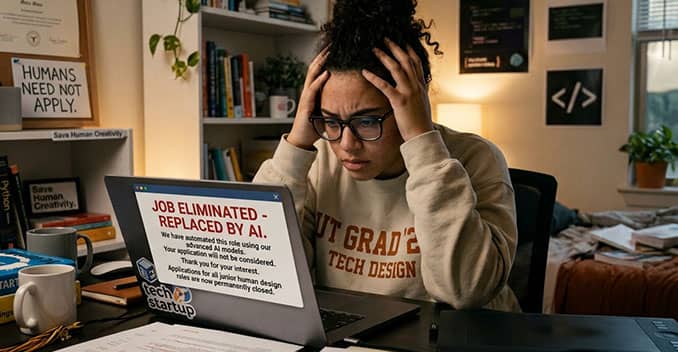
The Vanishing Entry Level
The question of whether artificial intelligence represents a net win or a catastrophic loss for human creativity is a sharp, double-edged sword. On one side of the blade, the democratic potential is immense: an individual can theoretically conceptualise, iterate and execute complex visual or written narratives at a pace that would have historically required an entire production studio. Yet, this hyper-efficiency carries a brutal premium. The heaviest impact is being absorbed not by established creative directors, but by junior workers and the next generation of creative professionals looking for an entry point into the market.
As startups rapidly integrate generative pipelines to maximise commercial impact, traditional entry-level positions are evaporating. The routine, foundational tasks that once served as the mandatory apprenticeship for young writers, illustrators and developers are being outsourced to machines. Work that would have previously generated competitive bidding wars for junior creatives on freelance platforms like Fiverr is now handled instantly for pennies. Combined with relentless waves of redundancies across major technology institutions, the bottom rungs of the creative ladder are being systematically dismantled, leaving a highly educated workforce with nowhere to begin their careers.
Market Volatility
Is this monumental trade-off actually worth the structural destabilisation of the creative workforce, or does the modern professional simply need to swallow their pride and get on board? The answer remains an emergent, highly volatile phenomenon. Despite hundreds of billions of pounds flowing into generative infrastructure, the entire ecosystem is sitting on an over-leveraged tech position that is increasingly looking like an asset bubble waiting for a pin. The industry is defined by profound structural instability and intense sensitivity to shifting macroeconomic winds and volatile fundamentals.
This fragile reality was laid bare during a massive Wall Street correction in June 2026, where growing skepticism over the actual financial returns of massive enterprise spending triggered a sharp sell-off. Trillion-pound hardware giants and key GPU chipmakers saw astronomical sums wiped off their valuations in a matter of days. Investors who bankrolled the infrastructure are growing intensely impatient; they want to see clear, recurring software revenue rather than endless technical demos. If the underlying financial engine stalls due to market fatigue, the creative sector may find itself structurally upended by a tool whose economic foundation was built on sand.
The AI Fatigue Loop
The Hidden Cost of Anti-Work and Tech Debt
The promised return on investment for generative tools frequently ignores a growing, counter-productive phenomenon: the generation of “anti-work” and compounding technical debt. This is the precise point where the illusion of machine efficiency shatters. Creative teams are finding that they regularly spend significantly more time massaging, correcting and perfecting a good but inherently flawed machine output than they would have spent creating the asset entirely from scratch.
This trap is known as the ‘AI fatigue loop’. It is a tedious process where a designer edits a text prompt fifty times, cross-references historical data points, cleans up anatomical anomalies and fixes broken syntax just to get a usable pitch deck illustration or marketing copy or boilerplate set of unit tests. The initial speed of generation is completely canceled out by the prolonged tax of human revision. Instead of liberating the creative mind, the process turns the human designer into a glorified, exhausted editor of uninspired machine templates.
The Myth of the Autonomous Creator
Hallucinations and the Reality of the Digital Helper
The widespread narrative that generative code can function as an autonomous creator capable of replacing human intuition remains a corporate myth. To preserve any semblance of cultural quality, consumers and executives must reframe these systems as algorithmic helpers rather than standalone creators. While these models are exceptionally adept at breaking the tyranny of the blank page—producing baseline templates, outline foundations and code snippets—they lack any conceptual understanding of the world they mimic.
When tasked with executing genuinely complex, completely new, high-stakes assignments, the systems consistently falter. This is essentially because of inference. In fields requiring absolute precision, such as complex bioengineering, advanced structural engineering, or highly nuanced conceptual design, the tendency of these models to confidently generate plausible-sounding fabrications—commonly known as hallucinations—renders them highly dangerous without strict human oversight. The technology is undoubtedly improving at a breakneck trajectory, but treating it as an independent creative agent is a fundamental misunderstanding of statistical probability.
Wrapper Saturation and Future Feature Paywalls
The Saturated Marketplace of Single-Purpose Utilities, AI Go Faster
The modern software marketplace is thoroughly saturated with an endless parade of single-purpose startups that are often little more than thin interfaces wrapped around existing foundation models. Utilities like DeepAI and DomoAI offer highly specific, often hit-and-miss visual processing outputs that capture brief cultural attention before fading into irrelevance. For the working creative, navigating this fragmented landscape is an expensive, frustrating exercise in diminishing returns. At least at this level serious creative cannot be wholly outsourced to AI.
Because these platforms almost universally operate on predatory freemium pricing models, the advanced settings required to generate commercially viable assets are locked tight behind expensive tier paywalls. The micro-subscription costs accumulate with alarming speed, forcing professionals to realise that relying on a unified, multi-purpose system that evolves over time is a far more sustainable strategy. Even the titan software ecosystems are not immune to quality concerns; the output from early iterations of Adobe Firefly faced heavy criticism from professionals for feeling clinical and uninspired, though the platform is steadily iterating to defend its market dominance and improving.
The Environmental Cost of the Cloud and Ground AI Data Centres
The staggering material cost of keeping these systems operational raises profound, uncomfortable ethical dilemmas at a moment when global ecological resources feel incredibly scarce. In a world grappling with accelerating climate disruptions and intense regional resource competition, the wisdom of constructing massive, power-hungry computational hubs must be rigorously questioned. This environmental reality was highlighted by Meta’s expansive data center infrastructure rollouts, which require immense resources to keep cutting-edge server racks from overheating.
The data demands are staggering: standard hyperscale installations require millions of gallons of water daily to operate their evaporative cooling mechanisms. In arid or drought-prone territories, this corporate consumption places tech giants in direct conflict with the basic survival needs of local populations. We face a dystopian scenario where local agricultural communities could find their communal water tables severely depleted to power server hubs whose primary cultural function is generating synthetic images of cats for social media feeds.
The Fiction of the Unbiased Metric
Algorithmic Bias and Historical Confabulation
The internal architecture of modern generative models is deeply compromised by systemic algorithmic bias and training dataset corruption. Because these systems are trained on vast, uncurated scrapes of the historical internet, they naturally absorb and magnify the structural prejudices, historical omissions and cultural stereotypes of the data they consume. The resulting outputs regularly perpetuate deeply unhelpful caricatures, reinforcing societal biases under the guise of objective, machine-generated neutrality.
More concerning still is the tendency of these models at times to produce outright fiction when queried about historical milestones or real-world events. When the system encounters a gap in its training dataset, it does not stop; it seamlessly invents plausible-sounding dates, figures and historical narratives that have absolutely no basis in reality. This smooth confabulation presents an existential threat to the integrity of public information, transforming digital archives into echo chambers of synthetic myth where historical truth is systematically eroded.
Transparency, Regulation and the Human-in-the-Loop
Within the closely guarded corridors of the global entertainment complex—across major film studios, record labels and broadcast networks—artificial intelligence is being experimented with. Studios remain intensely protective of their exact workflows, terrified of public backlashes or union disputes, yet the technology is deeply gaining more adoption. Algorithms are quietly utilised to analyse script pacing, generate early concept art, pre-visualise complex sequences and sketch out temp musical scores.
The reality of modern entertainment is not the total displacement of the artist, but a heavily integrated, partnered approach where human-in-the-loop (HITL) systems guide the machine’s raw computational output. Pure machine output lacks the emotional resonance, subtext and happy accidents that define enduring art. While the creative workforce can take a breath knowing their unique perspectives remain vital, there must be a global, unified push toward strict corporate governance, copyright transparency and statutory regulation. We cannot allow the preservation of human culture to be sacrificed to corporate optimisation.
Preserving the Human Anchor in a Synthetic World
The Future Battle for Cultural Authenticity
The rapid expansion of artificial intelligence throughout the cultural sphere has permanently altered how society produces, consumes and values creative expression. The initial hyperbole positioning these tools as either the absolute saviour or the total executioner of human art has faded, revealing a complex, grinding landscape of industrial optimisation. The true danger facing modern culture is not a sudden takeover by sentient machines, but a slow, corporate slide into algorithmic mediocrity—a world where our films, books and music are explicitly engineered to satisfy retention metrics rather than provoke genuine human emotion. And, ironically its a world of our making.
To stem this synthetic future, the creative community must aggressively reassert the value of the human anchor. The flaws, the inefficiencies and the emotional vulnerabilities that define human creation are not bugs to be patched out by an engineering team in Silicon Valley; they are the exact qualities that make art meaningful. As we navigate this transition, our focus must remain fixed on holding technology platforms accountable to the societies they profit from, ensuring that the automation of our tools never mutates into the devaluation of our souls.
Have your say, What do You Think About the Rise of AI?
Join the conversation and drop a comment below or follow us on facebook, instagram, youtube, TikTok, LinkedIn and X/Twitter or why not submit your own article! Or email at contribute@criticalmatters.net
Verified Facts
- In June 2026, concerns regarding high valuations, a hawkish Federal Reserve outlook and growing skepticism over the commercial returns of enterprise AI spending led to a significant market correction, wiping out $680 billion from tech indices in a single week.
- Major chipmakers and memory suppliers, including Nvidia, Micron, Qualcomm and SK Hynix, experienced sharp valuation drawdowns in mid-June 2026, with Nvidia’s market cap briefly dipping below the $5 trillion threshold.
- Meta’s global sustainability architecture outlines a corporate commitment to achieve a “water positive” status by 2030, pledging to restore more water to local watersheds than its infrastructure consumes.
- Meta’s standard one-gigawatt, AI-optimised data centre design, scheduled to become operationally active later in 2026, utilises a closed-loop liquid cooling system paired with dry coolers to mitigate traditional evaporative water loss.
- Academic and environmental impact assessments project that hyperscale data center operations within the state of Texas alone will consume an estimated 49 billion gallons of water annually by the conclusion of 2025.
Links
- Financial Times: US chipmakers lead Wall Street slide on interest rate rise worries
- Pluang News: NVIDIA stock dips near $200 amid broad chip selloff, testing key support level
- Meta Data Centers: Water Stewardship and Infrastructure Resilience Program
- NetZeroCompare: Meta Expands Water Stewardship Initiatives in Data Center Communities
- Lincoln Institute of Land Policy: Data Drain: The Land and Water Impacts of the AI Boom



Be the first to comment