

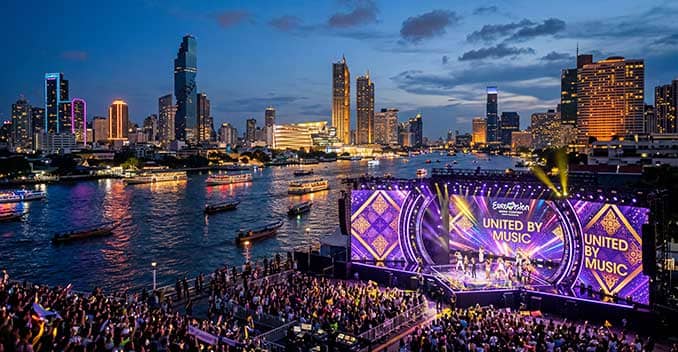
The Eurovision Song Contest has always been a beautiful, glittering paradox. Born in 1956 as a technocratic experiment by the European Broadcasting Union (EBU) to test the limits of live international broadcasting, it has morphed into a sprawling, camp, and occasionally profoundly moving geopolitical chess match. For decades, it was a strictly continental affair, a way for a fractured post-war Europe to hum the same tune for three minutes. But the borders have been more porous for years. From Israel’s debut in 1973 to Australia’s permanent residency since 2015, the “Euro” in Eurovision has become increasingly metaphorical.
Now, the expansion is heading for a definitive pivot. As of March 2026, the EBU and partners like Voxovation have officially confirmed that the inaugural Eurovision Song Contest Asia will land in Bangkok, Thailand, on 14 November 2026. It is a move that feels both inevitable and risky. To the purist, it’s brand dilution; to the strategist, it’s an untapped market of 600 million people. Bangkok, a city that already functions as a global cultural crossroads, is the perfect stage for this experiment in “soft power” pop. It is edgy, it is maximalist, and it understands the assignment: spectacle above all.
The Foundations of a Pop Empire
A Brief History of Musical Federalism
The contest didn’t start with glitter cannons. It started in Lugano, Switzerland, on 24 May 1956, with seven nations and a very polite set of rules. Each country brought two songs—the only time that was ever allowed—and Lys Assia took the trophy for the hosts. Since that quiet evening, the contest has grown into a titan. To date, over 50 countries have stepped onto the stage. The evolution from the monochrome “Grand Prix” to the psychedelic arena shows of the 2020s mirrors the continent’s own growing pains.
The mechanics of the win have always been the draw. Ireland and Sweden sit at the top of the food chain with 7 wins apiece. However, the modern era belongs to the efficient; Ukraine, with only 21 participations, boasts a staggering 14% win rate (3 wins), the highest in the contest’s history. It’s a masterclass in using the platform not just for art, but for national narrative. The contest has survived the Cold War, the fall of the Berlin Wall, and the advent of the internet, proving that as long as there is a scoreboard and a sequin, people will watch.
Cultural Temblors: When the Song is Secondary
Eurovision isn’t just about the music; it’s about the “moment.” In 1998, Dana International became the first transgender winner, a cultural earthquake that originated from Israel and rattled traditionalists across the globe. Then there was Conchita Wurst in 2014, whose “Rise Like a Phoenix” victory was less a song and more a manifesto for European liberalism. These aren’t just entries; they are benchmarks of social change.
The contest acts as a mirror. In 2022, Ukraine’s Kalush Orchestra secured a massive 631 points, largely propelled by a record-breaking public vote of 439 points. It was a reminder that the “United By Music” slogan isn’t just marketing—it’s a diplomatic tool. When the world is watching, the three minutes on stage become the most valuable real estate in the world for a nation looking to define its identity.
The British Renaissance and the Five-Star Club
For a long time, the United Kingdom was the grumpy uncle of the contest—occasionally brilliant, often disillusioned. But the stats don’t lie: the UK has won five times. The roll call is a tour of pop history: Sandie Shaw (1967), Lulu (1969), Brotherhood of Man (1976), Bucks Fizz (1981), and Katrina and the Waves (1997).
The 1976 win with “Save Your Kisses for Me” was a particular juggernaut, earning 164 points, a record that stood for a decade. After a long “nil points” drought in the early 21st century, the UK found its groove again with Sam Ryder in 2022, who took “Space Man” to 2nd place with 466 points. It proved that the British music industry, when it actually tries, can still dominate a format it helped create.
Politics, Protests, and the Forbidden 12 Points
The EBU insists the contest is non-political, which is arguably the funniest joke in entertainment. Controversy is baked into the DNA. Take 1978, when Jordanian broadcaster JTV cut the feed because it became clear Israel was going to win, eventually showing a picture of some daffodils instead of the results.
Or consider the 2009 Georgian entry, “We Don’t Wanna Put In,” which was disqualified for its not-so-subtle dig at the Russian leader. More recently, the 2024 contest in Malmö was defined by the tensions surrounding Eden Golan’s entry, “Hurricane,” which faced intense scrutiny and protests. Eurovision is where the world’s frictions are played out in four-four time, and that friction is exactly what keeps the ratings high.
The Pantheon: The Top 10 Elite
If we look at the sheer weight of points and cultural impact in the modern era, the leaderboard is a mix of heritage and high-concept artistry.
| Rank | Year | Country | Artist | Song | Points |
| 1 | 2017 | Portugal | Salvador Sobral | “Amar pelos dois” | 758 |
| 2 | 2022 | Ukraine | Kalush Orchestra | “Stefania” | 631 |
| 3 | 2017 | Bulgaria | Kristian Kostov | “Beautiful Mess” | 615 |
| 4 | 2024 | Switzerland | Nemo | “The Code” | 591 |
| 5 | 2023 | Sweden | Loreen | “Tattoo” | 583 |
| 6 | 2024 | Croatia | Baby Lasagna | “Rim Tim Tagi Dim” | 547 |
| 7 | 2016 | Ukraine | Jamala | “1944” | 534 |
| 8 | 2018 | Israel | Netta | “Toy” | 529 |
| 9 | 2023 | Finland | Käärijä | “Cha Cha Cha” | 526 |
| 10 | 2021 | Italy | Måneskin | “Zitti e buoni” | 524 |
Why Eurovision Still Matters in 2026
In an era of fragmented streaming and niche algorithms, Eurovision is one of the last “water cooler” moments left. It’s a monoculture event in a multiculture world. Last year, only 30% of contestants sang in their native language—a controversial dip from 100% in 1956—but the spectacle remains universal. It is the Olympics of pop, a place where Måneskin can go from the Sanremo stage to global superstardom in a single night. It’s not just a show; it’s an incubator.
Crossing the Rubicon: The Expansion Beyond Europe
The term “Eurovision” has always been about the Eurovision Transmission Network, not geography. This explains why Morocco (1980), Israel, and Azerbaijan are regulars. Australia’s inclusion in 2015 was the first major break in the dam, and it worked. Dami Im’s 2nd place in 2016 proved that the Eurovision aesthetic isn’t bound by latitude or longitude. The upcoming Eurovision Song Contest Asia is the logical conclusion of this globalist philosophy.
The Heart of the Concept: Can Thailand Host?
At its core, Eurovision is about “United By Music.” It’s about creating a neutral space where cultural exchange happens through a very specific, high-gloss lens. For a country like Thailand, hosting isn’t just about the music—it’s about branding the nation as the cultural hub of Southeast Asia. The choice of IdeaLive in Bangkok, a venue within the BRAVO BKK complex with a capacity for 4,000+ guests, suggests a focus on intimacy and high-production broadcast quality rather than just raw stadium size.
Bangkok’s Bid: The Road to November 2026
The bid was officially confirmed on 31 March 2026. Thailand’s Channel 3, in partnership with S2O Productions, is leading the charge. Bangkok is a logistical powerhouse, consistently ranking as one of the most visited cities on earth with upwards of 20–30 million visitors annually. By securing the 14 November 2026 date, Thailand is positioning itself as the leader of the Asian expansion. The “Soft Power” initiative of the Thai government is clearly at play here, using the contest to drive tourism and creative growth.
The Entry: Will Thailand Compete?
Yes. Thailand is not just hosting; they are a flagship participant. The Eurovision Song Contest Asia 2026 will feature a provisional lineup of 10 countries, including South Korea, Vietnam, the Philippines, Malaysia, and Bangladesh. Thailand’s entry will be selected through a national final, a process that usually guarantees a high-stakes, highly produced local celebrity face-off. The winner of this inaugural Asian contest will also be invited to perform as a guest at the main Eurovision Song Contest 2027 in Europe, finally closing the loop between the two hemispheres.
Summary: The Continental Shift
A New Rhythm for the Golden Land
The expansion of Eurovision into Thailand is a bold, albeit somewhat cynical, play for global relevance in an increasingly Eastern-centric century. It is a collision of the EBU’s rigid European structures and the fluid, vibrant, and often chaotic energy of the Asian pop market.
While purists may argue that the “Euro” is being surgically removed from the brand, the reality is that Eurovision has always been about the expansion of influence. By placing the first Asian edition in Bangkok, the EBU is betting on Thailand’s unique ability to blend the traditional with the avant-garde. If the contest can navigate the regional geopolitics as well as it has the European ones, the 14 November 2026 final at IdeaLive won’t just be a concert; it will be the start of a new world order in entertainment.
Balanced against the risks of cultural sanitisation and “over-branding,” the prospect of a Thai-produced Eurovision is undeniably exciting. It’s edgy, it’s overdue, and it’s exactly what the aging contest needs to stay “hip.”
[Facts]
- 1956: The year the Eurovision Song Contest was founded in Lugano, Switzerland.
- 5 wins: The number of times the United Kingdom has won the contest.
- 14 November 2026: The date of the inaugural Eurovision Song Contest Asia in Bangkok.
- 758 points: The highest score ever recorded (Salvador Sobral, Portugal, 2017).
- 30%: Percentage of 2025 entries that sang in their native language.
- 14%: Ukraine’s win rate, the highest in the competition.
- 4,000+: Seating capacity of the IdeaLive venue in Bangkok.



Be the first to comment