

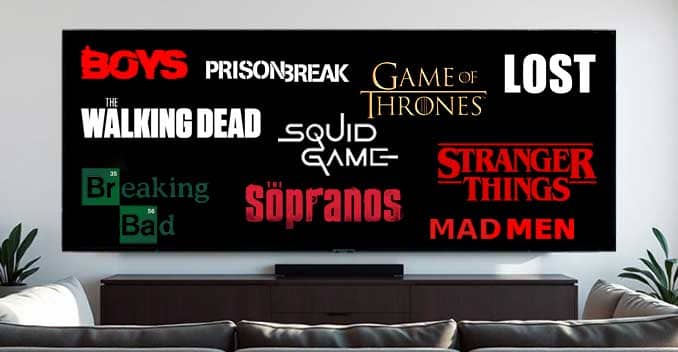
There was a time, back when the ‘90s were still smelling of teen spirit and optimism, that television was a polite guest in our living rooms. It wore a tie, it told jokes with a laugh track, and it made sure that by the 59th minute, the world was back on its axis. But then, somewhere around 1999, the guest stopped leaving. It took off its tie, sat in our best armchair, and started telling us uncomfortable truths about our fathers, our empires, and the thin, vibrating line between a hero and a monster.
In the last thirty years, we haven’t just watched TV; we’ve been indoctrinated and radicalised by it. We’ve moved from the “Must-See TV” monoculture of the broadcast giants to a fragmented, high-octane landscape where a South Korean critique of capitalism can become the biggest show in British history within a fortnight. This isn’t just entertainment; it’s a visceral, high-definition mirror. We’ve traded the comfort of the sitcom for the cold, hard logic of the prestige drama—a genre that doesn’t just want your attention, it wants your soul.
From the suburban malaise of New Jersey to the radioactive ghosts of Pripyat, the following sixteen series didn’t just capture the zeitgeist; they grabbed it by the throat and shook it until the loose change fell out. They are edgy, often controversial, and entirely unapologetic. They’ve turned actors into icons and viewers into obsessed detectives. This is the definitive hierarchy of the non-comedy series that broke the mould.
1. The Sopranos
Creator: David Chase
Key Characters: Tony Soprano, Carmela Soprano, Christopher Moltisanti, Dr Jennifer Melfi.
Fan Favourites: Paulie ‘Walnuts’ Gualtieri, Silvio Dante.
Premiering on 10 January 1999, The Sopranos didn’t just change TV; it invented the world we currently live in. Before Tony Soprano (James Gandolfini) walked into Dr Melfi’s office, the protagonist had to be “likable.” Chase decided that was boring. Tony was a sociopath, a murderer, and a deeply depressed father who loved his ducks. The narrative arc wasn’t about him becoming a better man—it was about the impossibility of change in a world built on blood and gabagool.
The show’s iconic moments are etched into the cultural subconscious: the sudden, silent “cut to black” in the June 2007 finale, the strangling of a rat in Maine while touring colleges with his daughter. It gave us the “Prestige Drama” blueprint: slow pacing, psychological depth, and a refusal to explain itself. Gandolfini’s performance remains the high-water mark of the medium, a physical manifestation of American anxiety that grew more gargantuan with every season.
2. Game of Thrones (GoT)
Creators: David Benioff & D.B. Weiss (Based on George R.R. Martin).
Key Characters: Jon Snow, Daenerys Targaryen, Tyrion Lannister, Cersei Lannister.
Fan Favourites: Arya Stark, The Hound, Brienne of Tarth.
If The Sopranos was the scalpel, GoT was the broadsword. Debuting in April 2011, it took high fantasy—a genre previously reserved for nerds and Renaissance fairs—and made it the most-watched show on the planet. Its narrative arc was a brutal lesson in consequences: if you play the game of thrones, you win or you die. There was no plot armour. When Ned Stark’s head hit the floor in Season 1, the collective gasp of 18.4 million viewers (by the finale) was heard across the Atlantic.
The “Red Wedding” remains perhaps the most traumatising hour in television history, a masterclass in subverting expectations. While the final season in 2019 remains a point of fierce controversy, the show’s contribution to the “Event TV” culture is undeniable. It launched the careers of Emilia Clarke and Kit Harington, turning them into global symbols of a new, darker mythology.
3. Breaking Bad
Creator: Vince Gilligan
Key Characters: Walter White, Jesse Pinkman, Skyler White, Hank Schrader.
Fan Favourites: Saul Goodman, Mike Ehrmantraut, Gus Fring.
Breaking Bad is the most “perfect” machine in television history. Starting in January 2008, Vince Gilligan’s “chemistry” experiment asked: can you take a protagonist and turn him into the antagonist? The answer was a resounding, meth-blue “Yes.” Walter White’s (Bryan Cranston) descent from a pathetic chemistry teacher to the kingpin Heisenberg was a narrative arc so tight it felt like a noose.
4. Squid Game
Creator: Hwang Dong-hyuk
Key Characters: Seong Gi-hun, Cho Sang-woo, Kang Sae-byeok.
Fan Favourites: Oh Il-nam (The Old Man), Ali Abdul.
In September 2021, a South Korean thriller about playground games became a global obsession. Squid Game is a cynical, neon-soaked critique of late-stage capitalism. The plot is simple: 456 people in dire debt play children’s games for a massive cash prize. The catch? The losers are “eliminated” in the most literal sense.
The iconic “Red Light, Green Light” scene became an instant meme, but the show’s heart lay in its harrowing narrative arc concerning the loss of dignity. It proved that international audiences were ready for non-English content, reaching 142 million households in its first four weeks. Lee Jung-jae’s performance as the flawed but resilient Gi-hun earned him a historic Emmy, signaling a shift in the global cultural hierarchy.
5. Prison Break
Creator: Paul Scheuring
Key Characters: Michael Scofield, Lincoln Burrows, Sara Tancredi.
Fan Favourites: T-Bag, Fernando Sucre.
Debuting in 2005, Prison Break was the ultimate “hook” show. Michael Scofield (Wentworth Miller), a genius engineer, gets himself sent to prison to break out his wrongly accused brother, Lincoln. The twist? He’s tattooed the prison blueprints onto his body. The first season was a masterclass in high-concept tension, though the narrative arc arguably struggled to maintain its momentum as the escape moved from the prison to a global conspiracy.
The character of T-Bag (Robert Knepper) became one of TV’s most reviled yet fascinating villains. While later seasons were met with mixed reviews, the show’s contribution to the “binge-able” cliffhanger format cannot be overlooked. It remains a cult favourite, proving that a strong enough premise can carry a show across multiple continents and revivals.
6. Stranger Things
Creators: The Duffer Brothers
Key Characters: Eleven, Mike Wheeler, Dustin Henderson, Joyce Byers.
Fan Favourites: Steve Harrington, Eddie Munson.
In July 2016, Netflix tapped into the collective vein of ’80s nostalgia and struck oil. Stranger Things is a love letter to Spielberg and King, but its narrative arc is surprisingly dark, dealing with government trauma and puberty-as-horror. Eleven (Millie Bobby Brown) became a generation’s icon—a silent, powerful girl fighting monsters both interdimensional and human.
The show’s iconic moments, like the “Running Up That Hill” sequence in Season 4, revitalised the careers of icons like Winona Ryder and even Kate Bush. It is a commercial juggernaut, proving that “kids’ shows” can have the stakes and production values of a blockbuster movie.
7. The Walking Dead
Creator: Frank Darabont (Based on Robert Kirkman).
Key Characters: Rick Grimes, Daryl Dixon, Michonne, Carol Peletier.
Fan Favourites: Glenn Rhee, Negan.
When The Walking Dead shuffled onto screens in October 2010, it wasn’t just about zombies (or “walkers”). It was a survivalist drama that asked: how long can you stay “good” when the world is gone? The narrative arc of Rick Grimes (Andrew Lincoln) from a lawman to a brutal survivor was the show’s backbone.
Iconic moments like the gruesome introduction of Negan (Jeffrey Dean Morgan) and the tragic death of Glenn in Season 7 were controversial, leading to significant viewer fatigue. However, at its peak, it was the highest-rated show in cable history, proving that horror could be a mainstream drama powerhouse.
8. Lost
Creators: J.J. Abrams, Damon Lindelof, Jeffrey Lieber.
Key Characters: Jack Shephard, Kate Austen, James ‘Sawyer’ Ford, John Locke.
Fan Favourites: Hugo ‘Hurley’ Reyes, Desmond Hume.
Lost (2004–2010) was the first show of the internet age. It turned viewers into detectives, obsessively pausing frames to find “The Numbers” or Dharma Initiative logos. The plot—survivors of a plane crash on a mysterious island—quickly spiraled into time travel, mythology, and purgatory.
The “We have to go back!” cliffhanger at the end of Season 3 is widely considered the greatest twist in TV history. While the finale remains one of the most debated endings in culture, the show’s contribution to serialized storytelling and the “Flash-Forward” mechanic is foundational.
9. Mad Men
Creator: Matthew Weiner
Key Characters: Don Draper, Peggy Olson, Joan Holloway, Betty Draper.
Fan Favourites: Roger Sterling, Pete Campbell.
Mad Men (2007–2015) is the most elegant show on this list. Set in a 1960s advertising agency, it followed the enigmatic Don Draper (Jon Hamm), a man who built a life on a stolen identity. The narrative arc wasn’t about action; it was about the slow, agonizing change of a decade and the people left behind by it.
Peggy Olson’s (Elisabeth Moss) rise from secretary to creative powerhouse provided the show’s feminist soul. Its iconic “Carousel” pitch remains one of the most moving scenes ever filmed. It won the Emmy for Outstanding Drama Series four years in a row, cementing Jon Hamm as the definitive face of masculine melancholy.
10. The Boys
Creator: Eric Kripke (Based on Garth Ennis).
Key Characters: Billy Butcher, Hughie Campbell, Homelander, Starlight.
Fan Favourites: Kimiko, Frenchie.
In an era of Marvel saturation, The Boys (2019–Present) arrived to burn it all down. It asks: what if superheroes were actually corporate-sponsored sociopaths? Homelander (Antony Starr) is perhaps the most terrifying villain of the 2020s—a Superman with the ego of a dictator and the emotional maturity of a toddler.
The show is infamously edgy, featuring moments of extreme gore and social satire that skew everything from religious extremism to corporate woke-washing. It’s a cynical, loud, and necessary counter-narrative to the “hero” mythos.
11. Buffy the Vampire Slayer
Creator: Joss Whedon
Key Characters: Buffy Summers, Willow Rosenberg, Xander Harris, Rupert Giles.
Fan Favourites: Spike, Angel.
Buffy (1997–2003) is the secret mother of modern TV. It used supernatural monsters as metaphors for the horrors of being a teenager. Buffy Summers (Sarah Michelle Gellar) subverted the “cheerleader dies first” trope, becoming a warrior for the ages.
The silent episode “Hush” and the musical “Once More, with Feeling” proved that TV could be experimental and high-art. While the creator’s reputation has since been tarnished, the show’s cultural impact on female empowerment and genre-bending remains monumental.
12. Grey’s Anatomy
Creator: Shonda Rhimes
Key Characters: Meredith Grey, Derek Shepherd, Cristina Yang.
Fan Favourites: Alex Karev, Miranda Bailey.
Since 2005, Grey’s Anatomy has been the heartbeat of ABC. It’s easy to dismiss as a soap opera, but its narrative arc concerning Meredith Grey’s (Ellen Pompeo) resilience has lasted two decades. It redefined “shippability” and cultural representation in prime time.
The “Post-it Note” wedding and the tragic “plane crash” finale are moments etched into the hearts of millions. It is a commercial titan, proving that a character-driven procedural can maintain cultural relevance for generations.
13. Succession
Creator: Jesse Armstrong
Key Characters: Logan Roy, Kendall Roy, Shiv Roy, Roman Roy.
Fan Favourites: Cousin Greg, Tom Wambsgans.
Succession (2018–2023) is a Shakespearean tragedy disguised as a boardroom drama. The plot is simple: four siblings fight for the crown of their dying father’s media empire. The narrative arc is a devastating cycle of abuse and betrayal.
The “L to the OG” rap and the heartbreaking finale in the Barbados kitchen are iconic. Jeremy Strong’s “method” portrayal of Kendall Roy became a cultural lightning rod, while the show’s dialogue—terse, cruel, and hilarious—redefined the “Prestige” voice.
14. The Wire
Creator: David Simon
Key Characters: Jimmy McNulty, Stringer Bell, Bunk Moreland.
Fan Favourites: Omar Little, Bubbles.
The Wire (2002–2008) isn’t a cop show; it’s a Greek tragedy about a city (Baltimore). Every season focused on a different institution—the drug trade, the docks, the schools, the media. Omar Little (Michael K. Williams), the whistling, shotgun-toting robber of drug dealers, is perhaps the greatest character ever written.
The show’s refusal to simplify the “War on Drugs” makes it the most intellectually honest series on this list. It is mandatory viewing for anyone trying to understand the modern Western world.
15. Devs
Creator: Alex Garland
Key Characters: Lily Chan, Forest, Katie.
Fan Favourites: Stewart.
In 2020, Devs delivered a quiet, terrifying exploration of free will. A tech CEO (Nick Offerman) builds a quantum computer that can see the past and future. The narrative arc is a philosophical puzzle that asks: if the future is set, do we even exist?
It is visually stunning and intellectually dense, representing the “New Wave” of high-concept sci-fi that prioritises ideas over action.
16. Chernobyl
Creator: Craig Mazin
Key Characters: Valery Legasov, Boris Shcherbina, Ulana Khomyuk.
This 2019 miniseries was a cultural gut-punch. It detailed the 1986 nuclear disaster not just as a failure of engineering, but as a failure of truth. “What is the cost of lies?” became the definitive question of the late 2010s.
Jared Harris and Stellan Skarsgård delivered masterclasses in restrained drama. It remains one of the highest-rated shows in history, a haunting reminder of the fragility of our systems.
[Fun Facts]
- Breaking Bad was originally rejected by HBO, Showtime, and TNT before AMC took the risk.
- Game of Thrones Season 8 episodes cost an average of $15 million each.
- The Sopranos finale in 2007 drew 11.9 million viewers, despite the controversial ending.
- Squid Game generated $900 million in value for Netflix on a $21.4 million budget.
- The Wire never won a major Primetime Emmy Award during its original run.
- Chernobyl was the first non-comedy series to reach a 9.4/10 on IMDb within weeks of release.


Be the first to comment