

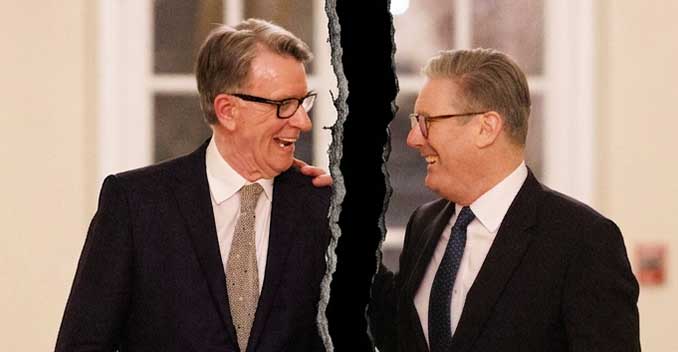
When High-Stakes Diplomacy Meets Low-Level Scandal—A Government at the Brink
The trajectory of the Labour government, since taking office in July 2024, has shifted from a promise of “stability” to a protracted war of attrition against its own decisions. As of April 2026, the narrative is no longer about the first 100 days; it is about a crisis of integrity that spans the Atlantic but which is rooted in the heart of UK government. The central figure in this storm is Lord Peter Mandelson, a man whose political resurrection as the UK’s “point man” to a second Trump administration was intended to be a masterstroke of realpolitik. Instead, it has become a lightning rod for accusations of institutional rot. The “Problem” is not merely the appointment itself, but the shadow cast by Mandelson’s historical and documented links to the late, convicted sex offender Jeffrey Epstein—a connection that has resurfaced with devastating timing through newly released documents.
Prime Minister Keir Starmer, once hailed for his “prosecutorial” rigour, now finds his leadership questioned by a series of U-turns and approval ratings that have hit historic lows. According to YouGov data from February 2026, Starmer’s net favourability rating plummeted to -47, a figure uncomfortably close to the depths seen by previous Prime Ministers on the eve of their resignations. This collapse in public trust is compounded by the perception of a “two-tier” integrity within the cabinet. While ordinary citizens navigate a cost-of-living crisis worsened by the controversial decision to cut Winter Fuel Payments for 10 million pensioners, the political elite appears insulated. The Mandelson affair, culminating in his resignation and a controversial £75,000 payoff in March 2026, has become the definitive symbol of a government that many feel has lost its moral compass.
Challenges
- The Integrity Gap: The dissonance between Labour’s “Clean Up Westminster” rhetoric and the reality of high-level appointments with compromised backgrounds.
- Transatlantic Influence: The desperation to influence a volatile US administration leading to “blind-eye” diplomacy.
- Leadership Stagnation: Whether Starmer’s rigid “managerial” style is capable of surviving a multi-front political and ethical scandal.
Facts
- Date of Resignation: Peter Mandelson resigned as US Ambassador on 11 March 2026.
- The Payout: Despite seeking over £500,000, Mandelson received a £75,000 severance payment from the government.
- Epstein Payments: Court documents released in early 2026 revealed Mandelson and his husband, Reinaldo Avila da Silva, received upwards of $75,000 from Jeffrey Epstein, with payments dating back to 2003.
- Approval Ratings: Starmer’s net favourability stood at -47 in February 2026 (YouGov).
The Starmer government argues that Mandelson’s appointment was a necessary evil to navigate the “Trump 2.0” landscape of tariffs and trade friction. However, this objective “necessity” has collided with an objective “unacceptability.” To the critic, the decision to appoint a man with documented links to Epstein—links described in released emails as including sickening “best pal” references and suggestions that Epstein’s conviction was “wrongful”—is an unforgivable lapse in vetting. To the supporter, it was a pragmatic attempt at heavyweight diplomacy which was ultimately sabotaged by the pernicious ghosts and skeletons of Lord Mandelson’s a past – that the government believed had been put to bed.
The Resilience of the ‘Stitch-Up’
Burned Bridges and Blocked Challengers
The internal pressure on the Labour leadership has reached a fever pitch following the “Gorton and Denton” by-election saga. In January 2026, the party’s National Executive Committee (NEC) voted 8–1 to block Andy Burnham, the Mayor of Greater Manchester, from standing as a parliamentary candidate. The decision, backed by Starmer, was widely characterised as a “stitch-up” to prevent a popular rival from returning to Westminster to mount a leadership challenge. This move has alienated significant portions of the party, with 53% of Labour members disagreeing with the move and 50 Labour MPs signing a letter of objection.
This perceived lack of character in leadership is further eroded by the government’s habit of tactical U-turns. Since late 2024, the government has reversed course on at least 16 major policies, including mandatory digital IDs and hikes to business rates. The irony is sharp: as ordinary people are told that “tough choices” mean losing their winter fuel support, the architect of the party’s US strategy walks away with a five-figure sum after being sacked over Epstein-related misconduct. The question for the local elections on 7 May 2026 is whether voters will see “Local Labour” as separate from the “National Crisis,” or if the toxicity of the Mandelson-Starmer-Epstein triad has already poisoned the well.
Concerns
- Factionalism vs. Unity: The deliberate exclusion of Andy Burnham as a symptom of leadership insecurity.
- Policy Volatility: The frequency of U-turns as a marker of a government without a clear ideological North Star.
- Local vs. National: The potential “contagion” of national scandals affecting local government elections.
Facts
- NEC Vote: On 25 January 2026, the NEC blocked Andy Burnham’s candidacy (8 votes to 1).
- Policy U-Turns: Labour has recorded 16 major U-turns since taking office, including the reversal on mandatory digital IDs in March 2026.
- Winter Fuel Cut: The policy affected approximately 10 million pensioners in the 2025/26 winter period.
- Arrest and Bail: On 23 February 2026, Peter Mandelson was arrested on suspicion of misconduct in public office and released on bail.
The Cost of Compromise
A Government Running Out of Road
The synthesis of the Mandelson, Epstein, and Starmer narrative reveals a government that is only just functioning but losing the cultural tone of decency. The integrity of the Labour project—represented by senior figures like Angela Rayner and David Lammy’s (outburst at the desptach box)—is increasingly viewed through the lens of these bad appointments. To prevent a repeat of the Mandelson catastrophe, the government has promised a “comprehensive review” of vetting for political envoys, but for many, the damage is already done. The cringe-inducing reality of a Cabinet minister allegedly passing government information to a convicted pedophile during the 2008 financial crisis—as suggested in the February 2026 Epstein files—has created a “zero tolerance” threshold among the electorate.
Keir Starmer’s ability to hold on depends entirely on whether he can pivot from “crisis management” to “inspirational governance” before the summer. With Andy Burnham in the wings and the public’s patience worn thin by the cost-of-living “job number one” promise of a better Britain is falling into tatters, the local elections on 7 May will be almost certainly the final verdict and the most critical inflection point. If Labour cannot turn their fortunes around, the Mandelson payout will not just be a footnote in a resignation; it will be the epitaph of the Starmer era.
In Brief
- The Final Verdict: The May local elections as a referendum on Starmer’s survival.
- Institutional Memory: Whether “vetting reviews” can truly erase the stain of the Epstein links.
- Economic Failure: The disconnect between high-level diplomatic spending and the “£1,000 worse off” reality for UK families in 2026.
Facts
- Cost of Living: Reports from April 2026 indicate hardworking families are approximately £1,000 worse off this year under current fiscal policies.
- Vetting Review: Starmer announced a “new licence” for vetting appointments on 4 February 2026 following a Humble Address in the Commons.
- Public Opinion: A April 2026 poll showed Labour voters split 46% to 46% in their opinion of the Prime Minister, a marked decline from the 2024 election high.
- Resignation Payout: Peter Mandelson was given £75,000 upon being sacked as US Ambassador in March 2026.
- Epstein Emails: The US House Oversight Committee released 147 pages of files in March 2026 detailing Mandelson’s (often gut wrenching and sickening) correspondence with Epstein.
- Arrest Details: Mandelson was arrested by the Metropolitan Police on 3 February 2026 as part of a formal criminal investigation.
- U-Turn Count: Bromsgrove Conservatives and other monitors listed 16 U-turns by the Labour government by March 2026.
Links
- YouGov: Political favourability ratings, February 2026
- Wikipedia: Relationship of Peter Mandelson and Jeffrey Epstein
- The Critic: Warm home, wrong decision – Analysis of Winter Fuel Cuts
- Bromsgrove Conservatives: Handy list of Labour’s 16 U-turns
Mandelson Requests more than £500,000.00 pay off more than 1/2 a million during a time when ordinary households and Britons are squeezed financially
Peter Mandelson asked for a more than half a million pounds as a payoff when sacked as US Ambassador
This video provides newsworthy coverage of the financial details and public scrutiny surrounding Peter Mandelson’s dismissal and the government’s subsequent release of files regarding his appointment.



Be the first to comment