

From Viral “Blind Date” Chaos to Algorithmic Vortexes—Is It Time for a Licence to Scroll?
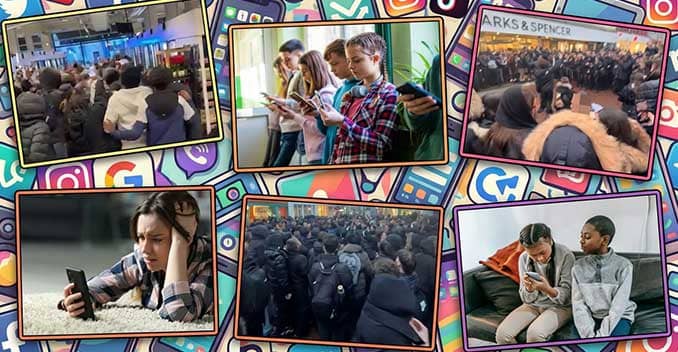
The year is 2026, and the “playground” has expanded to a global scale. It is no longer a physical space defined by asphalt and swing sets, but a digital expanse where the stakes are infinitely higher. In January 2026, the quiet streets of Sutton, South London, were transformed into a scene of suburban anarchy. Around 200 schoolchildren mobilised via a viral TikTok “blind date” challenge, descending on the town centre and clashing with the Metropolitan Police. It was a visceral reminder that the internet is no longer just a mirror of reality; for the modern teenager, it is reality—at a scale and speed that physical infrastructure cannot contain.
The tragedy is that this mobilisation often masks a deeper, quieter crisis. According to a landmark Imperial College London study published on 23 March 2026, children in Year 7 who use social media for more than three hours per day are significantly more likely to develop clinically relevant depression and anxiety by Year 10. The link is particularly acute for girls, driven by chronic sleep disruption and the relentless comparison engine of the algorithm. We are essentially handing 11-year-olds a supercomputer—a device more powerful than the technology used to put men on the moon—and expecting them to navigate a psychological minefield that even adults struggle to survive.+1
We are setting a dangerous path by treating the internet as an optional extra rather than a core environmental hazard. If we require a licence to drive a car or a test to handle heavy machinery, why is the most powerful psychological tool in human history “plug and play” for toddlers? The autonomy of the child is important, but it should not be a suicide pact with a Silicon Valley algorithm.
A Licence to Scroll: Defining the ‘Right’ Age
Beyond the ‘Nanny State’—The Case for Digital Competency
What is the “right” age to enter the digital colosseum? Current UK law, bolstered by the Online Safety Act 2023, pushes for stricter age verification, yet Ofcom’s 2025 report reveals that 40% of children under 13 already have an active social media profile. The reality is that “chronological age” is a blunt instrument. One child may be resilient at 12; another may be spiralling at 16. Perhaps the solution isn’t just a birth certificate, but a competency test.
We teach sex education and the dangers of narcotics in Year 6; we should be teaching algorithmic literacy with the same urgency. A “digital driving test”—covering grooming, misinformation, and the “one child is one too many” approach to self-harm content—could bridge the gap between autonomy and safety. Mandating such requirements feels like a “nanny state” move until you consider the alternative: the status quo, where the most aggressive algorithms are rewarded for keeping children engaged by any means necessary.
The “right age” is a moving target, but the “right environment” is not. We need neutral, non-extractive algorithms for anyone under 18. If a child’s data is being used to “predict” their next vulnerability, that isn’t a service—it’s a digital predatory practice.
The Ghost in the Machine: Self-Harm and the Algorithm
When Engagement Metrics Become Lethal
The name Molly Russell haunts the UK’s regulatory landscape. The 14-year-old’s death in 2017 was a watershed moment, with a coroner ruling in 2022 that social media content contributed to her death in a “more than minimal way.” In the six months prior to her suicide, she interacted with over 2,100 pieces of content related to depression and self-harm. In 2026, the Molly Rose Foundation continues to warn that “technology-facilitated suicide” remains a primary threat, with roughly one young person per week lost to suicide where digital content played a role.+1
The algorithm doesn’t care if you are a “TikTok rockstar” or a grieving teenager; it only cares that you stay on the app. This is the heart of the matter: adult algorithms—designed to maximise “time spent”—are being applied to children. For a boy, this might mean a “rabbit hole” of aggressive “alpha” content or body dysmorphia; for a girl, it might be the “pro-ana” (pro-anorexia) communities that the Online Safety Act was designed to purge, but which still linger in the darker corners of the feed.
We must adopt a zero-tolerance, “one child is one too many” stance. The tech giants claim they are “monitoring,” but until the financial penalty for a child’s death exceeds the profit made from their engagement, the needle will not move. It is time for a “Duty of Candour” for tech firms, similar to the financial services sector.
The Future of the ‘Digital Native’
Reclaiming Reality in a Hyper-Connected World
As we look toward the 2030s, the “digital native” is no longer a trendy term—it is a description of a generation that has never known a world without the “infinite scroll.” We are setting a bad example by being “phone-first” parents and then wondering why our children want to be TikTok influencers instead of doctors or engineers. The internet has become “more real than reality,” a place where a “blind dating” gathering in Sutton is more significant than a local youth club.
The path forward requires a balance of hard-hitting regulation and soft-power education. We need to dismantle the addictive nature of these devices—supercomputers that allow a child to talk to every other child in the playground at once, amplifying both the joy and the trauma by a factor of millions. If we don’t act now, we aren’t just losing our children to screens; we are losing their ability to exist in the real world.



Be the first to comment